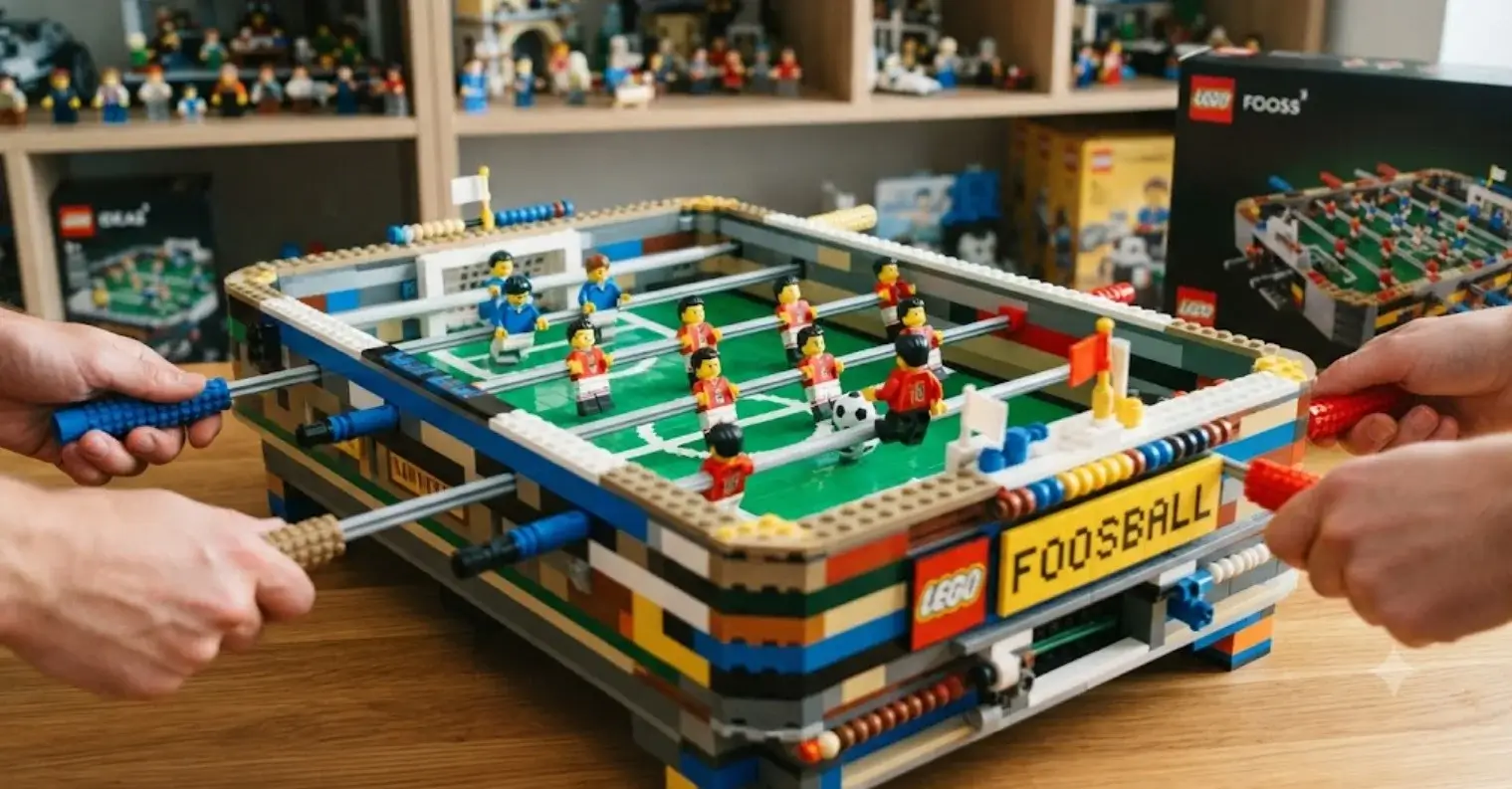
LEGO foosball sits in an unusual place between a construction project and a playable table game.
You can build the official LEGO Ideas set, study its mechanisms, or create an original table from loose bricks. Each option offers a different balance of playability, appearance, and building difficulty.
This guide covers the official set, its minifigures, instructions, playing system, and practical ways to build your own LEGO foosball table.
What Is the Official LEGO Foosball Set?
The official LEGO foosball set is LEGO Ideas Table Football 21337.
LEGO uses the name “Table Football,” while many American buyers search for LEGO foosball, LEGO table foosball, or table soccer.
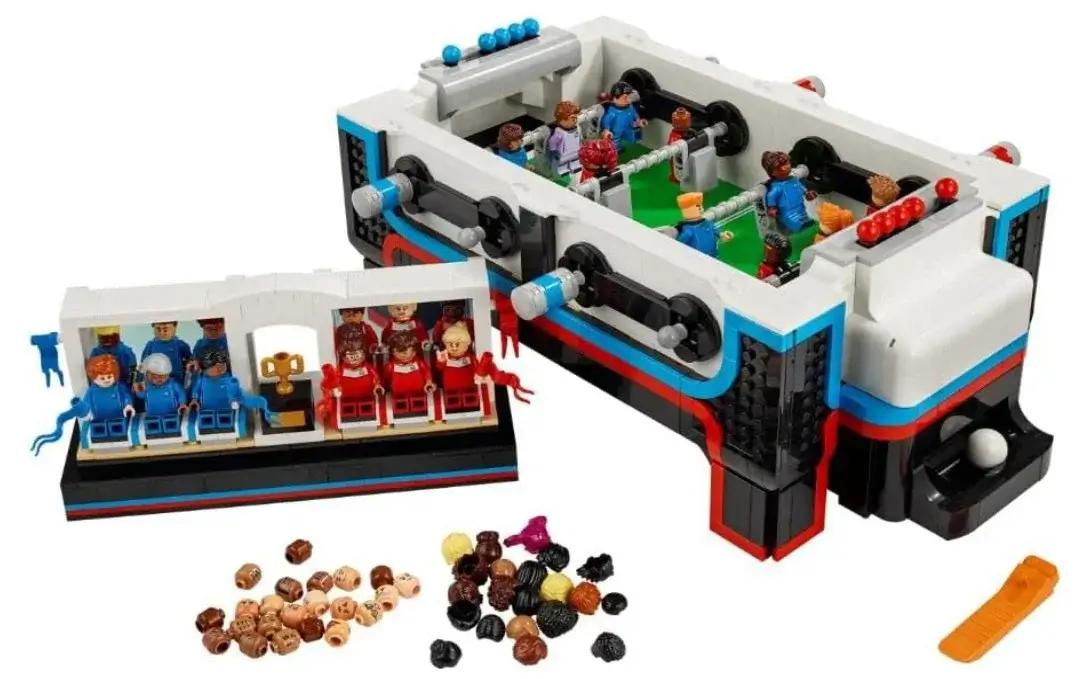
Set 21337 is not a static football display. It is a functional, brick-built table with moving rods, goals, score controls, customizable players, and a separate spectator stand.
LEGO released the set in 2022 as part of the LEGO Ideas theme. It is now listed as a retired product on LEGO’s official website.
LEGO Ideas 21337 Overview
| Feature | Official specification |
| Official name | LEGO Ideas Table Football |
| Set number | 21337 |
| LEGO theme | LEGO Ideas |
| Release year | 2022 |
| Recommended age | 18+ |
| Piece count | 2,339 pieces |
| Minifigures | 22 |
| Active players | Five per team |
| Playing rods | Two per team |
| Height | About 15 cm |
| Width | About 41 cm |
| Depth | About 29 cm |
| Current status | Retired |
The compact dimensions make the model easier to display and move than a conventional tabletop football table. It still needs a stable surface during play.
How a LEGO Ideas Project Became Set 21337
LEGO Ideas Table Football began as a fan-designed project rather than a standard LEGO product concept.
Hungarian LEGO fan designer Donát Fehérvári, known as Constructions by Donat, submitted the original table to the LEGO Ideas We Love Sports contest.
His project received 1,244 votes and won the competition. LEGO later selected it for development as an official set.
The original design included a larger field, more players, and longer control rods. However, those features created structural problems during physical testing.
LEGO model designer Antica Bracanov helped adapt the digital model into a durable retail product. The design team strengthened the internal frame and reduced the table to five active players per side.
The production model uses:
- Two rods per team
- One goalkeeper
- Two defenders
- Two strikers
- Shorter Technic axles
- A smaller, more rigid frame
Long Technic axles could bend or snap during energetic play. Shorter rods reduced flex, player weight, and stress on the surrounding bricks.
A foosball player may promise to “take it easy,” but the rods usually hear something different.
For custom builders, the lesson is simple:
Build the table around the strength of the rod mechanism, not around the largest possible player count.
How the LEGO Foosball Table Actually Works
The LEGO foosball table uses familiar football table movements inside a compact brick-built structure.
Players slide each rod sideways and rotate it to block, pass, or strike the ball.
Players and Rod Arrangement
Each team controls five active minifigures through two rods.
The rear rod carries:
- One goalkeeper
- Two defenders
The front rod carries:
- Two strikers
This arrangement gives each team defensive coverage near the goal and two attacking players farther up the pitch.
The rods rotate and move laterally. LEGO also designed the table for two-player or four-player matches.
Playing Field, Ball, Goals, and Scoring
The model uses a green brick-built pitch with printed football markings.
Raised walls keep the ball inside the playing area. Corner flag assemblies help guide it away from difficult spaces.
The set includes two smooth foosballs. A spare is useful because a tiny ball can disappear faster than a midfielder avoiding defensive work.
Each goal has a collection area behind the goalkeeper. Color-coded sliding knobs above the goals record the score without batteries or electronic parts.
Independent testing found that the corner design helps prevent unreachable dead spots. Custom builds may still develop them if the wall angles or player positions are incorrect.
What Keeps the Table Stable?
The most important structural features are:
- Short Technic axle rods
- A reinforced internal frame
- Multiple rod support points
- Neck brackets securing the players
- Supports limiting backward leg movement
- Gripping elements beneath the feet
The result feels less like a hollow display box and more like a small mechanical game built from bricks.
See the LEGO Foosball Mechanism in Action
The following video provides a useful visual reference for the table, players, and rod movement.
LEGO Foosball Minifigures, Teams, and Accessories
The LEGO foosball minifigures are one of the set’s most distinctive features.
They allow owners to change the teams without rebuilding the table or modifying its playing system.
How the 22 Minifigures Are Used
The set contains 22 uniformed minifigures.
Each team receives 11 figures, but only five from each side play on the table at one time.
That creates:
- Ten active players
- Twelve substitutes or spectators
- Five playing positions per team
- Six non-playing figures per team
The unused figures can sit in the separate buildable grandstand beside the table.
Heads, Hairstyles, and Uniforms
LEGO includes 44 heads and 43 hairstyle elements.
Builders can change facial expressions, hairstyles, skin tones, and player combinations. The figures wear red or blue team uniforms, with separate designs for the goalkeepers.
Because some heads and hairstyles remain unused during any single setup, store them carefully. A standard black brick is usually easy to replace. An exclusive head or uniform may be harder to find.
Creating Custom LEGO Foosball Teams
Custom teams can make the set feel more personal without affecting its mechanism.
Ideas include:
- Matching players to friends or relatives
- Creating fictional football clubs
- Building home and away lineups
- Changing goalkeeper colors
- Adding player numbers
- Designing team flags
- Creating tournament squads
Avoid large accessories on active players.
Oversized hats, backpacks, hairpieces, or handheld items may strike the sidewalls or loosen when a rod spins.
No referee will issue a red card for an escaping hairpiece, but it can stop the match.
Grandstand and Accessories
The official set also includes:
- A spectator stand
- Two foosballs
- A trophy
- Supporter flags
- Team flags
- Score controls
- Customization pieces
The grandstand is separate from the main table. When checking an opened set, confirm that both structures and the small accessories are present.
LEGO Foosball Review: Building and Playing Set 21337
Most buyers considering LEGO Ideas 21337 want to know whether it is a genuine game or mainly a display model.
The honest answer is that it serves both purposes, with a few compromises.
What the Building Experience Is Like
With 2,339 pieces, this is a substantial adult build.
Much of the construction focuses on the internal frame, pitch, rods, player supports, and exterior casing. Keeping the frame square is important because poor alignment can make the rods bind.
Some stages repeat similar structural elements. That repetition is necessary because both sides need matching strength.
The set works best for builders who enjoy:
- Functional LEGO mechanisms
- Reinforced structures
- Minifigure customization
- Football-related displays
- Models that remain usable after assembly
It may feel less satisfying for someone seeking an open, highly detailed display scene.
How Playable Is the Finished Table?
Independent reviewers generally found the finished table functional and enjoyable.
The rods respond well enough for casual shooting, blocking, and passing. The model is suitable for short two-player games, four-player team matches, and friendly tournaments.
However, it does not reproduce the control of a full-sized competition table.
The smaller pitch creates faster rebounds, while the compact ball gives players less time to prepare controlled shots.
Think of it as a LEGO game using foosball mechanics, not a regulation football table made from LEGO.
As a display model, the black frame, green field, minifigures, and grandstand clearly communicate the subject. Its compact size also makes storage easier.
However, many pieces sit inside the reinforced structure, so the completed model may appear smaller than its piece count suggests.
Main Strengths and Limitations
| Strengths | Limitations |
| Functional rod mechanism | Smaller than the original fan design |
| Strong internal construction | Five active players per team |
| Customizable minifigures | Less control than a full-sized table |
| Compact and movable | Many pieces remain hidden internally |
| No batteries required | Small accessories are easy to misplace |
| Official instructions remain available | Complete retired sets may be harder to find |
| Works as a game and display | Not designed for aggressive spinning |
Foosball Junkie verdict: Set 21337 succeeds as a playable LEGO engineering project.
It does not replace a serious foosball table, but it was never designed to do so.
Is LEGO Ideas Table Football 21337 Retired?
Yes. LEGO currently identifies Table Football 21337 as a retired product.
That means it is no longer part of LEGO’s standard active product range. Availability may now depend on remaining retailer stock, Amazon marketplace sellers, BrickLink stores, local collectors, or used LEGO sellers.
A LEGO foosball table price can vary after retirement, so condition and completeness matter more than an outdated fixed figure.
What to Check in an Opened or Used Set
Before buying, confirm:
- The listing identifies set number 21337.
- The playing rods slide and rotate correctly.
- All 22 minifigures are included.
- Both foosballs are present.
- The table, grandstand, score controls, trophy, and flags are included.
Also check whether the extra heads and hairstyle pieces remain with the set.
Ask for clear photographs of the players and mechanism. A picture of the closed box reveals very little about an opened product.
Official LEGO Versus Compatible Sets
Some marketplace products use phrases such as “compatible with LEGO,” “brick table soccer game,” or “building block foosball table.”
These may be third-party building sets rather than official LEGO products.
Check the manufacturer, packaging, and set number. Only set 21337 should be described as the official LEGO Ideas Table Football product discussed here.
LEGO Foosball Table Instructions and Replacement Parts
Retirement does not make the official LEGO foosball instructions disappear.
LEGO still provides the building manual for set 21337 through its online instruction service.
Where to Download the Official Instructions
Search LEGO’s official building instructions page for set number 21337.
The listing provides a downloadable PDF for the complete model. Digital instructions are useful when:
- A used set has no booklet
- The printed manual is damaged
- You are rebuilding a disassembled table
- You want to inspect the construction before buying
- You need to identify a missing section
Finding Missing or Replacement Pieces
Begin with the inventory near the end of the official instruction manual.
You can then compare your pieces with the detailed set inventory on BrickLink.
Replacement options may include:
- LEGO Pick a Brick
- LEGO replacement-parts support
- BrickLink sellers
- Existing personal collections
- Local LEGO parts stores
Prioritize pieces affecting the mechanism:
- Technic axles
- Bushings
- Rod supports
- Player brackets
- Handles
- Smooth foosballs
- Goal components
- Score-slider parts
- Printed pitch tiles
A cosmetic substitution may only change the appearance. A bent axle or missing rod support can prevent the table from working properly.
How to Build a Simple LEGO Foosball Table
You do not need to recreate all 2,339 pieces to build an enjoyable LEGO foosball project.
A custom table can be decorative, partly functional, or fully playable. For most builders, a compact two-rod model offers the best balance of stability and playability.
1. Choose a Compact Layout
A simple playable model can use:
- One defensive rod per team
- One attacking rod per team
- Three to five players per side
- A short tiled field
- A smooth, lightweight ball
Short rods are easier to align and less likely to bend.
Larger models require stronger reinforcement, more precise axle alignment, and additional player spacing. Rod length becomes a problem faster than field size.
2. Build a Rigid, Smooth Playing Field
Start with the field before designing the outer shell.
Decide:
- Field length and width
- Wall height
- Goal size
- Rod positions
- Player spacing
- Ball diameter
- Retrieval points
Use smooth tiles across the pitch. Exposed studs can slow the ball, create unpredictable bounces, and trap it beside the walls.
Add raised sidewalls and reinforce the corners. Leave room beneath the pitch for overlapping plates and structural supports.
A pretty frame that separates after three goals is still a losing design.
3. Install Supported Rods and Players
Technic axles are the most practical rod choice.
Useful parts include:
- Technic cross axles
- Bushings
- Axle connectors
- Technic bricks
- Handles
- Neck brackets
- Player supports
Each rod should pass through at least two aligned support points.
Before attaching all the players, confirm that each rod:
- Rotates without scraping
- Slides without binding
- Remains level
- Resists visible bending
- Stays connected to the handle
Keep the minifigures simple and balanced. Their feet should approach the ball without dragging across the field.
Also check clearance from the sidewalls, pitch, nearby players, and goal structures.
4. Add Goals, Scoring, and Ball Access
A simple goal can use an opening in the rear wall with a collection area behind it.
Useful additions include:
- Recessed goals
- Rear ball trays
- Side retrieval openings
- Removable access panels
- Sliding score markers
- Ball storage
Keep the retrieval opening large enough for your fingers. Builders sometimes create a beautiful goal and then discover they cannot remove the ball.
Test the complete prototype before adding decorative exterior panels.
Common Mistakes to Avoid
- Making the rods too long
- Building a weak or lightweight frame
- Allowing players to touch the pitch
- Using an uneven or unsuitable ball
- Leaving unreachable dead zones
- Adding heavy accessories to active players
- Finishing the exterior before testing the mechanism
Roll the ball across every part of the field and check whether an active player can reach it.
Make one adjustment at a time. Otherwise, you may solve one problem while creating another.
Creative LEGO Foosball Projects and Modifications
A custom build does not need to copy LEGO Ideas 21337.
Some of the most interesting LEGO foosball ideas focus on one feature and develop it further.
Mini Minifigure-Scale Foosball Table
A small decorative table can fit inside a LEGO arcade, office, bar, clubhouse, or game room.
Possible details include:
- Fixed players
- Decorative rods
- Tiny goals
- Coin slot
- Score counters
- Team colors
- Overhead lighting
- Tournament posters
The mechanism does not need to work if the table is intended only for display.
Compact Playable Two-Rod Table
A simplified two-rod table offers a practical balance between:
- Size
- Rod strength
- Player coverage
- Parts usage
- Playability
Three players per team may be enough for a very small table. Five per side provide better coverage but require more careful spacing.
Modified LEGO Ideas Set 21337
Owners can customize the official set without rebuilding it from the beginning.
Possible modifications include:
- Larger handles
- Different team colors
- Custom player lineups
- New supporter flags
- Expanded grandstand seating
- Easier ball access
- Alternative score markers
- Team badges
- A tournament trophy platform
Test functional changes carefully. A larger handle may improve grip but place more leverage on the axle.
LEGO Foosball Stadium
Instead of changing the playing mechanism, expand the setting around it.
A stadium project might include:
- Larger spectator stands
- Team benches
- Scoreboard
- Commentary desk
- Player tunnel
- Trophy stage
- Advertising boards
- Custom banners
- Media area
This approach preserves the tested table while increasing its display value.
Digital LEGO Foosball Design
BrickLink Studio can help builders plan dimensions, colors, parts, and instructions before ordering pieces.
It can also create a parts list and BrickLink wanted list.
However, digital collision tools cannot fully predict axle flex, friction, weight distribution, or physical stability. Build a small rod prototype before ordering every decorative component.
Official Set or Custom LEGO Foosball Build?
The official set and a custom project solve different problems.
| Choose set 21337 when | Choose a custom build when |
| You want tested instructions | You already own suitable bricks |
| You prefer an official LEGO model | You want a smaller project |
| Minifigures are a major attraction | You prefer different team colors |
| You want a proven rod layout | You enjoy designing mechanisms |
| You value predictable construction | You need specific dimensions |
| You prefer building over engineering | You only need a decorative table |
Set 21337 removes much of the trial and error.
A custom build provides more freedom, but expect to rebuild the rod supports or player spacing more than once.
You can also use the official model as inspiration without copying it completely.
Its most useful design ideas include:
- Short rods
- Five-a-side formation
- Reinforced framing
- Secure player brackets
- Sliding score controls
- Separate spectator seating
LEGO Foosball Resources
The following resources can help with rebuilding, parts identification, and further research:
- Official LEGO product page: Specifications, dimensions, minifigures, and playing layout
- Official LEGO building instructions: Downloadable manual for set 21337
- BrickLink inventory: Detailed parts and minifigure component list
The LEGO Ideas project history and independent LEGO review sites also provide useful background about the original design and its five-a-side development.
Final Thoughts
LEGO Ideas Table Football 21337 shows that a brick-built model can support real foosball movement without becoming a full-sized table.
The official set suits buyers who want a tested mechanism and extensive minifigure customization. A custom build suits those who prefer experimentation and control.
Whichever approach you choose, focus on short rods, a rigid frame, correct player clearance, and smooth ball movement.
Get those fundamentals right, and your LEGO foosball project has a much better chance of surviving both construction and kickoff.