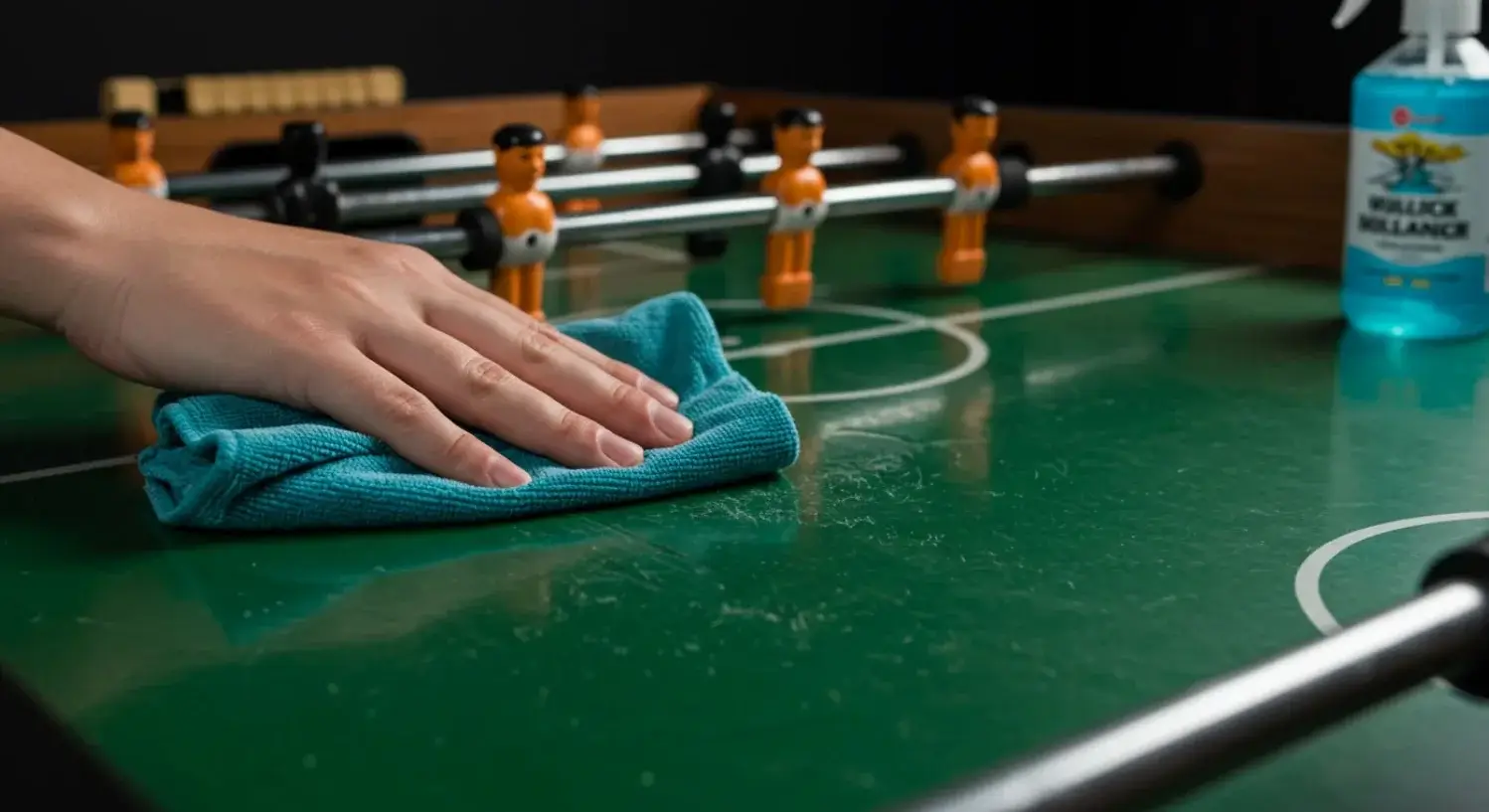
A dirty foosball table does not just look neglected. It changes how the game feels.
Dust slows the ball. Sticky rods kill reaction time. Dirty foosballs drag grime back across the playfield. And if rust starts creeping onto the rods, every pull shot feels like it came with a parking brake.
This guide explains how to clean a foosball table safely, including the playing surface, rods, balls, bearings, players, handles, goals, corners, and ball return. It focuses only on cleaning. Rod lubrication is a separate maintenance step.
Manufacturer care guidance for game tables and laminate-style surfaces generally favors damp cloths, mild cleaners, complete drying, and avoiding flooding, abrasives, ammonia, acetone, and strong solvents. That same careful approach is the safest starting point for most home foosball tables and football table surfaces.
Video Guide for Cleaning Your Foosball Table
For a quick visual walkthrough, check out this video to see how to safely clean the playfield, rods, balls, and players. Watching the steps can make the process easier and prevent accidental damage.
Quick Check Before You Clean Your Foosball Table
Before you grab a cloth and attack the table like it just scored on you, take one minute to inspect it.
This keeps you from overcleaning the wrong parts and missing the areas that actually affect play. Good foosball table maintenance starts with knowing where the dirt lives.
Check the playing surface
Look across the playfield from a low angle. You are checking for dust, grime, fingerprints, drink stains, ball marks, and dirty corners.
A clean foosball playing surface should feel smooth and consistent. If the ball slows down near one wall or dies in a corner, the problem may be residue, trapped debris, a worn ball, or a table level.
Common signs include:
- Dust sitting across the game field
- Sticky spots near goals
- Ball marks across the table top
- Dirt packed along the side walls
- Uneven ball movement
A quick look tells you whether the playfield needs a dry wipe, a damp clean, or more attention in the corners.
Check the rods
The rods should slide and rotate without feeling gritty.
Pull each rod out and look at the exposed steel or chrome finish. Then push it in and check the other side. Sticky rods usually come from grime, drink residue, hand oils, dirty bearings, or surface rust.
Watch for:
- Slow rod movement
- Visible grime
- Scratches or discoloration
- Surface rust
- Bent rods
- Rough sliding near the bearings
A clean rod should not feel like it is arguing with you.
Check the bearings
Bearings sit where the rods pass through the cabinet walls. They are small, but they matter a lot.
Dirt collects around bearing openings because rods carry residue back and forth during play. Some tables have removable bearings, while others do not. Never force parts apart unless your table is designed for it.
Look for:
- Black buildup near bearing walls
- Tight or noisy rod movement
- Squeaking or grinding
- Cracks
- Visible wear
If the rods are clean but still drag, the bearings may be dirty, worn, overtightened, or damaged.
Check the balls and players
Foosball buyers often focus on rods and cabinets, but balls and player feet touch the action every second.
Dirty foosball balls can transfer grime back onto the playfield. Worn balls can lose traction. Dirty player feet can reduce control, especially on tables where passing and pinning matter.
Check for:
- Dirty balls
- Smooth or worn ball texture
- Cracked or misshapen balls
- Dirty foosball men
- Grime under the player’s feet
- Loose or misaligned figures
A buyer looking at a used table should pay close attention here. Clean parts are nice. Worn parts tell a deeper story.
Safe Cleaning Tools and Supplies You Need
You do not need a garage full of chemicals to clean foosball table parts well.
In fact, too many strong products create more risk than benefit. Several surface care guides recommend mild soap, nonabrasive cloths, careful rinsing, and full drying for laminate-style finishes, while warning against flooding and abrasive cleaners.
Here is a simple cleaning kit that works for most home tables.
| Tool | Best used for | Avoid using on |
| Microfiber cloth | Playfield, rods, cabinet | Heavy rust removal |
| Soft cloth | Handles, players, cabinet | Deep grooves |
| Soft brush | Corners, textured balls, and player feet | Glossy surfaces with hard pressure |
| Cotton swabs | Bearings, tight spaces, player feet | Large surface areas |
| Mild soap and warm water | Grime and fingerprints | Cork balls, soaked seams |
| Spray bottle | Light dampening | Directly spraying bearings |
| Paper towels | Quick drying | Scrubbing playfield |
| 70% isopropyl alcohol | Rod cleaning is safe | Painted, rubber, wood, acrylic, or coated parts |
The CDC notes that 70% isopropyl alcohol is used for some external equipment surfaces, but alcohol can damage certain finishes and materials. Use it only on suitable metal rod surfaces, test first, and keep it away from painted graphics, rubber handles, plastic parts, and the playfield.
Cleaning products to avoid
Skip anything that behaves like it wants to win a fight.
Do not use:
- Bleach
- Ammonia cleaners
- Harsh chemical cleaners
- Abrasive pads
- Coarse steel wool
- Sandpaper on finished rods
- Too much water
- Furniture polish on the playfield
- Strong solvents, unless approved by the manufacturer
Garlando’s table care guidance, for example, warns against ammonia-based cleaners, scoring compounds, solvents such as acetone and gasoline, waxy or abrasive detergents, and flooding the table.
How to Clean the Foosball Playing Surface?
The playing surface is where most buyers notice problems first.
A dull, sticky, or stained playfield makes a football table feel older than it is. The goal is simple: remove dust and residue without damaging the laminate finish, field markings, or surface edges.
Remove loose dust and debris first
Start dry. Always.
Remove the balls from the table. Use a dry microfiber cloth and wipe from one end of the playfield to the other. Work around goals, field edges, and corners.
For trapped debris, use a soft brush. Do not grind dirt into the surface.
This matters because dust can act like fine grit. If you add water too soon, you can smear grime into a film instead of lifting it away.
Wipe grime and fingerprints with a damp cloth
Mix warm water with a tiny amount of mild soap.
Lightly dampen a soft cloth. It should feel damp, not dripping. Wipe the dirty areas gently and follow the grain or direction of the surface when possible.
Do not soak the playing area. Do not scrub field markings. Do not spray cleaner directly into seams, corners, or goal openings.
Formica care guidance recommends using a clean, damp, nonabrasive cloth with mild detergent, rinsing with clean water, avoiding flooding near seams, and drying with a soft cloth. That is a useful model for laminate-style foosball surfaces.
Dry the playfield immediately
Drying is not optional.
Use a clean microfiber cloth and dry the playfield right away. Pay special attention to corners, goals, and side walls.
Moisture near edges can be a problem on tables with laminate, printed graphics, wood-based cabinet materials, or layered playfields. A football table is built for games, not bubble baths.
Test the playing surface after cleaning
Roll a clean ball across different parts of the playfield.
Try slow rolls from side to side, goal to goal, and diagonally. If the ball slows down in one area, clean that spot again. If it still drags, check the ball condition and table level.
The test is simple: a cleaner surface should give you more consistent ball movement and better control.
How to Clean Foosball Rods?
Rods take the most abuse.
Hands, sweat, dust, spilled drinks, old residue, and bearing grime all collect there. Learning how to clean foosball rods properly helps rod movement, rod responsiveness, and overall table feel.
This section covers cleaning only. If your rods are clean but still slow, lubrication may be the next step.
Wipe each rod from both sides
Pull one rod outward.
Wipe the exposed section with a dry microfiber cloth. Push the rod inward and wipe the other side. Repeat this for every rod.
Move slowly near the cabinet wall so you do not push loose grime into the bearing opening.
This basic step often fixes rods that feel dirty but not damaged.
Remove sticky residue from rods
For sticky buildup, use a slightly damp cloth.
If the residue does not lift, use a small amount of safe cleaner or 70% isopropyl alcohol only if it is suitable for your rod finish. Test on a hidden area first.
Wipe gently. Do not let liquid run into the bearings. Dry the rods completely.
Foosball.com’s table maintenance notes mention cleaning rods with alcohol and cleaning bearings, while manufacturer guidance varies by table design. When in doubt, follow your table’s manual first.
Clean near the bearing openings
Use a cotton swab around the bearing opening.
Remove dark buildup near the bearing wall. Wipe the rod where it enters the bearing, then dry the area.
Do not shove wet cotton deep into internal components. You are cleaning the opening and nearby surface deposits, not flooding the bearing.
Inspect the rod condition after cleaning
Once the rods are clean, check them again.
Look for:
- Rust spots
- Bent rods
- Scratches
- Chrome damage
- Rough sliding
- Uneven rod movement
- Discoloration
Clean rods should move better. If they still feel slow, stiff, or gritty, read a separate foosball rod lubrication guide or inspect for bearing wear, rust, or rod alignment problems.
How to Clean Rusty Foosball Rods?
Rust changes the conversation.
Light surface rust may be cleanable. Deep corrosion, pitting, and flaking chrome usually mean the rod has moved from “needs cleaning” to “needs replacing.”
For buyers considering a used foosball table, rusty rods are one of the biggest inspection points.
Identify the rust level first
Not all rust is equal.
- Light rust looks like small orange spots on the surface.
- Moderate rust feels rough and may cover larger patches.
- Heavy rust includes pitting, flaking, deep corrosion, or metal deterioration.
If you can feel pits with your fingernail, cleaning may improve appearance, but it probably will not restore smooth rod performance.
Clean slight rust on foosball rods
Start by wiping dust and grime from the rod.
Dry it fully. Treat only the rusty spot with a gentle rust removal method that is safe for the rod finish. Test on a hidden area first.
Then wipe away residue, dry again, and inspect the chrome finish.
Avoid coarse steel wool, sandpaper, and aggressive scrubbing on finished rods. Chrome finishes are thin, and once they are damaged, rust tends to return faster.
When rusty rods should be replaced
Replace rods if:
- Rust is deep
- Chrome is flaking
- Rods have pits
- Rods feel rough after cleaning
- Rods are bent
- Rust returns quickly
- Rod movement stays uneven
A rod that scratches bearings or fights every shot is not a cleaning project anymore. It is a replacement part wearing a disguise.
How to prevent rust after cleaning
Rust prevention is mostly about moisture control.
Keep the table in a dry room. Wipe rods after heavy use. Avoid damp garages, patios, or basements unless the table is built for those conditions.
Use a table cover, keep drinks away, and dry rods fully after cleaning. Garlando also advises that indoor tables should not be left outdoors, noting that rain, snow, humidity, and prolonged sun can damage materials and colors.
How to Clean Foosball Bearings?
Bearings control how the rods pass through the cabinet wall.
When they collect dirt, the rods may feel sticky even after you clean the exposed metal. That is why bearing cleaning belongs in any serious foosball maintenance routine.
Signs your bearings need cleaning
Your bearings may need attention if:
- Rods feel stiff after cleaning
- Rods squeak or grind
- Dirt collects near bearing walls
- Rods do not rotate smoothly
- Sticky buildup appears near openings
Users often blame the rods first. Sometimes the rod is fine. The bearing area is the mess.
Clean bearing openings without removing parts
Pull the rod outward.
Wipe the rod near the bearing. Use a dry or barely damp cotton swab around the bearing opening. Lift away dirt, old residue, and dark buildup.
Dry the area before moving the rod repeatedly.
Keep water and cleaner out of internal parts. Cleaning should remove grime, not create a moisture trap.
Clean removable bearings if your table allows it
Some tables have removable bearings. Others do not.
Check your table design first. Remove bearings only if they are meant to come out. Wipe the bearing walls, remove debris, inspect for cracks, then reinstall carefully.
Do not overtighten parts. Too much pressure can create tight rod movement or wear.
When cleaning bearings is not enough
Cleaning cannot fix everything.
Bearings may be worn. Bearing walls may be cracked. Rods may be bent. Internal components may need replacement.
If a clean rod still grinds in one spot, the issue may be alignment or part wear rather than dirt.
How to Clean Foosball Balls?
Foosball balls are tiny dirt delivery systems.
If you clean the playfield but ignore the balls, grime comes back quickly. Clean balls improve ball traction, reduce residue transfer, and make play feel more predictable.
Separate balls by material
Before washing anything, identify the material.
Most tables use plastic, composite, textured, or cork foosballs. Each surface handles moisture differently.
Plastic and composite balls are usually easier to clean. Textured balls need gentle brushing. Cork balls require extra caution because cork absorbs moisture.
Clean plastic or composite foosball balls
Use a damp soft cloth first.
For grime, add a small amount of mild soap to warm water. Wipe each ball, brush textured areas gently, then wipe again with a clean, damp cloth.
Dry fully before play.
A wet ball on a clean playfield is how you turn maintenance into regret.
Clean textured foosball balls
Textured balls need a little patience.
Use a soft brush to lift grime from the texture. Do not scrape the ball or flatten the surface. Wipe with a damp cloth if needed, then dry completely.
Textured finish matters because it affects grip, control, and passing feel.
Be careful with cork foosballs
Cork balls are different.
Do not soak them. Do not leave them sitting in water. Cork can absorb moisture, lose shape, and feel worse during play.
For dirty cork balls, use a barely damp cloth and dry quickly. If they are badly stained, misshapen, or too smooth, replacement is often better than heroic cleaning.
When to replace foosball balls
Replace balls if:
- They are cracked
- They are too smooth
- They lost grip
- They are misshaped
- They roll unevenly
- Dirt does not come off
A good ball is cheaper than blaming your five-bar for every bad pass.
How Do You Clean a Foosball Player?
Foosball men are not just decoration.
The player’s feet touch the ball constantly, so grime on the figures can affect ball grip and control. This matters even more for buyers who care about passing, pinning, and precise shots.
Wipe the player figures
Use a damp soft cloth.
Wipe the front and back of each figure. Clean fingerprints, dust, and sticky marks. Avoid soaking screws, pins, or holes.
Dry the figures after wiping.
Plastic players are durable, but they still do not need a chemical spa day.
Clean the player’s feet
Use a cotton swab or soft brush around the player’s feet.
Clean grooves, edges, and the bottom contact area. Remove sticky buildup and dry before play.
This small step can make the table feel sharper, especially if dirty player feet were smearing residue onto the ball.
Inspect player alignment and condition
While you are there, check for:
- Loose figures
- Cracks
- Worn player feet
- Misalignment
- Loose screws or pins
- Players spinning on the rod
A clean but loose player still plays badly. Maintenance is part cleaning, part detective work.
Clean the Handles, Goals, Ball Return, and Corners
These areas are easy to forget because they are not glamorous.
But they collect sweat, crumbs, dust, and residue. Worse, hidden dirt can move back onto balls and rods after you have already cleaned the obvious parts.
Clean the handles
Handles collect sweat, fingerprints, food residue, and sticky buildup.
Use a damp soft cloth with mild soap if needed. Wipe each handle, then dry it well.
Avoid alcohol on rubber, painted, or delicate handle materials unless the manufacturer says it is safe. Alcohol can damage some rubber, coated, painted, and plastic surfaces.
Clean the goal boxes
Goal boxes collect more dust than most people expect.
Wipe inside the goals with a soft cloth. Use a brush for corners. Remove debris that could stick to the ball after a goal.
Yes, even the ball deserves a clean walk of shame after getting scored on.
Clean the ball return
The ball return is one of the sneakiest dirty spots on a football table.
Dust, crumbs, old dirt, and stuck particles can sit inside the return path. Then every clean ball rolls through and comes back dirty.
Use a cloth, soft brush, or cotton swab, depending on the design. Dry the area before putting balls back.
Clean table corners and edges
Use a soft brush or cotton swab for corners, side walls, field edges, and hard-to-reach spots.
Do not jab at the surface. Loosen debris gently and wipe it away.
This is where a table often goes from “mostly clean” to actually clean.
Post Cleaning Performance Check
Cleaning is not finished until the table plays better.
A quick performance check helps you spot what you missed and separates dirt problems from worn part problems.
| Test | What to do | What does it tell you |
| Ball roll test | Roll a clean ball in several directions | Checks surface consistency |
| Rod movement test | Slide and rotate every rod | Checks rod responsiveness |
| Bearing check | Listen and feel near the bearing walls | Finds stiffness or wear |
| Surface residue test | Wipe a clean cloth across the playfield | Confirms field cleanliness |
Ball roll test
Roll the ball slowly across the playing surface.
Test multiple directions. Watch for dragging, dead spots, or sudden speed changes.
If one spot feels slow, clean that area again. If the ball still rolls oddly, check the ball condition, table level, or playfield warping.
Rod movement test
Move each rod in and out.
Then rotate each rod. Check for sticking, grinding, or rough travel.
If your rods are clean but still feel slow or stiff, read our separate guide on foosball rod lubrication.
Bearing check
Listen closely.
Noise, tight movement, cracks, or worn bearing walls may point to bearing wear. Cleaning helps get rid of dirt. It does not rebuild damaged parts.
Surface residue test
Wipe a clean cloth across the playfield.
If the cloth picks up dirt, clean it again. Check corners, goals, and the ball return, too.
A clean table should not keep handing you evidence.
Foosball Table Cleaning Schedule
A simple schedule keeps dirt from becoming a restoration project.
This routine works for most home foosball buyers, game rooms, offices, and family tables. Adjust it if your table gets heavy play or sits in a dusty room.
| Frequency | Task | Time needed | Why it matters |
| After heavy use | Wipe handles, clean spills, and remove visible dust | 3 to 5 minutes | Stops grime buildup |
| Weekly | Dust the playfield, wipe the rods, and clean dirty balls | 10 minutes | Keeps playing consistently |
| Monthly | Clean players, player feet, bearings, corners | 20 minutes | Catches hidden dirt |
| Every 3 months | Deep clean surface, inspect rods, check level | 30 minutes | Supports long-term performance |
| Yearly | Full inspection and part check | 45 minutes or more | Finds wear before failure |
After heavy use
Wipe handles, remove visible dust, and clean spills immediately.
If rods feel dirty, wipe them before storage. This is especially useful after parties, office matches, or game room nights where snacks somehow become part of the defense strategy.
Weekly
Dust the playing surface. Wipe rods. Clean dirty balls.
Check the goals and ball return so clean balls do not pick up old debris.
For casual players, weekly light cleaning is usually enough.
Monthly
Clean player figures and player feet.
Inspect bearings, check for rust spots, clean handles, and brush out corners. This is the sweet spot for preventive care.
Every 3 months
Deep clean the playfield.
Inspect rods, check table level, tighten loose screws, and replace worn balls if needed.
For buyers, this is also a good interval to review whether the table still plays the way it did when new.
Yearly
Do a full deep clean and inspection.
Check rods, bearings, handles, bumpers, players, balls, cabinet condition, and storage conditions. Replace damaged parts before they cause bigger issues.
Manufacturer guidance for some football table models also recommends periodic inspection and replacing damaged or worn parts, especially where wear could affect safety or reliability.
Common Foosball Table Cleaning Mistakes to Avoid
Most cleaning damage comes from good intentions with the wrong tool.
Here are the mistakes that make a table look clean today and worse next month.
Mistake 1: Using too much water
Too much water can seep into seams, edges, and layered surfaces.
Use a damp cloth, not a wet one. Dry the playfield immediately.
Mistake 2: Using harsh chemical cleaners
Bleach, ammonia, acetone, and strong solvents can damage finishes, colors, cabinet surfaces, and markings.
Use mild soap and warm water first. Escalate only if your manufacturer allows it.
Mistake 3: Scrubbing the playfield too hard
Field markings are not floor tile.
Hard scrubbing can dull the smooth surface or damage printed lines. Gentle pressure works better.
Mistake 4: Cleaning the table but not the balls
Dirty balls bring dirt back.
Clean them before testing the table. Otherwise, you are basically mopping the floor with muddy shoes on.
Mistake 5: Ignoring the ball return
The ball return hides crumbs, dust, and old grime.
Clean it so your freshly wiped balls do not come back dirty.
Mistake 6: Leaving rods wet after cleaning
Wet rods invite surface rust and oxidation.
Dry every rod fully, especially near bearings.
Mistake 7: Using abrasive tools on rods
Coarse steel wool, sandpaper, and abrasive pads can damage the chrome finish.
Once the protective finish is scratched or flaking, rust prevention gets harder.
Mistake 8: Washing cork balls
Cork absorbs moisture.
Do not soak cork foosballs. Clean lightly or replace them when they are badly dirty or worn.
Mistake 9: Ignoring dirty bearings
Bearings affect rod responsiveness.
If rods feel sticky after cleaning, check the bearing openings before blaming the rods.
Mistake 10: Storing the table in a damp room
Poor storage causes rust, swelling, discoloration, and long-term wear.
A dry room and table cover do more than people think.
Troubleshooting After Cleaning
Sometimes cleaning improves the table, but does not solve everything.
That does not mean you failed. It means dirt was only part of the problem.
| Problem | Likely cause | Cleaning fix | When to replace parts |
| Rods still sticky | Bearing grime, residue, rust, bent rod | Reclean the rod and bearing opening | Replace if bent, pitted, or worn |
| The ball rolls slowly | Dirty ball, residue, uneven table | Clean the ball and surface again | Replace worn or misshapen balls |
| The table still looks dirty | Hidden grime in corners or the ball return | Brush tight areas | Replace stained or damaged parts if needed |
| Rust returns | Humidity, wet rods, damaged chrome | Dry rods improve storage | Replace deeply corroded rods |
Rods are still sticky after cleaning
Possible causes include dirt near bearings, old residue, a bent rod, rust damage, or worn bearings.
Reclean the rod near the bearing. Wipe the bearing wall. Dry the rod fully. Inspect for scratches, corrosion, or bending.
If everything is clean but the rod still feels slow, the next step is likely lubrication or part inspection.
The ball still rolls slowly
Possible causes include a dirty playfield, dirty ball, worn ball texture, uneven table, or warped playing surface.
Clean the ball again. Rewipe the surface. Clean the goals and ball return. Check if the ball needs replacement.
If several balls all slow down in the same spot, check the table level and playfield condition.
The table still looks dirty after wiping
Hidden dirt may sit in corners, under players’ feet, inside the ball return, or along the side walls.
Use a soft brush, then wipe with a damp cloth and dry with microfiber.
Repeat gently. Do not increase pressure just because the dirt is stubborn.
Rust keeps coming back
Recurring rust usually points to humidity, wet rods, damaged chrome, or poor storage.
Dry rods completely. Use a table cover. Move the table away from damp rooms if possible.
Replace rods with deep corrosion or flaking chrome.
Frequently Asked Questions About Foosball Cleaning
How often should you clean a foosball table?
For casual home use, light weekly cleaning is usually enough.
Clean more often if the table gets heavy play, dust, food residue, or drink spills. Monthly detail cleaning helps with bearings, player feet, corners, and rods.
What is the best way to clean a foosball playing surface?
Use a dry microfiber cloth first.
For grime, use a slightly damp cloth with mild soap and warm water. Wipe gently, avoid soaking the surface, and dry immediately.
How do you clean foosball rods?
Pull each rod outward and wipe the exposed section with a soft cloth.
Then push it inward and wipe the other side. Remove sticky residue carefully, clean near the bearing opening, and dry the rods completely.
How do you clean rusty foosball rods?
Clean and dry the rod first.
For slight rust, treat only the affected spot with a gentle rust removal method that is safe for the finish. Test first. Replace rods with pitting, flaking chrome, deep corrosion, or rough movement.
How do you clean foosball bearings?
Use a cotton swab or soft cloth around the bearing opening.
Remove dust, grime, and residue. Dry the area and inspect for cracks, tight movement, or wear.
How do you clean foosball balls?
Clean plastic or composite balls with a damp cloth, mild soap, and a soft brush if needed.
Dry them fully before play. Avoid soaking cork balls because cork can absorb moisture and lose shape.
How do you clean foosball players?
Wipe player figures with a damp soft cloth.
Use a cotton swab or soft brush around the player’s feet. Dry everything before play and inspect for loose or cracked figures.
Why are my rods still slow after cleaning?
If rods are clean but still slow, the issue may be bearing wear, rod damage, rust, alignment, or lubrication.
Read a dedicated foosball rod maintenance or lubrication guide before adding any product to the rods.
Final Cleaning Checklist
Use this quick checklist whenever your table starts feeling dusty, sticky, or slow.
- Remove dust from the playing surface
- Wipe grime and fingerprints
- Dry the playfield
- Clean rods from both sides
- Clean around bearing openings
- Remove light rust carefully
- Clean balls based on material
- Wipe player figures and player feet
- Clean handles, goals, corners, and ball return
- Inspect rods, bearings, balls, and players
- Store the table in a dry area
A clean foosball table does not turn a rookie into a tournament shark overnight. Sadly, microfiber has limits.
But it does make the table fairer, faster, and more enjoyable. For buyers, it also protects the table you paid for and helps you spot worn parts before they ruin the game.
Clean first. Inspect carefully. Dry everything.
That is the quiet side of foosball maintenance that keeps the loud side, the goals, blocks, banks, and friendly trash talk, feeling right.