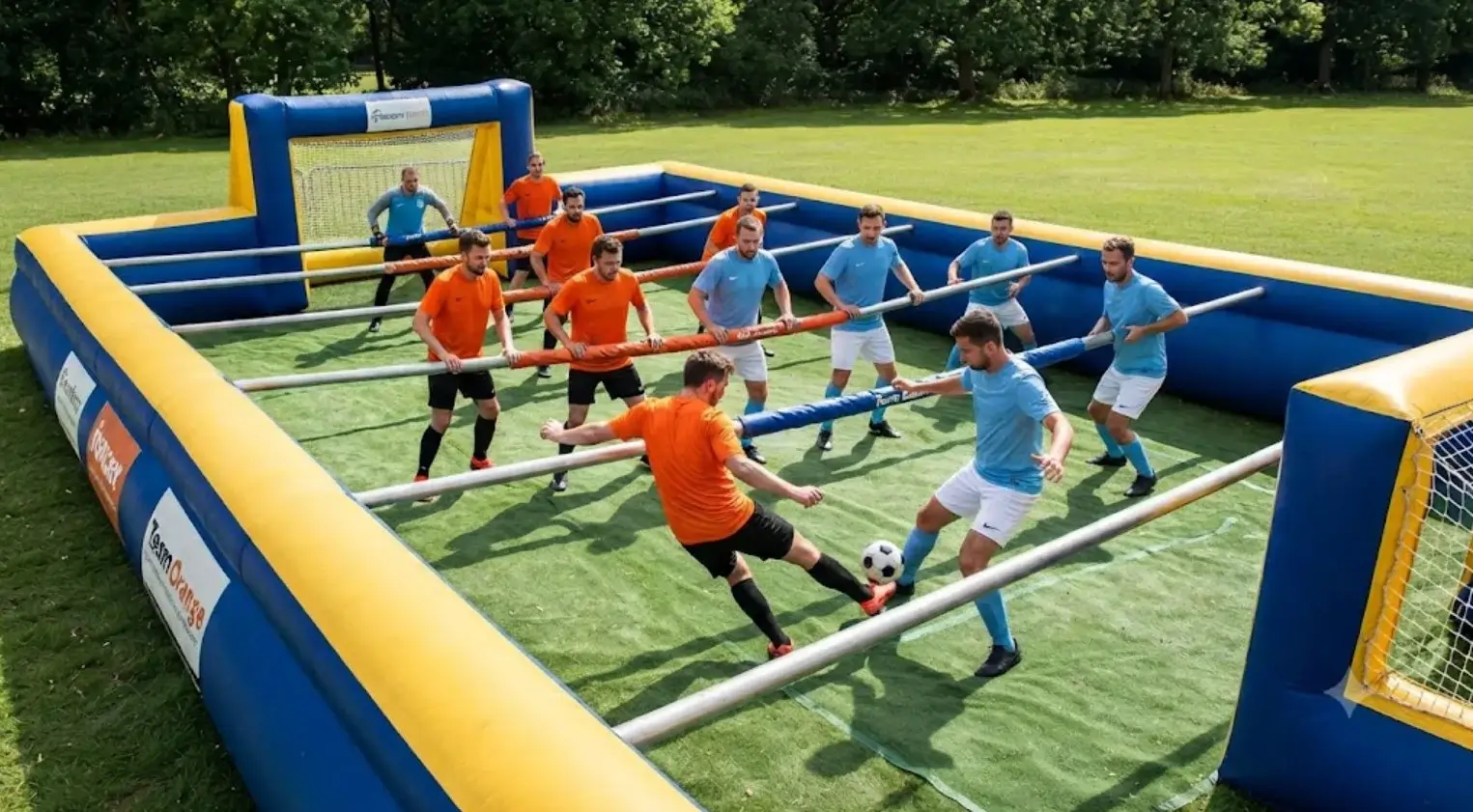
A standard foosball table tests your hands, reactions, and rod control. Human foosball tests something harder: whether several people can move in the same direction without arguing.
This life-size game turns players into foosball figures inside an enclosed court. This Foosball Junkie guide explains how it works, how to play, common rules, court sizes, inflatable options, rentals, purchasing, and DIY setups.
What Is Human Foosball?
Human foosball is a life-size version of traditional table soccer.
Instead of controlling miniature figures on a football table, real players stand in fixed rows. They hold bars, sleeves, ropes, or handles that limit their movement.
Players can usually move from side to side, but they cannot run freely toward the ball.
Two teams pass, defend, and shoot a soccer-style ball into opposing goals. The court may be an inflatable arena, a permanent framed structure, or a homemade enclosure.
Human foosball is also called:
- Life-size table football
- Human-size foosball
- Giant human foosball
- Live-action table soccer
- Human foosball soccer
- Human foosball table
- Human-sized foosball
A human-size foosball table is not really a raised table. It is a ground-level playing area designed to recreate a traditional foosball layout with people replacing the playing figures.
Some established venues use seven or eight players per team. Many event rental units use five players per side. This variation matters because there is no single universal human foosball format.
Human Foosball vs. Regular Foosball
The basic objective remains familiar, but the playing experience changes considerably.
| Feature | Traditional foosball | Human foosball |
| Players | Miniature playing figures | Real people |
| Movement | Rod rotation and sliding | Mainly lateral movement |
| Ball | Small foosball | Soft or lightweight soccer ball |
| Playing area | Raised football table | Enclosed life-size court |
| Main control | Hands and rods | Feet, positioning, and communication |
| Team challenge | Ball control and timing | Coordinated group movement |
| Space needed | Small indoor area | Large indoor or outdoor area |
Traditional table soccer rewards precise individual control. Human foosball places greater pressure on communication because several teammates may share the same row.
That is where the chaos begins.
How Does Human Foosball Work?
A human foosball court copies the general structure of a foosball table.
Players line up across the field in fixed defensive, midfield, and attacking rows. A goalkeeper normally occupies the final position in front of each goal.
Horizontal support bars, ropes, or poles span the width of the playing area. Each player holds a handle or movable sleeve attached to that support.
The setup allows lateral player movement while preventing free forward and backward running. Each person controls a specific zone, much like a figure on a traditional table soccer rod.
A referee or supervisor places the ball into play. Teams then pass through their rows and attempt to score in the opposing goal. Established rulesets commonly stop play after a goal, foul, out-of-bounds ball, or expired time.
Typical Player Positions
The exact formation depends on player capacity and court design.
Goalkeeper
The goalkeeper protects the central scoring area. Some courts give the keeper more movement than field players, while others use the same restricted system.
Defenders
Defenders block direct shots and move the ball away from their goal. They should avoid kicking every loose ball forward without looking.
Midfielders
Midfield players connect defense and attack. They often receive the most touches because the ball repeatedly rebounds through the center.
Forwards
Forwards create shooting opportunities and pressure the opposing defense. Good forwards anticipate wall rebounds rather than waiting directly in front of the goal.
Smaller inflatable human foosball games may use five players per team. Larger courts may accommodate additional midfielders or forwards.
How to Play Human Foosball
The game is easy to understand, but coordinated play takes practice.
A short briefing before the match prevents confusion, unsafe movement, and the classic problem of five people shouting “left” at once.
1. Divide Players Into Two Teams
Create equal teams whenever possible.
Assign each player to goalkeeper, defense, midfield, or attack. Match the number of players to the court’s stated capacity.
Avoid squeezing extra participants into an inflatable arena. Overcrowding reduces movement and increases accidental contact.
2. Place Players in Their Rows
Every player enters a designated lane or row.
Depending on the setup, players may hold:
- A horizontal bar
- A sliding PVC sleeve
- A rope handle
- A fixed hand grip
- A waist strap or harness
Players sharing one support must coordinate their side-to-side movement. One player moving suddenly can pull teammates away from the ball.
3. Put the Ball Into Play
A referee normally rolls or places the ball near midfield.
Starting from the center gives both teams a fair chance to challenge for possession. Some casual games let the team that conceded restart from midfield.
Venue instructions should always take priority.
4. Pass and Shoot
Players use their feet to control, pass, block, and shoot.
They cannot chase the ball into another lane. Instead, they must move into position and rely on teammates to continue the play.
Effective teams move the ball through several rows:
- The goalkeeper or defender clears danger.
- Midfield receives or redirects the ball.
- Forwards create a shooting angle.
- The nearest player shoots toward the goal.
Hard kicks are not always helpful. A controlled pass often works better because the enclosed walls produce quick rebounds.
5. Decide the Winner
Common match formats include:
- First team to reach an agreed goal total
- Team with the most goals after a fixed period
- Best of several short games
- Knockout tournament matches
One rental operator suggests agreeing on a winning target between three and ten goals. An established tournament venue uses six-minute pool games and eight-minute playoff games, showing how much match formats can vary.
Human Foosball Rules
There is no worldwide human foosball rulebook comparable to the formal rules used in competitive table football.
Rental businesses, permanent venues, tournament organizers, and DIY builders may apply different instructions. However, most human foosball game rules follow the same basic principles.
Core Rules
- Players must remain in their assigned row.
- Movement is limited mainly to side-to-side action.
- Players must continue holding their bar, sleeve, or handle.
- Hands cannot control the ball during normal play.
- Players cannot leave their positions to chase the ball.
- Intentional physical contact is not allowed.
- A goal counts when the ball enters the opposing goal.
- Play stops after a goal, foul, out-of-bounds ball, or expired time.
- Players must follow the referee’s directions.
- Climbing or hanging from the support bars is prohibited.
- Dangerous kicking should result in an immediate stoppage.
- Teams should use equal numbers whenever practical.
Fresh Coast Phoosball requires players to keep both hands on their sleeves and at least one foot touching the ground. Those are sensible controls, but they remain venue-specific rules rather than universal requirements.
Common Fouls and Penalties
A referee may call a foul when a player:
- Uses a hand to stop or control the ball
- Releases the required handle
- Leaves the assigned position
- Deliberately delays play
- Pushes or contacts an opponent
- Kicks dangerously near another player
- Hangs from a support bar
- Climbs on an inflatable wall
- Ignores the supervisor
- Deliberately sends the ball out of play
- Interferes with another row
The usual penalty is possession or a restart for the non-offending team.
Some organized rules use midfield and forward restarts. A deliberate handball that stops a clear shot may carry a stronger penalty. Your referee should explain these consequences before the match begins.
Restarts
Keep restarts simple so the game continues smoothly.
| Situation | Practical restart |
| Goal scored | Conceding team restarts near midfield |
| Ball leaves the court | Opposing team receives midfield possession |
| Defensive foul | Attacking team receives a forward restart |
| Attacking foul | Defending team receives possession |
| Ball enters safety netting | Goalkeeper restart |
| Unclear stoppage | Neutral midfield roll-in |
Complex rules rarely improve a casual event. Players came to kick a ball, not attend a three-hour refereeing seminar.
Match Length and Tiebreakers
A recreational match can last about 5 to 15 minutes.
Short games work well for busy events because new teams can rotate through the court. Longer matches become tiring, especially when players must maintain a fixed stance.
Possible tiebreakers include:
- One sudden-death goal
- A short overtime period
- A penalty shootout
- A three-shot challenge for each team
Human Foosball Court Dimensions and Space Requirements
There is no official human foosball court size.
Dimensions vary according to player capacity, wall construction, lane spacing, goal size, and whether the court is inflatable or rigid.
Buyers should therefore avoid listings that describe one measurement as the standard human size foosball dimension.
Human Foosball Dimension Examples
The following examples show how much commercial and homemade courts can differ.
| Example | Actual court dimensions | Recommended setup area |
| Medium rental inflatable | 40 × 23 × 8 feet | 46 × 29 × 10 feet |
| Taller rental inflatable | 40 × 23 × 10 feet | 50 × 33 × 13 feet |
| Manufacturer-listed inflatable | 44 × 20 × 7 feet | Not stated |
| Homemade enclosed court | 35 × 14 feet | Extra perimeter clearance needed |
These are individual product and project measurements. They are not official human foosball court dimensions.
What Determines the Required Court Size?
Several factors affect the equipment footprint:
- Number of players
- Number of fixed rows
- Space between opposing players
- Goal width and depth
- Inflatable wall thickness
- Length of horizontal bars
- Blower position
- Entry and exit points
- Spectator clearance
- Indoor ceiling height
- Delivery access
- Emergency exit space
A small court creates faster rebounds and more player interaction. However, reducing the dimensions too far can produce cramped lanes and unsafe foot contact.
A larger court offers more reaction time but requires more venue space and stronger communication between rows.
Measure the Setup Area, Not Just the Court
This is one of the most important lessons for buyers and renters.
The stated court size may only describe the inflated equipment. The actual setup area must also accommodate anchors, blowers, electrical cables, entrances, and safe walking clearance.
For example, one 40 × 23-foot unit requires a 46 × 29-foot setup area. Another similarly sized unit requires 50 × 33 feet and 13 feet of vertical clearance.
Measure:
- Usable floor or ground space
- Ceiling height
- Door and gate width
- Route from the delivery vehicle
- Distance to electrical power
- Overhead branches or utility lines
- Spectator and queue areas
A court that technically fits can still be impossible to install.
Types of Human Foosball Courts
Human foosball is available in several forms. The best choice depends on how often it will be used, where it will be installed, and who will operate it.
Inflatable Human Foosball
An inflatable human foosball court uses padded air-filled walls to enclose the field.
Most commercial units require continuous airflow from an electric blower. The blower replaces air escaping through seams and keeps the structure firm during operation.
Advantages
- Portable when packed
- Padded boundaries
- Suitable for temporary events
- Visually noticeable
- Faster professional installation
- Easier to relocate than a rigid court
Limitations
- Requires electricity
- Requires correct anchoring
- Needs dry storage
- Can be affected by weather
- Requires inspection and supervision
- May need professional repair after damage
A blow-up human foosball unit works well for occasional events. It makes less sense for a buyer without suitable storage, transport, power access, or trained setup staff.
Rigid or Framed Human Foosball
A rigid court may use timber, fencing, steel supports, PVC, or a combination of materials.
Its harder boundary walls can create rebounds that feel closer to a regular football table. It can also remain assembled for repeat use.
However, a rigid court requires careful bracing, padding, storage, and inspection. Poorly designed supports can create a greater impact risk than padded inflatable walls.
Open DIY Human Foosball
A basic homemade human foosball game may use ropes, poles, cones, portable goals, and marked player lanes.
This approach costs less to organize and can be easier to transport. It also produces a less authentic table soccer experience because the ball frequently leaves the playing area.
Open setups work best for supervised practice or a casual field day. They are less suitable when the organizer wants controlled rebounds or continuous competitive play.
Indoor Human Foosball
Indoor human foosball offers:
- Predictable weather
- A level playing surface
- Easier electrical access
- Better control over spectators
- Consistent event scheduling
The venue still needs enough ceiling clearance, floor protection, ventilation, entry access, and emergency space.
Some commercial units stand 8 to 10 feet high and require additional vertical clearance.
Outdoor Human Foosball
Outdoor human foosball provides more room but introduces new risks.
The area should be level, clear, and suitable for anchoring. Organizers must monitor weather and stop using the equipment when conditions conflict with manufacturer or rental-provider instructions.
Do not assume that heavy equipment cannot move. Inflatable models have a large surface area and must be secured correctly.
Human Foosball Inflatable: What Buyers Should Know
An inflatable human foosball game can look simple in a product photo. Operating one responsibly involves more than connecting a blower.
Before renting or buying, confirm:
- Actual inflated dimensions
- Required setup dimensions
- Player capacity
- Recommended age range
- Weight or height restrictions
- Number and rating of electrical circuits
- Blower specifications
- Included anchors or sandbags
- Accepted setup surfaces
- Minimum access width
- Setup and takedown time
- Cleaning procedure
- Weather restrictions
- Repair requirements
- Storage dimensions
Power requirements are not consistent across every model.
One rental unit requires a 20-amp outlet. Another lists one circuit, while different event units may specify other outlet ratings. Follow the documentation supplied with the exact equipment rather than copying requirements from a similar-looking inflatable.
Also ask whether the blower must run continuously. For most commercial event inflatables, switching off the blower means the arena will lose its structure.
Renting Human Foosball for an Event
Human foosball game rental is usually the practical option for occasional use.
A rental provider can manage transportation, installation, inflation, anchoring, and removal. Some packages also include supervision or operating instructions.
The game works particularly well for:
- Corporate team-building events
- School field days
- Church festivals
- College activities
- Summer camps
- Community fairs
- Sports club events
- Fundraisers
- Family gatherings
- Promotional events
Its fixed playing positions make communication more important than individual speed. That gives less athletic participants a meaningful role, although mobility and balance requirements still vary by unit.
Questions to Ask Before Renting
Contact the provider with your venue details before booking.
Ask:
- What are the actual dimensions?
- What setup area is required?
- How many players can participate?
- What ages, heights, or weights are allowed?
- Is delivery included?
- Who installs and removes the unit?
- Is an attendant required?
- What electrical supply is needed?
- Is a generator available?
- Can the unit be installed indoors?
- Which ground surfaces are permitted?
- What anchoring method will be used?
- What happens if weather becomes unsafe?
- Is cleaning included?
- Are the ball and accessories supplied?
- What access width is required?
- Are stairs permitted on the delivery route?
- What is the cancellation policy?
- Is the provider insured?
- Who is responsible for monitoring players?
Rental terms can include minimum passage widths, surface restrictions, generator requirements, supervision, and weather policies. Read the agreement instead of assuming every service is included.
Buying Human Foosball
Buying may make sense for organizations that operate frequent events.
Likely buyers include:
- Event rental companies
- Schools
- Recreation centers
- Summer camps
- Resorts
- Sports clubs
- Entertainment venues
- Large community organizations
An occasional backyard user will probably gain more value from renting. Ownership adds transportation, storage, cleaning, inspection, setup, and repair responsibilities.
What to Check Before Purchasing
Do not select an inflatable human foosball for sale based only on appearance.
Evaluate:
Construction
Check the fabric specification, stitching, seams, wall padding, netting, handles, player lanes, and reinforced stress points.
Player capacity
Confirm whether the stated capacity means total players or players per team.
Power requirements
Check the required voltage, amperage, number of blowers, cable limitations, and generator compatibility.
Anchoring system
Confirm whether stakes, straps, ballast bags, or other anchor points are included.
Included equipment
Look for the ball, blower, repair materials, storage bag, groundsheet, operating instructions, and spare components.
Storage and transportation
An inflatable packs smaller than a rigid court, but commercial units can still be heavy and difficult to move.
Warranty and support
Ask about seam failure, blower coverage, replacement parts, repairs, and response times.
Compliance
Check the safety, insurance, inspection, and amusement-device requirements that apply in your location.
Commercial products vary widely in size and construction, and some manufacturers offer custom dimensions or branding. That flexibility can be useful, but customized dimensions also change capacity, power, setup, and transportation requirements.
Rent or Buy?
| Consideration | Renting | Buying |
| Best for | Occasional events | Frequent commercial or institutional use |
| Storage | Usually unnecessary | Required |
| Maintenance | Usually handled by provider | Owner’s responsibility |
| Transportation | Usually included or arranged | Owner must manage |
| Setup knowledge | Provider may install | Staff training needed |
| Customization | Limited | Often available |
| Long-term control | Low | High |
| Operational responsibility | Shared with provider | Primarily the owner |
Buy only when the expected use justifies the ongoing operational work.
How to Build a DIY Human Foosball Court
A DIY human foosball setup can be a rewarding group project, but it should remain simple and conservative.
The objective is not to copy a commercial inflatable. It is to create stable player rows, clear boundaries, controlled movement, and enough space for safe play.
Basic DIY Components
A homemade court may include:
- Rectangular playing area
- Two goals
- Side boundaries
- Cross-court poles or ropes
- Sliding sleeves or handles
- Stable side supports
- Court markings
- Soft soccer ball
- Padded exposed edges
- Clear safety perimeter
One documented DIY project used a 35 × 14-foot court with six ropes spaced five feet apart. PVC sleeves allowed players to slide along the ropes, while fencing kept the ball inside. Treat that design as an example, not a certified construction plan.
Basic Construction Process
- Choose a level playing area.
- Decide the number of players and rows.
- Mark the court boundaries.
- Plan sufficient spacing between rows.
- Install stable side supports.
- Run poles or ropes across the court.
- Add sliding sleeves or safe hand grips.
- Build or mark both goals.
- Add secure side boundaries if practical.
- Pad hard edges and exposed connectors.
- Test every support under controlled pressure.
- Conduct a slow practice round.
- Inspect the setup again before full play.
PVC, timber, ropes, fencing, and weighted bases have all appeared in homemade designs. The safest option depends on the materials, engineering, ground conditions, and player group.
DIY Safety Warning
A homemade human foosball court is not automatically equivalent to professionally designed event equipment.
Supports must not tip, rotate, collapse, or pull free. Players need enough legroom to kick without striking another row.
Avoid sharp edges, exposed fasteners, unstable buckets, loose ropes, and heavy unpadded poles.
Children require active adult supervision. Stop play immediately when any support, grip, rope, boundary, or goal becomes loose.
Human Foosball Safety Tips
Fun disappears quickly when a loose anchor becomes the most active player on the field.
Complete a safety check before every session.
- Inspect walls, ropes, bars, sleeves, and handles.
- Secure every support and anchor point.
- Use a soft or lightweight ball.
- Require closed-toe athletic shoes.
- Remove loose jewelry and accessories.
- Keep spectators outside the playing area.
- Group participants sensibly by size and mobility.
- Keep the entrance clear.
- Stop play on wet or slippery surfaces.
- Do not permit climbing or hanging.
- Monitor weather during outdoor use.
- Keep electrical connections protected.
- Use a trained attendant or responsible adult.
- Stop immediately if the structure loses pressure.
- Follow the manufacturer’s operating instructions.
Fresh Coast Phoosball requires footwear that covers the entire foot and prohibits hanging from poles. Rental operators may also require an adult monitor while the unit remains inflated.
Safety disclaimer: This guide provides general information, not engineering, legal, or equipment-certification advice. Follow the manufacturer, rental provider, venue, insurer, and local authority requirements for your specific setup.
Simple Human Foosball Strategies
Good human foosball strategy resembles good traditional foosball strategy. Control space, create passing lanes, and avoid shooting without purpose.
Move as a Row
Players sharing a support should call the direction before moving.
Use simple commands such as “left,” “right,” “hold,” and “center.” Long tactical speeches are rarely helpful while the ball is approaching your feet.
Maintain Your Position
Do not drag an entire row toward every loose ball.
Protect the center first. Force opponents into weaker angles instead of leaving the goal path open.
Pass Before Shooting
A defender should not treat every touch as a scoring opportunity.
Controlled passes help the team move possession through midfield. This principle works on a regular football table and becomes even more important when real people need time to reposition.
Use the Walls
Enclosed courts produce useful rebounds.
A pass against the side wall can move the ball around a defender or create a better angle for a teammate. Watch the court during the opening minute to learn how strongly its walls return the ball.
Protect the Direct Route
Goalkeepers and defenders should guard the center.
Wide shots usually offer more reaction time. A ball traveling directly toward the middle of the goal is harder to recover from.
Communicate Constantly
Useful calls include:
- Left
- Right
- Hold
- Center
- Pass
- Turn
- Shoot
- Clear
Coordination is more important than individual speed. A talented player cannot cover the whole arena while attached to one row.
Is Human Foosball Suitable for Children and Adults?
Human foosball can accommodate children, teenagers, and adults, but suitability depends on the individual court.
Some operators recommend specific minimum ages. Others describe their units as suitable for broad age groups. Player capacity and physical requirements also vary.
Before allowing someone to play, consider:
- Height relative to the handle
- Ability to maintain balance
- Ability to follow instructions
- Footwear
- Mobility
- Size difference between participants
- Court-specific age and weight limits
Mixed-age games need careful supervision. Pairing young children with much larger adults may produce uncomfortable or unsafe contact, even when everyone remains in a fixed lane.
Human foosball may not suit people who cannot safely maintain balance, grip the support, or move laterally. The responsible approach is to adapt the activity rather than pressure everyone to participate.
Frequently Asked Questions
What is human foosball?
Human foosball is a life-size version of table soccer. Real players stand in fixed rows inside an enclosed court, move laterally along bars or ropes, and use their feet to pass and shoot a ball into the opposing goal.
How many people play human foosball?
Five players per team is common in rental inflatables, creating a ten-player game. Larger venues may use seven or eight players per team. The correct number depends on the court’s stated capacity.
How do human foosball players move?
Players normally move from side to side while holding a bar, sliding sleeve, rope, or handle. They cannot run freely forward and backward.
Can players use their hands?
Players generally cannot use their hands to control the ball. Hands remain on the assigned handle or sleeve. A referee or goalkeeper may handle the ball during certain restarts if the local rules permit it.
How long does a human foosball game last?
Casual matches commonly use a short time limit or an agreed goal total. A practical session may last 5 to 15 minutes, while tournament organizers can set their own match schedule.
What size is a human foosball court?
There is no universal human foosball court size. Commercial examples can measure around 40 to 44 feet long and 20 to 23 feet wide, but other dimensions are available. Always check the required setup area as well as the equipment footprint.
Can human foosball be played indoors?
Yes. The indoor venue must provide sufficient floor space, ceiling height, electrical access, ventilation, delivery access, and permission for the equipment.
Does an inflatable human foosball court need electricity?
Most commercial inflatable models need electricity to run one or more blowers. Exact outlet and circuit requirements vary by unit.
Can you build human foosball at home?
Yes, but a DIY human foosball court needs stable supports, safe spacing, padded edges, controlled movement, and active supervision. Treat online projects as inspiration rather than certified building plans.
Is human foosball the same as giant foosball?
The terms are often used interchangeably. However, giant foosball can also describe an oversized tabletop game. Human foosball specifically means that people occupy the playing positions.
Should I rent or buy human foosball?
Rent for occasional events or when you lack storage and setup staff. Consider buying for frequent organizational or commercial use when you can manage transport, inspection, maintenance, cleaning, and supervision.
Final Thoughts
Human foosball takes the structure of table football and turns it into a physical team challenge.
Its defining feature is not the inflatable wall or giant court. It is restricted movement. Every participant controls one zone and must depend on the rest of the team.
Before renting, purchasing, or building a court, check its player capacity, dimensions, required setup area, power supply, anchoring system, and operating rules. There is no universal format, so specifications from the actual provider matter more than generic measurements.
Plan the space carefully, explain the rules clearly, and place safety ahead of competition. Do that, and human foosball becomes more than oversized table soccer. It becomes a very funny test of teamwork.