A premium foosball table can become a family heirloom or an expensive coat rack. The difference often comes down to choosing the right brand and understanding its playing style.
Bonzini has built its reputation around French craftsmanship, controlled play, repairable components, and unmistakable café character. This guide explains the brand, its main models, ownership experience, vintage value, and long-term parts support.
What Is Bonzini Foosball?
Bonzini is a French manufacturer best known for traditional babyfoot tables. The company began in Bagnolet, near Paris, in 1927. Its first foosball table entered production in 1935.
Unlike brands created around inexpensive home recreation, Bonzini developed its identity through furniture making and precision mechanics. Its tables were designed to function as substantial pieces of furniture, not disposable game-room toys.
The B60 later became closely connected with French cafés, hotels, restaurants, and bars. Since the 1960s, it has represented the traditional French café babyfoot experience. The coin mechanism, cork ball, telescopic rods, and aluminum players all contribute to that identity.
Bonzini still designs and assembles its tables in Bagnolet using French-made materials and components. That local manufacturing approach gives the brand more control over construction, customization, and replacement parts.
In other words, Bonzini is not simply another football table manufacturer. It represents a specific French table soccer tradition.
What Makes Bonzini Different?
Several premium manufacturers build strong tables. Bonzini stands apart because its cabinet, rods, players, balls, and handles create one connected playing system.
That distinction matters for buyers. You are not only choosing how the table looks. You are choosing how it responds to every pass, pin, and shot.
Recognizable French Construction
The B60 and B90 use premium solid beechwood and laminated beechwood in their cabinets. Bonzini reinforces the carpentry with metal elements and protects the wood with polyurethane varnish.
The primary construction details include:
- Solid and laminated beechwood cabinets
- Solid beechwood removable legs
- Steel-reinforced carpentry joints
- Polyurethane varnish
- Polished aluminum goals
- Aluminum players attached with high-resistance screws
- Hand-decorated and kiln-painted player finishes
These features are not included only for appearance. Dense wood and reinforced cabinet joints help the table remain stable during aggressive play. Removable legs make delivery and future servicing more manageable, although the cabinet remains heavy.
The aluminum players are also individually replaceable. If one player becomes damaged or loose, you do not need to replace an entire rod assembly.
That repairable design is important when buying a table intended to remain in service for decades.
Bonzini Telescopic Rod System
Bonzini uses interchangeable telescopic rods made from ground steel with a hard-chrome finish. The fixed inner rods remain inside the cabinet while the outer player rods slide over them.
This design prevents rods from extending through the opposite side of the table. That makes Bonzini attractive for family rooms, cafés, schools, and other spaces where players may stand close together.
The rod movement depends on several serviceable components:
- Ground-steel inner rods
- Outer player rods
- Nylon bearings
- Internal and external springs
- Polyurethane washers
- Neoprene shock-absorbing rings
- Threaded aluminum handle tips
Bonzini sells these components separately through its parts catalog. The bearing assembly itself combines a bearing body, nylon bearing, spring, washer, and fastening hardware.
When correctly cleaned and lubricated, the rods provide a smooth, controlled movement. Neglected rods can feel sticky or uneven, especially when old oil attracts dirt inside the tubes.
For used-table buyers, rod condition deserves more attention than cosmetic scratches. A beautiful cabinet cannot rescue a poorly maintained playing system.
Handles and Customization
Bonzini handles are not decorative afterthoughts. They change grip pressure, wrist movement, control, and shot selection.
The traditional round handle is short and wide. Its grooved surface offers a firm grip and suits precise wrist-based play. However, it is not the easiest choice for snake shots.
The standard long handle supports a broader range of movements. Its narrower shape can also feel more comfortable for smaller hands.
The USA Long handle combines a cylindrical palm section with a tapered front. Bonzini developed it for American players seeking a familiar, flexible grip. It works well for open-hand shots, push-pull movements, and snake techniques.
The longer magnesium Snake handle targets competition-style snake shots. It gives the hand more room to accelerate the rod, although recreational buyers may find it unnecessarily specialized.
Choose handles by comfort before appearance. A polished handle looks impressive, but the wrong shape can make a long session tiring.
The ball may be cork, but your excuses will still bounce.
How Does a Bonzini Foosball Table Play?
Bonzini rewards control more than uncontrolled speed. Its traditional playing experience emphasizes possession, pinning, passing, and carefully placed shots.
Compared with many American table soccer setups, a Bonzini can initially feel softer and more deliberate. Players accustomed to fast plastic balls may need time to adjust their touch.
That adjustment is not necessarily a disadvantage. Buyers who enjoy controlled passing often appreciate the ability to trap the ball and build a move rather than immediately losing possession.
The table also communicates mistakes clearly. A heavy touch sends the ball away. A controlled touch keeps it available for the next pass.
Bonzini Cork Balls and Plastic Balls
The ball dramatically changes the Bonzini playing feel.
A natural cork ball is light, grippy, and easy to control. It supports deliberate passing, pinning, and technical possession. Bonzini describes it as its lightest and most versatile ball.
Dyed cork has a slightly harder, smoother surface. It moves faster while retaining much of the grip associated with cork.
The heavy cork ball adds density for stronger shots. It can suit buyers who enjoy cork control but want more force behind the ball.
Bonzini also offers an ITSF-B composite plastic ball. It is heavier, faster, and approved for elite competition. The standard hard plastic ball is durable and quick but more difficult to control because of its slippery surface.
Ball type | Playing characteristic | Best suited to |
Natural cork | High grip and controlled possession | Traditional Bonzini play |
Dyed cork | Smoother and slightly faster | Balanced recreational play |
Heavy cork | More weight and stronger shots | Players wanting added power |
ITSF-B composite | Fast, firm competition response | Tournament-focused players |
Standard plastic | Fast and durable, but slippery | Casual high-speed games |
For most first-time Bonzini owners, natural or dyed cork provides the clearest introduction to the brand.
Bonzini B60 vs B90
The B60 and B90 share the recognizable Bonzini construction and playing system. Their main difference is how and where they are intended to be used.
The B60 is the traditional commercial model. The B90 removes the coin mechanism and adapts the same core experience for private ownership.
Feature | Bonzini B60 | Bonzini B90 |
Main use | Cafés, bars, hotels, and commercial venues | Homes, offices, and private establishments |
Coin mechanism | Yes | No |
Cabinet | Opening or split cabinet | One-piece cabinet |
Ball return | Central commercial-style return | Ball return on each long side |
Internal access | Opens for coin box and playing area access | Does not use the B60 opening system |
Brand position | Traditional French café babyfoot | Free-play counterpart to the B60 |
The B60 makes sense when a venue needs controlled paid play, secure internal access, and traditional café character.
The B90 usually makes more sense for a home buyer. It preserves the materials, rods, players, and general playing feel without adding commercial hardware that most families will never use.
Main Bonzini Foosball Tables
Bonzini offers several models and finishes, but buyers do not need to memorize the entire catalog.
The B90 and B60 remain the tables that best explain what the brand represents.
Bonzini B90 and B90 Original
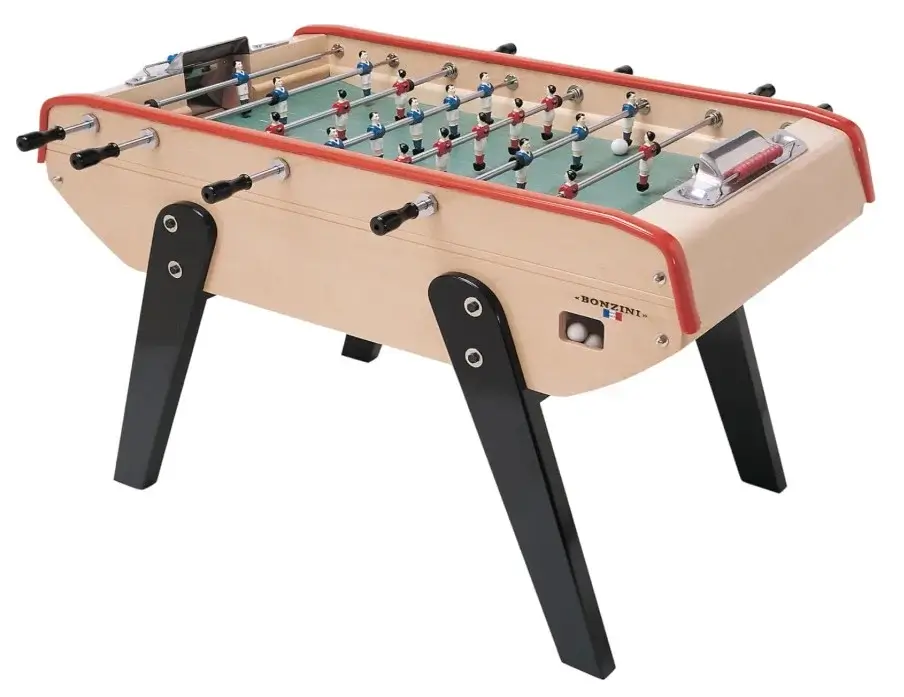
The Bonzini B90 is the brand’s best-known home model. It uses a one-piece cabinet and has no coin mechanism.
Official specifications include solid and laminated beechwood construction, polyurethane varnish, telescopic ground-steel rods, aluminum players, polished aluminum goals, removable beechwood legs, and ball returns on both long sides.
The B90 is suitable for:
- Dedicated home game rooms
- Offices and employee recreation spaces
- Social clubs
- Schools and community facilities
- Buyers who want the Bonzini experience without commercial hardware
The B90 Classic Blonde listed by Bonzini USA provides a useful example. It combines a natural beech-colored cabinet, red rails, black legs, a lined green playfield, USA Long handles, and six raw cork balls. Light final assembly is required, and the listing includes the necessary hand tools and rod lubricant.
An Amazon listing for the B90 Classic presents a similar home-focused configuration with the brand’s recognizable cabinet and traditional color scheme.
That product is worth mentioning because it shows how a current B90 may be packaged for American buyers. However, it should not be treated as the only version of the B90.
Different distributors may offer different handles, finishes, player colors, accessories, and ball-return configurations.
Bonzini B60 and B60 Original
The B60 is the coin-operated model most closely associated with French café foosball.
Its cabinet opens for access to the playing surface, ball return, coin box, and internal storage. A lock helps secure the commercial components. The central ball return allows venue owners to control play through the coin mechanism.
The B60 is better suited to:
- Bars and cafés
- Hotels and restaurants
- Public recreation spaces
- Commercial game rooms
- Collectors seeking an authentic café babyfoot
- Restoration buyers interested in vintage French tables
For a normal home game room, the coin system may add weight and complexity without adding practical value.
For a collector, that same mechanism can be part of the attraction.
Other Bonzini Models
Bonzini also produces several alternative models and finishes.
The Stadium is a simplified, lighter model inspired by the B90. It uses a melamine cabinet finish with solid beechwood legs and retains recognizable Bonzini colors.
Compact 2-Rod and 3-Rod models serve smaller rooms. They offer a shortened playing format rather than the complete B60 or B90 experience.
The eFoosball model adds connected technology to a B60-based platform while attempting to preserve the traditional Bonzini playing feel.
B60 finishes include Cerused, Rustic, White Lacquer, glass-topped, and B93-inspired versions. The glass-topped B60 targets public or high-traffic locations where ball theft and unauthorized access are concerns.
These models show the brand’s range, but most buyers should begin their comparison with the B60 and B90.
Bonzini Foosball Table Price
Anyone searching for a Bonzini foosball table price should avoid relying on one fixed number.
Prices change by country, distributor, configuration, shipping method, and customization. Used and restored tables introduce even more variation.
What Affects the Price?
The most important factors include:
- B60 or B90 construction
- Coin-operated hardware
- Standard or custom cabinet finish
- Handle type and material
- Player colors and personalization
- Special rails, goals, and score counters
- Dealer location
- International freight
- Professional delivery or room-of-choice installation
- New, used, or professionally restored condition
The B90 is normally positioned below the B60 because it does not include the B60 coin mechanism, opening cabinet, and commercial ball-return hardware.
Customized colors and decorative finishes can also increase the total cost. Bonzini allows buyers to personalize finishes, handles, players, colors, and accessories across parts of its range.
Shipping deserves special attention. These are heavy tables, not flat-pack furniture that one person can casually carry upstairs.
Measure doorways, staircases, elevators, and turning spaces before ordering. A successful purchase should end with a match, not a cabinet trapped in the hallway.
New vs Used Bonzini Tables
A new Bonzini provides a known configuration, current components, dealer support, and more control over customization.
A used Bonzini foosball table may offer better value, but condition matters more than age alone.
Inspect:
- Rod movement
- Inner rod straightness
- Bearing wear
- Player tightness
- Cabinet moisture damage
- Leg stability
- Goal condition
- Ball-return operation
- B60 coin-mechanism function
- Evidence of incomplete restoration
A low purchase price can quickly lose its appeal after replacing rods, bearings, players, hardware, and damaged wood.
A vintage B60 may hold stronger collector interest when it remains complete, original, and professionally maintained. However, restoration quality matters. Fresh paint does not automatically mean a properly restored table.
How to Identify a Vintage Bonzini Foosball Table
A vintage Bonzini foosball table should be identified through its construction and serial number, not through seller claims alone.
Fortunately, Bonzini provides a dedicated vintage lookup system for the B60 and B90.
Find the Bonzini Serial Number
The serial number is stamped into the wood on the lower lateral cross-piece of the cabinet. Look near one of the short goal ends.
Owners can submit that number through Bonzini’s vintage lookup module to request the table’s production year.
Before buying an old Bonzini foosball table:
- Ask the seller for a clear photograph of the serial number.
- Compare the number with the cabinet condition.
- Request photographs of both goal ends and the underside.
- Confirm whether the seller has used Bonzini’s lookup system.
- Be cautious when a seller refuses to provide identifying details.
A serial number confirms age more reliably than phrases such as “rare vintage model” or “probably from the 1960s.”
Check the Table’s Originality and Condition
Age alone does not determine Bonzini resale value.
A well-maintained B90 can be more desirable than an older B60 with bent rods, water damage, missing hardware, and an incomplete coin system.
Inspect the following areas:
- Cabinet: Look for swelling, separation, cracks, or poor repairs.
- Beechwood legs: Check for movement around bolts and cross-pieces.
- Rods: Test for bends, rough sliding, corrosion, and excessive play.
- Bearings: Listen for grinding and feel for uneven resistance.
- Players: Confirm that the aluminum figures are secure.
- Goals: Look for loose fittings or damaged aluminum.
- Score counters: Check for missing beads or improvised replacements.
- Ball return: Confirm that balls travel freely.
- B60 coin system: Test the coin box, lock, chute, and release.
- Handles: Identify whether they are original or later replacements.
- Springs and washers: Look for worn or missing shock-absorbing parts.
Replacement parts do not automatically reduce a table’s usefulness. For collectors, originality matters more. For players, correct fit and mechanical condition may matter more than historical purity.
Can You Still Get Bonzini Replacement Parts?
Parts support is one of Bonzini’s strongest ownership advantages.
Bonzini maintains model-specific catalogs for maintaining, repairing, and restoring its tables. Available categories include rods, inner rods, players, bearings, handles, springs, washers, cabinet hardware, legs, goals, and other mechanical components.
Commonly available components include:
- Outer player rods
- Full inner rods
- Goalkeeper rods
- Aluminum players
- High-resistance player screws
- Nylon bearings
- Internal and external springs
- Polyurethane washers
- Neoprene shock-absorbing rings
- Handles and handle fittings
- Cabinet leg hardware
- Replacement legs
- Polished aluminum goals
- Cleaning brushes
- Recommended rod lubricant
- Protective covers
Bonzini also sells a fitted protective cover for the B60 and B90. It protects the cabinet from dust, scratches, and splashes when the table is not being used.
This does not mean every old component will always be available in every country. Distributor stock and international delivery can vary.
Still, a supported vintage brand is generally easier to own than an abandoned table with unidentifiable rods and custom-sized bearings.
The best premium table is not only built well. It can also be repaired when real life happens.
Bonzini Brand Strengths and Limitations
A balanced Bonzini foosball table review should acknowledge both sides of ownership.
Bonzini has genuine strengths, but its playing style, weight, and cost will not suit every buyer.
Strengths
- Distinctive French craftsmanship
- Solid and laminated beechwood construction
- Controlled cork-ball play
- Smooth telescopic rods
- Replaceable mechanical components
- Broad parts support
- Strong café and table soccer identity
- Multiple handle choices
- Customization options
- Recognizable vintage appeal
- Separate home and commercial configurations
Limitations
- Premium acquisition cost
- Heavy cabinets that require delivery planning
- Different playing feel from many American tournament tables
- Cork balls wear faster than hard plastic balls
- Round handles may limit some modern shot techniques
- Local dealer availability varies
- International parts shipping may add time and expense
- Vintage examples can hide expensive mechanical problems
The B90 Original weighs about 80 kilograms, while the B60 Original weighs about 90 kilograms. That stability is helpful during play, but it makes spontaneous room changes unlikely.
Measure twice. Invite strong friends once.
Is Bonzini Worth It?
Bonzini is worth considering when you value brand history, controlled play, repairability, and furniture-grade construction.
The B90 is usually the most practical choice for a home buyer. It delivers the core Bonzini experience without adding a coin system.
The B60 makes more sense for:
- Commercial venues
- Collectors
- French café enthusiasts
- Buyers restoring a period game room
- Owners who specifically want a coin-operated table
Bonzini may not suit players who only enjoy fast American-style play. The cork-ball response and telescopic rod system create a different rhythm.
It may also be excessive for a buyer who expects the table to receive occasional holiday use. A simpler football table could satisfy that need with less weight and maintenance responsibility.
Before purchasing, try to play on a B60 or B90. Ten minutes of real table soccer can answer questions that specification sheets cannot.
Frequently Asked Questions
Are Bonzini foosball tables made in France?
Yes. Bonzini designs and assembles its tables in Bagnolet, east of Paris. The company also states that its materials and components are French-made.
What is the difference between the Bonzini B60 and B90?
The B60 includes a coin mechanism, opening cabinet, and central commercial ball return. The B90 removes the coin mechanism and uses a one-piece cabinet with side ball returns.
How much does a Bonzini foosball table cost?
The final cost depends on the model, finish, handles, customization, distributor, shipping, and whether the table is new, used, or restored. Exact figures should be checked directly with an authorized seller.
Are vintage Bonzini tables valuable?
Some vintage B60 and B90 tables attract strong buyer interest. Value depends on model, production year, originality, mechanical condition, cabinet condition, restoration quality, and local demand.
How can I identify the age of a Bonzini table?
Find the serial number stamped into the lower lateral wooden cross-piece near a goal end. Submit it through Bonzini’s official vintage lookup system to request the production year.
Can I still buy replacement parts for an old Bonzini?
Bonzini maintains an extensive parts catalog for its models. It includes rods, inner rods, players, bearings, springs, washers, handles, legs, cabinet hardware, and goals. Exact availability may vary by model and region.
Do Bonzini tables use cork balls?
Yes. Bonzini offers natural cork, dyed cork, and heavy cork balls. It also offers plastic and ITSF-B composite balls for faster play.
Is the Bonzini B90 suitable for home use?
Yes. Bonzini created the B90 as a free-play alternative to the B60 for private buyers, organizations, schools, and businesses. It does not require coins and is the more practical core model for most homes.
Conclusion
Bonzini has maintained a clear identity in an industry filled with tables that often look more similar than they play.
Its beechwood cabinets, telescopic ground-steel rods, aluminum players, cork-ball control, varied handles, and replaceable parts create a distinctly French ownership experience. The result feels closer to a long-term piece of sporting furniture than a temporary game-room accessory.
Choose the B90 when you want the traditional playing system in a practical home configuration. Choose the B60 when the coin mechanism, opening cabinet, and French café history are central to your purchase.
For buyers who appreciate controlled play, repairability, craftsmanship, and genuine brand character, Bonzini foosball remains one of the most distinctive choices available.