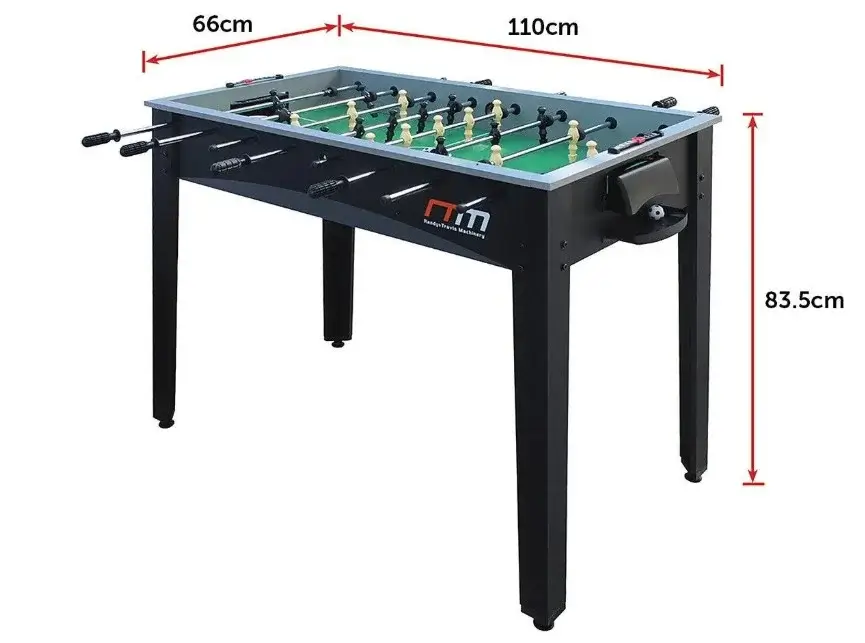
A foosball table has two favorite hobbies: stealing floor space and exposing bad measurements.
That is why this topic matters. Buyers often check the cabinet size, ignore the rods, then realize their “perfect fit” now owns the room. The short answer is this: most full-size foosball table dimensions land around 54 to 56 inches long, 29 to 30 inches wide, and 34 to 36 inches tall, but the real space you need is bigger once rods and player clearance enter the chat.
If you came here from a search for foosball size, foosball table measurements, or even football table dimensions, this guide will keep it simple and practical.
Standard Foosball Table Dimensions at a Glance
Before you compare brands or room layouts, lock in the numbers that matter most. This quick chart covers the measurements people actually use when planning a game room or picking the right football table for home use.
| Measurement | Typical Full-Size/Standard Range | Practical Note |
| Length | 54 to 56 in | 137 to 142 cm is the common full-size range |
| Width, cabinet only | 29 to 30 in | Often excludes rod extension |
| Width with rods | About 42 to 48 in, sometimes near 70 in total on some tournament-style models | This varies a lot by rod design and model |
| Height | 34 to 36 in | Adult-friendly height on full-size tables |
| Recommended room size | Around 8 x 10 ft to 9 x 9.5 ft minimum | More room feels better in real play |
Typical Full-Size, Standard, and Regulation Measurements
Most buyers use standard, full-size, and regulation almost interchangeably. In casual search behavior, that is understandable because the measurements are usually close. A common tournament-style benchmark is 56 x 30 x 36 inches, and one official ITSF competition table model from Garlando is shown at 143 cm long, 125 cm wide, and 94 to 96 cm high depending on the leg levelers.
That said, not every home table follows one exact template. MD Sports notes that 54-inch alternatives can still keep strong playability, which explains why many “standard” home tables fall into a narrow range rather than one fixed number.
Foosball Dimensions in Inches, CM, and MM
Most American listings use inches. Many buyers still search for foosball table dimensions in cm or foosball table size mm, so here is the simple conversion logic:
- 54 in = 137.2 cm = 1372 mm
- 56 in = 142.2 cm = 1422 mm
- 30 in = 76.2 cm = 762 mm
- 36 in = 91.4 cm = 914 mm
What Is the Standard Size of a Foosball Table?
This is the main intent behind most searches. People are not just asking for a number. They want to know what counts as normal, what counts as official, and what size actually feels right in a real room.
Standard Size
For most home buyers, standard foosball table size means a full-size adult table that feels close to tournament play. In practice, that usually means:
- Length: 54 to 56 inches
- Width: 29 to 30 inches
- Height: 34 to 36 inches
So if someone asks, “What are the dimensions of a foosball table?” this is the range that answers the question cleanly.
Regulation, Official, and Competition Size
Regulation-sized foosball table dimensions usually point toward tournament-ready proportions, not just “large enough.” A widely cited benchmark is 56 x 30 x 36 inches, and ITSF-recognized competition tables are built around professional play standards. The Garlando #1 official competition table, for example, is listed at 143 cm x 125 cm x 94/96 cm, while the Tornado T3000 is listed at 56 x 30 x 36 inches.
This is also where details like goalie setup, rod quality, bearings, and table stability start to matter more. Size alone does not make a table competitive, but competitive tables almost always live in this full-size range.
Full-Size vs Standard vs Regulation
Here is the simple version:
- Full-size usually means adult-size and close to tournament proportions.
- Standard size usually means the common home version of full-size.
- Regulation or official size points more directly to tournament norms and approved-style designs.
In real buying language, the overlap is heavy. In real gameplay, regulation tables tend to be stricter about setup, feel, and build quality. That is why readers exploring full-size professional foosball tables should care about more than raw measurements alone.
Foosball Table Measurements Explained
The outside dimensions tell only half the story. To pick the right table, you need to understand what each measurement actually affects.
Table Length
Length shapes the overall gameplay feel. Full-size tables are typically 54 to 56 inches long, which gives players enough spacing for realistic passing, better shot setup, and less cramped play. MD Sports also notes that some 54-inch models can still preserve good playing surface proportions, so shorter does not always mean toy-like.
If your goal is a serious home setup, shorter than that usually feels more like a compromise than a smart alternative.
Table Width
Most listings show cabinet width, not the true side-to-side space the table consumes. A standard width is about 29 to 30 inches, but that number can be misleading if you stop reading there.
This is one reason so many people search for football table size requirements after purchase instead of before.
Foosball Table Dimensions With Rods
This is the measurement buyers miss most. The rods can add 12 to 18 inches or more to the total width when extended, and some tournament-style listings show an assembled width of about 70 inches, including rods.
So yes, the table may be 30 inches wide on paper. In the room, it behaves much bigger.
That is why a smart room plan uses:
- cabinet width
- rod extension
- player standing space
- clearance from walls or furniture
Ignore one of those, and your table starts playing defense against your drywall.
Foosball Table Height
A standard adult table is usually around 34 to 36 inches tall, which works well for most teens and adults. Tournament-style examples also sit in that zone, including the Tornado T3000 at 36 inches and the Garlando official competition model at roughly 94 to 96 cm, or about 37 to 38 inches depending on leveler position.
Height matters more than many buyers expect. Too low feels awkward for adults. Too high can make control and comfort worse for younger players.
Playing Surface and Inner Field Dimensions
Not every 54-inch or 56-inch table plays the same. The cabinet, side walls, corner design, goalie layout, and rod spacing all shape how the playfield feels. MD Sports specifically notes that some shorter tables can reduce outer length without compromising playing surface dimensions, which is useful for buyers trying to save space without losing too much realism.
This is one reason Foosball Junkie often recommends checking detailed size breakdowns before buying, especially when comparing models on the best foosball tables by size pages.
How Big Is a Foosball Table in Real Life?
Numbers are helpful. Visualizing them is better.
A full-size foosball table is not massive like a pool table, but it is also not “small enough to squeeze in anywhere.” Once rods extend and two players lean in, the footprint grows fast.
What a Full-Size Table Feels Like in a Room
A standard full-size table often works in a spare room, basement corner, or game room, but it rarely feels comfortable in a tight nook. Manufacturer guidance and room-size calculators commonly land around 8 x 10 feet or roughly 9 x 9.5 feet as a practical minimum zone for play.
Users report the same thing over and over. The table fits. The players do not.
That is why I tell readers to think in play space, not storage space.
How Big Is a Standard vs. a Compact vs. a Tabletop Table?
The jump between sizes is meaningful.
- Full-size: Best match for adult play and realistic performance
- Compact or small: Easier to fit, but often shorter and lower
- Mini or tabletop: Portable and fun, but not a true substitute for full-size gameplay
A smaller football table can absolutely make sense in an apartment or kids’ room. Just do not expect it to feel like tournament foosball.
Foosball Table Size by Type
The right size depends on who will use it, where it will live, and how seriously you play. That sounds obvious, but it saves a lot of regret.
Full-Size Tables
Full-size tables are best for:
- adults
- frequent play
- serious practice
- dedicated game rooms
They give you better rod spacing, a more natural stance, and a closer match to tournament play. If you want the safe default, this is it. Foosball Junkie readers looking at standard-size foosball tables usually land here for good reason.
Compact or Small Tables
Compact tables work well when space is tight. Typical smaller examples include 52-inch and 48-inch models, which some guides list around 52 x 20 x 28 inches and 48 x 24 x 31 inches. They fit better in apartments, smaller bonus rooms, and family spaces.
The tradeoff is simple:
- less realistic feel
- shorter height on some models
- less room for strong, comfortable adult play
Still, for a small football table setup, this can be the right compromise. Foosball Junkie has a dedicated roundup of small and mini foosball tables for exactly this reason.
Tabletop or Mini Tables
Tabletop models are about convenience, not authenticity. One guide lists typical mini dimensions around 40 x 20 x 10 inches. That makes them easier to store and easier for kids to enjoy.
They are good for:
- children
- dorms
- temporary setups
- occasional casual play
They are not great for:
- adult comfort
- competitive practice
- long sessions
- realistic control
Adult vs Children’s Foosball Table Sizes
Adult players should usually stay close to the full-size range. Children’s tables are shorter in height and length, which helps younger players see the field and reach the handles, but that same sizing quickly feels cramped for adults. Foosball Soccer notes that many children-sized tables are around 4 feet long and about 2.5 feet tall.
If adults will use the table often, buy an adult-sized table. “The kids will grow into it” is not just parenting logic. Here, it is also good furniture logic.
How Much Room Do You Need for a Foosball Table?
This is the section that saves people money on wall repairs.
The biggest mistake is measuring the cabinet and calling it a day. A football table needs room for rods, hips, stance, and movement. Real play is wider than the spec sheet.
Minimum Room Size
For a regulation-style table, common room estimates land around:
- 8 x 10 feet from MD Sports’ suggested room chart for 54 to 58 inch tables
- About 9 x 9.5 feet from Bar Games 101’s clearance breakdown
Those numbers are not contradictory. One is a basic manufacturer planning guide. The other builds in more side clearance logic.
Recommended Room Size for Comfortable Play
Comfort starts where “minimum” ends. Foosball Soccer recommends adding about 3.5 to 4 feet on each side of the table width for comfortable play, especially when players lean back into a proper stance.
That extra breathing room matters if:
- Two adults play hard
- The table sits near a wall
- Furniture crowds the space
- You have kids running around nearby
Clearance Needed on Each Side
A good planning rule is:
- Check cabinet width
- Add rod extension
- Add player space
- Leave some margin
Bar Games 101 suggests 3 to 4 feet on each side for rods and players. That is practical advice, not overkill.
If your football table will sit against a wall, near a sofa, or close to storage cabinets, lean toward the bigger clearance estimate.
Foosball Table Footprint vs Play Space
The footprint is what the table occupies. Play space is what the table demands.
That difference is why buyers get caught out. A 56 x 30-inch table sounds manageable. A 56 x 70-inch table with rods, plus bodies, plus movement, is a different story.
Not Sure If a Foosball Table Will Fit Your Room?
Use our foosball table room size calculator to check your available space, rod clearance, and recommended playing room before buying a table.
What Size Foosball Table Should You Buy?
Now the useful part. Not every reader needs a regulation-style setup. The right pick depends on the room, the players, and how often the table will be used.
Best Size for Most Homes
For most homes, the best choice is a full-size standard table in the 54 to 56 inch range. It gives adults a comfortable height, better gameplay, and fewer compromises.
This size works best for:
- mixed family use
- teen and adult players
- steady weekend play
- buyers who want a “real” foosball feel
You can browse strong options on Foosball Junkie’s main best foosball tables guide.
Best Size for Small Rooms or Apartments
If you are short on space, a 48-inch or 52-inch table may be the smarter call. These sizes can still be fun and functional, especially for casual home use. Some guides estimate room needs around 8 x 8 feet for 52-inch models and even smaller footprints for certain 48-inch tables.
The downside is reduced realism. Good compromise, yes. Perfect substitute, no.
Best Size for Kids or Casual Family Use
For younger players, lower-height compact tables or mini tables can make sense. They are easier to reach, easier to fit, and less intimidating.
But if adults will play often too, do not undersize too aggressively. A table that only fits the room but not the players is a bad bargain.
Best Size for Competitive or Serious Players
If serious practice matters, stick to full-size, regulation-style dimensions and stable construction. Official competition examples and tournament-linked models such as Garlando and Tornado sit in the standard full-size bracket for a reason.
If that is your lane, explore full-size professional foosball tables rather than budget compact models.
Quick Foosball Table Size Comparison Chart
This quick table helps readers compare the most common options without wading through ten tabs and three suspicious seller listings.
| Table type | Typical dimensions | Height | Best for | Minimum room target |
| Full-size/standard | 54 to 56 x 29 to 30 in | 34 to 36 in | Adults, regular home use | About 8 x 10 ft to 9 x 9.5 ft |
| Regulation/competition | Often around 56 x 30 x 36 in | About 36 in | Serious play, tournament feel | Similar to full-size, with careful rod clearance |
| Compact | Around 48 to 52 inches long | Lower on many models | Apartments, limited space | Around 6 x 8 ft to 8 x 8 ft depending on model |
| Mini/tabletop | Around 40 x 20 x 10 in | Very low | Kids, portability, occasional use | Small surface area, not full room play |
Common Mistakes People Make When Measuring for a Foosball Table
This is where real-world use beats spec-sheet confidence.
Ignoring Rod Extension
This is mistake number one. Rods can add major side width, and some listings exclude them from the advertised width.
Measuring Only Cabinet Width
Cabinet width is not the total footprint. It is one piece of the puzzle. If you only measure the box, your room plan is already losing 1 to 0.
Forgetting Player Standing Space
Even if the rods clear the wall, the players still need room to stand and move. Foosball Soccer specifically notes the need for leg room and a real playing stance.
Buying for Kids When Adults Will Use It
A smaller football table may look like the flexible option. In practice, adults often outgrow it quickly, especially when the height is low, and the rods feel cramped.
Confusing Full-Size With Regulation
Many full-size tables are close to regulation dimensions. Not all of them are built to tournament standards. Size is necessary, but it is not the whole story.
FAQs
This final section answers the quick questions people search right before buying, comparing, or measuring.
What are the dimensions of a standard foosball table?
A standard full-size foosball table is usually about 54 to 56 inches long, 29 to 30 inches wide, and 34 to 36 inches tall.
What is the regulation size for a foosball table?
A common regulation benchmark is 56 x 30 x 36 inches, and official competition models from recognized brands stay close to that range.
How tall is a foosball table?
Most adult full-size tables are about 34 to 36 inches tall.
How wide is a foosball table with rods?
It varies by model. The cabinet may be around 30 inches, but rods can add 12 to 18 inches or more, and some assembled tournament-style listings show around 70 inches, including rods.
How much room do you need for a foosball table?
A practical starting point is around 8 x 10 feet or roughly 9 x 9.5 feet, depending on the table and how much player clearance you want.
Is a full-size foosball table the same as a regulation table?
Not always. Full-size often means adult-size. Regulation means full-size plus tournament-style standards in design and play feel.
What size foosball table should I buy for home use?
For most homes, buy a 54 to 56 inch full-size table if you have the room. Go smaller only when space truly forces the issue. If you need help comparing options, Foosball Junkie’s best foosball tables by size guide is the logical next stop.
What is the difference between standard, official, and professional foosball table sizes?
The dimensions often overlap. The difference is usually in competition readiness, approved design, stability, and play characteristics, not just the tape measure.
What are the foosball table dimensions in cm?
A common full-size table is roughly 137 to 142 cm long, 74 to 76 cm wide, and 86 to 91 cm tall. An official competition model example from Garlando is listed at 143 x 125 x 94/96 cm.
Are smaller foosball tables good for adults?
They can work for light casual play, but most adults prefer a full-size setup for comfort, control, and realistic gameplay.
Conclusion
If you remember only one thing, remember this: foosball table dimensions are not just about the cabinet.
For most buyers, the smart answer is a full-size table in the 54 to 56 inch range, at roughly 29 to 30 inches wide and 34 to 36 inches tall. But the real planning work comes from checking width with rods, player clearance, and room size before you buy.
A compact model can work in a tight room. A mini table can work for kids. But for most adults, a full-size foosball table, or football table if that is the phrase you grew up with, remains the safest, most satisfying choice.
Measure twice, celebrate once.