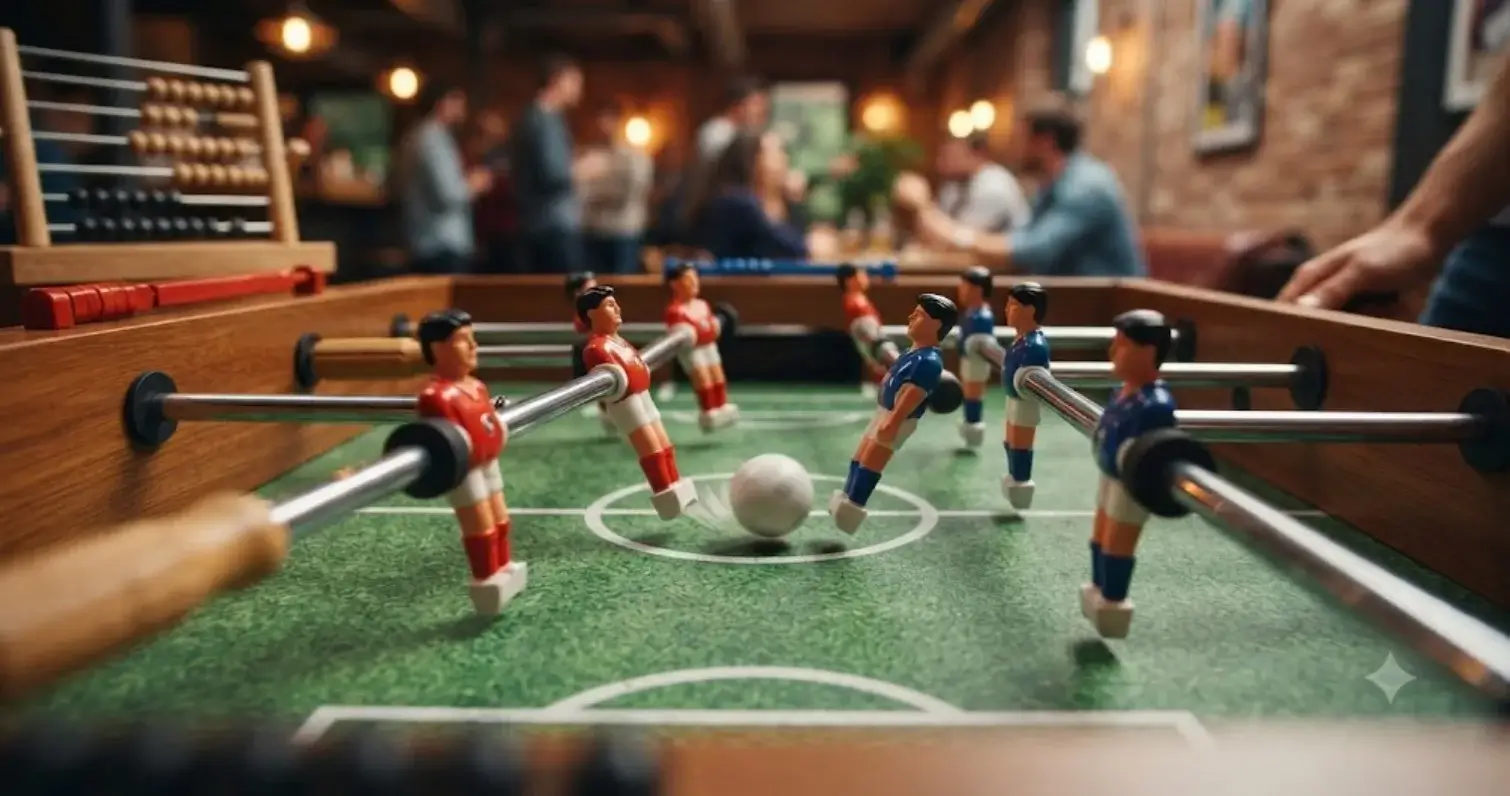
A foosball table asks for something valuable before you even play: floor space.
So, before buying one, it is fair to ask whether it offers more than occasional entertainment.
The good news is that foosball combines coordination, quick decisions, social competition, and active play surprisingly well.
Its biggest advantages come from what happens repeatedly during real matches, not from exaggerated health promises.
What Are the Main Benefits of Playing Foosball?
The benefits of foosball become clearer when you look at what a player actually does during a match.
You track movement, react under pressure, control your hands precisely, read an opponent, and make decisions within seconds.
Here is the practical picture:
| Benefit | What You Actually Practice |
| Hand-eye coordination | Matching ball movement with controlled rod movement |
| Reaction speed | Responding to shots, rebounds, and sudden passes |
| Fine motor control | Using small wrist movements with greater precision |
| Concentration | Following the ball while watching several playing figures |
| Decision-making | Choosing whether to pass, hold possession, defend, or shoot |
| Strategic thinking | Reading patterns and adjusting your approach |
| Stress relief | Taking an engaging break from routine tasks and screens |
| Social interaction | Playing face-to-face with friends, family, or coworkers |
| Teamwork | Coordinating responsibilities during doubles |
| Accessible recreation | Enjoying competition without running or contact |
That combination is what makes the benefits of playing foosball different from simply sitting with another indoor game.
A soccer table keeps your hands, eyes, attention, and opponent involved at the same time.
Physical Benefits of Foosball
Calling foosball a full workout would be a stretch.
You will not replace your morning run by dominating the five-bar.
Still, the game creates repeated physical demands involving coordination, timing, wrist control, and quick responses.
Improves Hand-Eye Coordination
Good foosball starts with seeing one thing and making your hands respond correctly.
The ball can change direction within fractions of a second. Your hands then have to position the right figure at the right place.
During a typical rally, you may need to:
- track a moving ball
- position a rod accurately
- time an interception
- catch or control a pass
- line up a shot
- react to an unexpected rebound
That continuous connection between visual information and hand movement explains why foosball hand-eye coordination is such an important part of improving.
Beginners often understand exactly where they want the player figure to go.
Their hands simply arrive late. With practice, movements usually become less frantic and more deliberate.
That does not prove foosball creates broad neurological improvements outside the game. Direct foosball-specific research is limited.
However, broader sports research shows that visual-motor training can improve measures such as hand-eye coordination and reaction performance under certain training conditions.
For a buyer, the practical takeaway is simpler:
Foosball repeatedly gives you a reason to coordinate what you see with what your hands do.
Develops Faster Reactions and Reflexes
Slow reactions get exposed quickly in table soccer.
A defensive opening may exist for less than a second.
A rebound can suddenly move from your opponent’s three-bar toward your goal.
You constantly react to:
- quick shots
- loose balls
- rebounds
- blocked passes
- changes in attacking direction
- sudden defensive movement
The interesting part is that experienced players do not merely become faster. They often become better at recognizing what deserves a reaction.
That matters. Moving every rod wildly is not a reflex strategy. It is mostly a good way to scare the bearings.
Experienced players tend to read positioning first, then respond.
Research in sports also suggests that skilled athletes can differ from less experienced participants in response speed and their ability to identify useful perceptual cues.
That does not mean a few evenings of foosball will suddenly give someone superhero reflexes.
It does mean the game regularly challenges reaction speed, visual attention, and timed movement.
Builds Fine Motor Control
Power gets attention in foosball. Control wins a surprising number of possessions. Moving a rod from one side to another is easy.
Stopping it exactly where you need it takes more skill. Better play involves small movements such as:
- adjusting a figure by a few millimeters
- cushioning a moving ball
- controlling shooting force
- keeping possession after a pass
- positioning the foot behind the ball
- changing wrist pressure during a shot
These are precision movements rather than strength movements. This is one reason simply hitting harder eventually reaches a ceiling.
A player who can catch, settle, position, and release the ball gains far more options. For buyers comparing foosball with passive game-room entertainment, this is an important distinction.
You are not only watching something happen. You are physically controlling every possession.
Keeps You Moving Without Feeling Like Exercise
Is foosball good exercise?
It provides movement, but it should not be treated as a substitute for regular exercise.
During longer sessions, players stand, shift their weight, reposition their arms, move around the table, and repeatedly operate the rods.
That makes foosball a form of active recreation rather than completely sedentary entertainment.
However, adults still need dedicated aerobic and muscle-strengthening activity.
Current CDC guidance recommends at least 150 minutes of moderate-intensity aerobic activity weekly for most adults, plus muscle-strengthening activity. Older adults also benefit from balance activities.
So, does foosball count as exercise?
It can contribute some movement. It should not be your entire fitness plan.
Think of it as a lively alternative to another hour sitting on the couch, not a replacement for walking, strength training, cycling, or other purposeful exercise.
Mental and Cognitive Benefits of Foosball
Foosball becomes mentally interesting once players stop chasing the ball and start controlling situations.
You must process movement quickly while deciding what your opponent is likely to do next.
That combination makes the mental benefits of playing foosball more practical than vague claims about “brain training.”
Improves Concentration and Visual Attention
Watching only the ball is rarely enough. At almost every moment, you are also judging:
- your opponent’s rod position
- open passing lanes
- defensive gaps
- your own figure placement
- likely rebounds
- available shooting angles
The better the opponent, the more expensive a brief lapse becomes. Look away at the wrong moment, and the ball may already be sitting behind your goalkeeper.
This makes foosball naturally demanding on attention. You are constantly filtering relevant movement from irrelevant movement.
For buyers who want something more mentally active than passive entertainment, that is one of the strongest foosball benefits.
Encourages Quick Decision-Making
A good possession creates choices.
- Do you shoot immediately?
- Do you control the ball first?
- Is the direct lane open?
- Will moving the defender create another opening?
- Should you pass instead?
Foosball repeatedly puts players in these small decision loops.
Beginners often make the first available move.
More experienced players learn that waiting half a second can sometimes create a much better option.
Research across team sports has found that perceptual-cognitive training can improve anticipation and decision-making measures, although improvements do not always transfer perfectly into real competition.
That limitation matters.
We should not claim playing foosball automatically improves everyday decision-making.
What we can reasonably say is that foosball gives players repeated practice making fast, game-specific decisions under pressure.
Develops Strategic Thinking
Fast hands alone eventually meet someone who knows where those hands are going. That is when strategy becomes important.
Advanced play involves thinking about:
- an opponent’s preferred blocks
- repeated shooting habits
- passing tendencies
- defensive positioning
- possession control
- timing changes
- deceptive movement
Suppose your opponent keeps covering the same lane. You can continue testing it and hope for a miracle.
Or you can deliberately establish one pattern, then attack somewhere else. That adjustment is part of the strategic thinking benefits of foosball.
The strongest players are rarely doing one thing faster than everyone else. They are often giving opponents several possibilities to worry about.
Encourages Pattern Recognition and Anticipation
After enough matches against someone, little habits become visible. Maybe they always shoot toward the near corner under pressure.
Perhaps they move the goalie before moving the two-bar. Maybe their five-bar pass always begins from the same setup.
Recognizing those patterns lets you start preparing before the ball actually moves. That is a valuable distinction.
Reaction means responding to something that happened. Anticipation means recognizing what may happen next.
Sports research consistently treats anticipation and perceptual cue recognition as important parts of skilled performance.
Foosball gives those processes plenty to work with. Your opponent is basically a puzzle with handles.
Foosball Can Be a Useful Stress-Relieving Activity
Sometimes the benefit is not developing another skill. Sometimes you simply need twenty minutes when your email inbox cannot score on you.
Foosball demands enough attention to interrupt routine thinking. During a competitive game, you are focused on possession, defense, shots, and your opponent.
That can make it an enjoyable recreational break. Other useful elements include:
- physical involvement
- short matches
- immediate feedback
- friendly competition
- laughter
- social contact
- a temporary break from screens
This is why foosball stress relief makes sense as a recreational benefit. Still, keep the claim realistic.
Foosball is not a treatment for anxiety, chronic stress, or another mental health condition.
And competitive personalities can occasionally turn a relaxing match into a courtroom dispute over whether the ball stopped moving.
The stress-relieving benefit works best when the game stays enjoyable.
Social Benefits of Playing Foosball
Some games require everyone to sit quietly and think.
Foosball gives people something to do together while conversation happens naturally around the action.
That makes its social value especially relevant for buyers choosing a game for shared spaces.
Makes Social Interaction Easier
Face-to-face conversation can sometimes feel forced, especially among people who do not know each other well.
Foosball changes the setting. Nobody needs to invent a conversation every ten seconds.
The game supplies:
- a shared objective
- something to react to
- natural pauses
- playful competition
- reasons to laugh
- easy opportunities for rematches
That works well in homes, recreation areas, clubs, schools, and other shared spaces.
A table soccer match can turn two people who barely spoke into opponents surprisingly quickly.
Five minutes later, someone is already demanding a rematch.
Encourages Friendly Competition
Competition gives ordinary games emotional weight. A blocked shot matters because someone tried to score it.
A comeback feels satisfying because someone else was trying to prevent it. Foosball supports this particularly well because games can remain short.
- Lose one?
- Reset the ball.
- Try again.
This creates room for playful rivalries without requiring an entire afternoon. For families and groups of friends, that repeatability is a real advantage.
Builds Teamwork in Doubles
Doubles changes the game completely. Now your decisions affect a partner. Players must communicate about:
- defensive coverage
- possession
- passing
- attacking responsibility
- switching positions
- adapting to mistakes
Good doubles partners also learn something important: Not every lost ball requires a committee investigation. You reset and defend the next possession.
That shared responsibility makes foosball team building more natural than activities where several people participate individually.
Benefits of Foosball for Families
Buying a game-room table usually comes with one major risk. It becomes furniture.
Foosball has a better chance of staying useful when several people in the household can actually enjoy it together.
Family games can be:
- started quickly
- stopped easily
- played one-on-one
- played in doubles
- rotated between several players
- enjoyed without another screen
The skill ceiling is high, but beginners can still participate almost immediately. That matters in homes with mixed ages.
A parent does not need to spend an hour explaining strategy before the first game begins. More importantly, the table gives families a recurring shared activity.
Not every match needs to become “family bonding.” Sometimes your brother just needs to learn that leaving the far post open has consequences.
Still, repeated offline activities create opportunities to spend time together. That is the real value behind foosball family bonding.
Benefits of Foosball for Kids
Children do not need every recreational activity optimized for development. Sometimes playing should simply be fun.
Foosball happens to combine fun with several useful challenges. During play, children can practice:
- tracking moving objects
- controlling hand movements
- concentrating on an opponent
- waiting for turns
- learning simple strategies
- managing frustration
- winning without gloating
- losing without melting into the carpet
The last two may require more practice than the pull shot. Foosball also provides a social activity without requiring children to stare at separate screens.
However, avoid turning these advantages into medical or developmental claims. There is no strong evidence showing foosball itself improves children’s cognitive development.
It simply creates an environment where coordination, attention, patience, and social play are repeatedly used.
For younger children, table height and safe access matter. A table that is uncomfortable to reach will reduce most of these advantages.
Is Foosball Good for Adults?
Adults often do not lack entertainment. We lack easy activities that pull several people into the same experience.
That is where the benefits of foosball for adults become interesting. A match offers:
- convenient indoor recreation
- mental engagement
- friendly competition
- a reason to step away from screens
- something to play with a partner
- an activity for visiting friends
- opportunities for family interaction
It also scales well with commitment. You can play three casual games. Or you can spend months learning controlled passes, defensive systems, and a reliable shot series.
That gives the game unusual longevity. A good football table does not require everyone in the house to become a serious player. It only needs enough interest to keep people returning.
Is Foosball Good for Seniors?
Foosball can work well for some older adults because it avoids running, jumping, tackling, and other high-impact movement. The potential advantages include:
- social interaction
- enjoyable competition
- hand-eye coordination practice
- visual attention
- light standing movement
- mentally engaging play
Social participation itself is especially relevant as people age.
The National Institute on Aging notes that social isolation and loneliness are associated with poorer health outcomes, while maintaining meaningful social connections can support well-being.
That does not mean foosball prevents dementia or other diseases. Those claims would go far beyond available evidence.
Its value is more practical: A shared game can provide another reason to interact, laugh, compete, and remain engaged with other people.
When Foosball May Not Suit a Senior Player
The game is not automatically comfortable because it is low impact. Potential difficulties include:
- arthritis
- wrist pain
- shoulder limitations
- poor balance
- difficulty standing
- reduced grip strength
- limited reach
Fast matches may also be tiring. Shorter sessions can help.
Some players may prefer slower games or seated play where the table setup permits it safely.
Older adults with health or mobility concerns should follow advice appropriate to their individual condition.
CDC guidance also emphasizes that older adults should choose physical activity according to their abilities and health circumstances.
Why Foosball Works Well as an Office Game
Foosball has become almost a cliché in office recreation spaces. That does not make it useless.
Its real benefit is not that a table magically improves productivity. A game cannot fix poor management with chrome rods.
What it can provide is a simple shared break. Office foosball works well because:
- matches can be brief
- two or four people can participate
- coworkers can interact informally
- departments can mix naturally
- the activity provides a non-screen break
- no complicated setup is required before each game
That creates opportunities for social interaction. It should be viewed as a recreational option, not evidence of workplace culture by itself.
A table nobody feels comfortable using is just very complicated office furniture.
What Skills Can You Develop by Playing Foosball?
Several foosball advantages overlap because one possession demands more than one skill. Here is the clearest way to separate them.
| Skill Area | Skills Used During Foosball |
| Physical | Hand-eye coordination, wrist control, timing, precision, reaction speed |
| Mental | Concentration, anticipation, decision-making, pattern recognition |
| Tactical | Passing choices, defensive positioning, possession management, shot selection |
| Social | Communication, teamwork, patience, sportsmanship |
These skills also explain why table soccer can stay interesting long after someone understands the basics.
You can always improve one layer. Maybe your reactions are fine, but your ball control is poor.
Maybe your offense works until someone recognizes your favorite shot. Maybe you play excellent defense and then immediately pass the ball back to your opponent.
Foosball has a very honest way of revealing the next thing you need to improve.
Is Foosball Actually a Good Game?
For the right buyer, yes. Foosball is especially strong when you want something that is:
- easy to begin
- difficult to fully master
- social
- competitive
- physically interactive
- suitable for short sessions
- playable with two or four people
- usable across a wide age range
Its accessibility is one of its greatest strengths. You do not need exceptional fitness to begin.
You also do not need to memorize dozens of rules before having fun.
At the same time, serious players can spend years developing passing series, shooting options, defensive reads, and controlled possession.
That combination gives foosball unusual replay value.
Who May Not Enjoy It?
Foosball is not automatically a good purchase for every household.
It may be less appealing when:
- nobody enjoys competitive games
- available space is limited
- players have wrist or mobility limitations
- household members strongly prefer solo games
- the table would rarely have two available players
That last point deserves thought before buying. The benefits of foosball come from playing.
A beautiful table used twice a year cannot improve your reflexes, teamwork, or family time through motivational energy alone.
Are There Any Downsides to Consider?
A balanced look at foosball benefits also needs the less exciting side.
Repetitive Movement Can Become Uncomfortable
Long sessions involve repeated wrist, forearm, shoulder, and standing movements. Take a break when something hurts.
Pain is not evidence that your snake shot is becoming more powerful.
Competition Can Become Frustrating
Friendly competition is a benefit until the “friendly” part disappears.
Matching players with reasonably similar skill levels can make recreational games more enjoyable.
Better Players Can Overwhelm Beginners
Foosball has a low entry barrier but a high skill ceiling.
An experienced player controlling possession against a complete beginner can make the game feel one-sided.
Playing slower, rotating partners, or avoiding advanced shots temporarily can create better games for mixed-skill groups.
Foosball Is Active Recreation, Not Complete Exercise
The game creates movement.
It does not provide the aerobic, strength, and balance training recommended for overall physical health.
Knowing that limitation actually makes the legitimate benefits easier to appreciate.
So, Is Playing Foosball Good for You?
Yes, provided we use “good for you” realistically.
Foosball gives players repeated opportunities to practice coordination, reaction, concentration, decision-making, strategy, and social interaction.
It also offers something increasingly valuable:
A reason for people to interact with each other instead of another screen.
For different buyers, the strongest benefit changes.
- Kids get an engaging activity involving coordination, patience, and social play.
- Adults get convenient recreation and competition.
- Families gain an activity several generations can share.
- Seniors may enjoy accessible social and mentally engaging recreation when the physical demands suit them.
- Coworkers get an easy format for brief, informal interaction.
That is why Foosball Junkie sees the strongest case for ownership beyond simple entertainment.
The table earns its space when people keep coming back to it.
And unlike many things bought for a game room, the better you become, the more interesting the game gets.
Frequently Asked Questions
What are the benefits of playing foosball?
The main benefits of playing foosball include hand-eye coordination practice, reaction speed, concentration, strategic thinking, social interaction, and teamwork.
It also provides active indoor recreation without requiring intense physical fitness.
Is foosball good for you?
Foosball can be a beneficial recreational activity because it combines movement, visual attention, decision-making, and social interaction.
However, it should not be presented as medical treatment or a replacement for regular exercise.
Is foosball good exercise?
Foosball involves standing, arm movement, wrist movement, and positional shifts.
It provides more physical activity than completely sedentary entertainment, but it is not a replacement for cardiovascular or strength exercise.
Does foosball improve hand-eye coordination?
Foosball repeatedly requires players to match visual information with precise hand movements.
Regular play therefore practices hand-eye coordination, although research proving broader coordination improvements specifically from foosball remains limited.
Does foosball improve reaction time?
Fast play repeatedly challenges players to respond to shots, passes, blocks, and rebounds.
Players may become quicker within game-specific situations as they improve, but foosball should not be claimed to universally improve reaction time outside the game.
Is foosball good for your brain?
Foosball is mentally engaging.
It requires concentration, anticipation, pattern recognition, and rapid decision-making.
However, there is currently not enough direct evidence to claim that playing foosball prevents cognitive decline or produces specific neurological health benefits.
Can playing foosball help relieve stress?
An enjoyable match can provide a recreational break from work, screens, and routine concerns.
Social interaction and friendly competition may also make the experience relaxing.
Foosball is not a treatment for chronic stress or a mental health condition.
Is foosball good for kids?
Foosball can provide children with opportunities to practice coordination, patience, concentration, sportsmanship, and social interaction.
Table height and age-appropriate supervision should also be considered.
Is foosball good for seniors?
It can be.
Foosball offers social interaction, mental engagement, coordination practice, and relatively low-impact recreation.
People with arthritis, balance difficulties, wrist problems, or other mobility limitations may need shorter sessions or another suitable activity.
What skills does foosball develop?
Foosball regularly uses hand-eye coordination, timing, wrist control, reaction speed, concentration, anticipation, strategic thinking, communication, and teamwork.
Most improvement is game-specific and develops through repeated practice.
Sources and Further Reading
For physical activity recommendations, see the U.S. Centers for Disease Control and Prevention guidance for adults and older adults. CDC Physical Activity Guidelines
For information on social connection and healthy aging, see the National Institute on Aging. NIA: Loneliness and Social Isolation
For research on anticipation and decision-making in sports, see this systematic review and meta-analysis indexed by PubMed. Perceptual-Cognitive Training Research
For research concerning visual-motor training, reaction time, and hand-eye coordination in athletes, see this systematic review indexed by PubMed. Visual-Motor Training Research