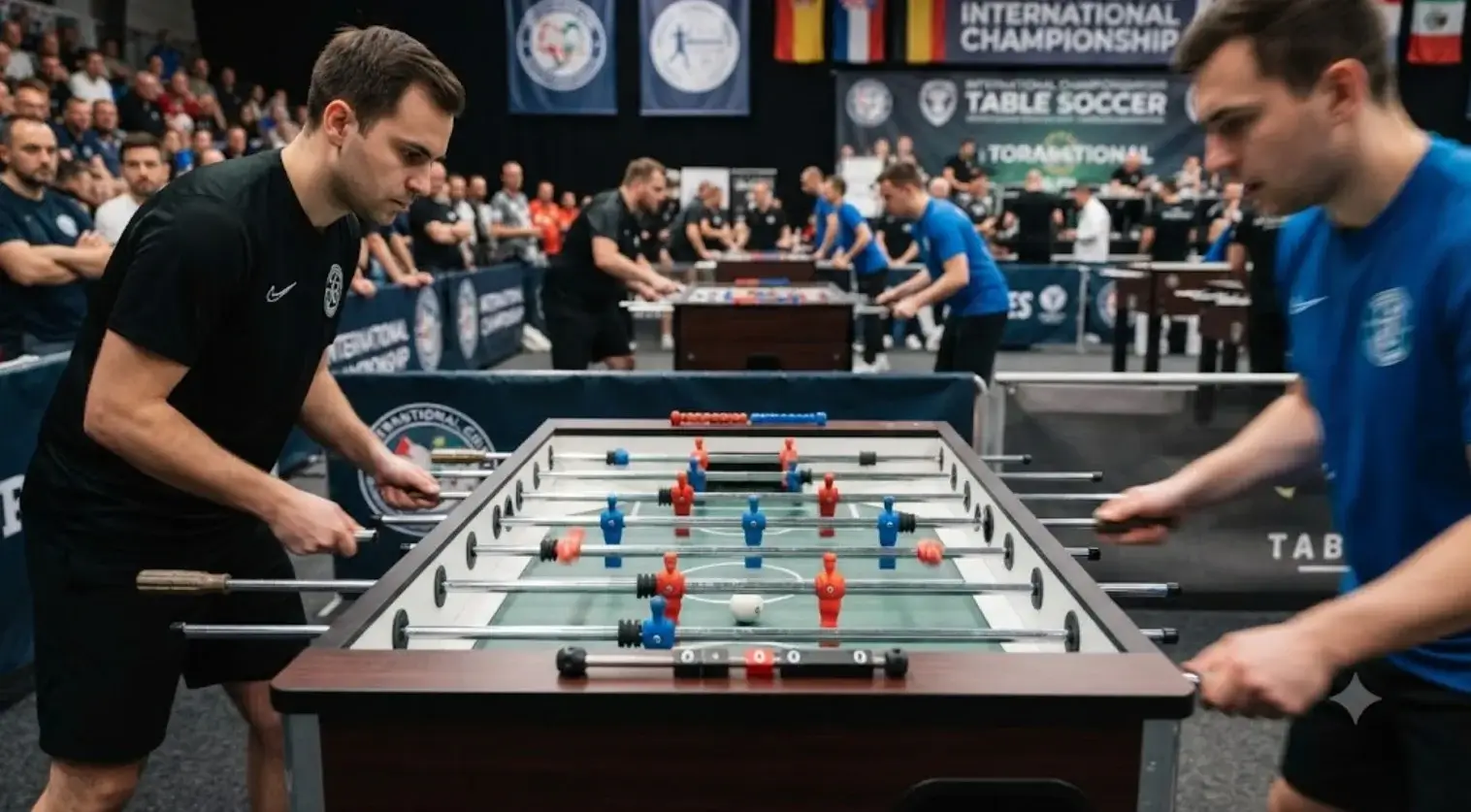
Buying a competition-style foosball table should be straightforward.
Then you meet ITSF, WFT, IFP, national associations, regional groups, and local clubs. Each name sounds official, but these organizations do very different jobs.
Understanding the structure helps buyers avoid expensive compatibility mistakes. It also shows which rules, tables, and playing styles matter locally.
Who Governs Foosball Worldwide?
The International Table Soccer Federation, commonly called ITSF, represents table soccer at the international level.
ITSF describes itself as the world organization representing the game of table soccer. It maintains rules, member associations, educational resources, international rankings, and competition structures.
However, ITSF is not the only organization buyers will encounter.
National associations manage domestic development. Professional tours organize competitive circuits. Local clubs connect players within towns and cities.
Here is the simplest way to understand the system:
| Organization | Type | Main role | Why buyers should care |
| ITSF | International federation | Global rules, representation, standards, and member coordination | Helps identify internationally used rules and table classifications |
| USA Foosball | National association | Supports organized foosball across the United States | Shows where Americans play and how national competition is organized |
| World Foosball Tour | Professional tour | Runs a competitive circuit, rankings, and events | Relevant for buyers preparing for WFT-style competition |
| International Foosball Promotions | Tournament promoter | Historically promoted and sanctioned American events | Appears frequently in older tournament records and player discussions |
| Local foosball club | Community organization | Provides regular play, practice, leagues, and local events | Often determines which table style a buyer should practice on |
The important takeaway is simple.
A federation governs. A tour organizes competition. A club builds the local playing community.
Those roles can overlap, but they are not interchangeable.
What Is a Foosball Federation?
A foosball federation coordinates the sport across a country, region, or international network.
The organization may use the word federation, association, union, or organization. The exact title matters less than its responsibilities.
A legitimate foosball governing body may handle:
- Official playing rules
- Referee development
- National representation
- Member association standards
- Player eligibility
- Disciplinary procedures
- Technical table standards
- Education programs
- Youth participation
- Inclusive competition
- International coordination
Not every foosball association performs every function.
Some focus heavily on recreational growth. Others manage national teams, official rankings, or international relationships.
That difference matters when researching equipment.
A seller may describe a football table as “professional” without identifying any rule system or organization. The word alone proves very little.
A recognized competitive connection provides more useful context.
What Is the International Table Soccer Federation?
The International Table Soccer Federation is the main international entity within organized foosball.
ITSF is the correct official name.
People sometimes search for:
- International foosball association
- International foosball federation
- World foosball association
- International federation of table soccer
- International soccer table federation
- International federation of table football
These phrases usually point toward ITSF, even when the word order is incorrect.
ITSF uses “table soccer” in its official name. In casual American conversation, most players simply say foosball.
Both terms refer to the same core game.
What Does ITSF Do?
ITSF provides an international framework for member federations and competitive table soccer.
Its website gives players access to rules, rankings, member information, education, tournaments, and World Cup resources.
Its current committee structure includes areas such as:
- Rules and referees
- Membership
- Discipline
- Appeals and recourse
- Education
- Youth development
- Women’s participation
- Accessibility
- Technical matters
- Data management
- Tournament assessment
- Legal affairs
- Sport development
This structure shows that a federation does more than publish tournament dates.
It also creates systems for accountability, education, participation, and consistent administration.
ITSF also publishes anti-doping rules, referee guidance, matchplay rules, safeguarding contacts, and specialized game formats.
That level of structure separates a governing federation from a simple event promoter.
How ITSF Membership Works
ITSF organizes its member associations through five continental groups:
- Africa Confederation
- Asia Confederation
- Europe Confederation
- Latin America Confederation
- North America Confederation
National associations operate within those broader regional structures.
An organization applying for membership must provide formal documentation.
ITSF requests government registration, nonprofit recognition, and organizational statutes or a constitution. It also asks federations to complete additional governance documentation.
This matters because anyone can build a website and call a group an association.
Formal membership requires considerably more than a logo and a contact form.
Why ITSF Matters to Foosball Buyers
Most home buyers will never submit a federation application or attend an international meeting.
ITSF can still influence their buying decision.
The federation identifies official and recognized competition tables. That information helps competitive buyers understand which playing systems exist internationally.
As of July 22, 2026, the ITSF website lists these official tables:
- Bonzini
- Leonhart
- Tornado
- Garlando
- Roberto Sport
It separately lists Rosengart, Ullrich Kicker, and Jiuxing Sports as recognized tables. It also lists Infinity Val in its two-leg table category.
These classifications can change. Buyers should check the official partner page before making a competition-focused purchase.
An Official Table Is Not Automatically Your Best Table
ITSF classification provides useful information.
It does not guarantee that a particular table suits every room, family, or playing goal.
Official tables can offer:
- Competition-relevant practice
- Established playing characteristics
- More standardized components
- Familiarity for tournament players
- Access to established player communities
- A clearer connection to organized table soccer
However, they may also present limitations:
- Different brands reward different techniques
- A local community may use only one table style
- Some designs require significant playing space
- Commercial features may not suit young children
- Parts availability can vary by location
- A competition feel may not suit casual family play
A federation logo cannot measure your room.
It also cannot tell whether your children need telescopic rods or whether parts ship easily to your area.
Buyers should treat official status as a compatibility signal, not a complete quality verdict.
What Do National Foosball Associations Do?
National foosball associations connect international structures with players inside one country.
Their responsibilities vary.
A national association may coordinate:
- National teams
- Domestic rules
- Player registration
- Referee education
- Local club development
- National representation
- Communication with ITSF
- Competitive standards
- Player and community resources
National organizations also help buyers understand the local playing environment.
A table popular internationally may have little community support in your city. Another table may dominate nearby clubs and leagues.
That local information can matter more than global popularity.
What Is the American Foosball Association?
“American Foosball Association” is a common search phrase.
The current organization uses the name USA Foosball and identifies itself as the United States Foosball Association.
Its website includes a board of directors, organizational documents, club listings, tournaments, rankings, and brackets. It also identifies the organization as a nonprofit public charity.
For American buyers, USA Foosball can answer a practical question:
What equipment and playing communities exist near me?
The organization’s club directory includes locations, playing schedules, and table availability where provided.
That information can prevent a common buying mistake.
A player may purchase a European-style table, then discover every nearby competitive group plays on another system.
The European table may still be excellent. It simply may not match the buyer’s competitive goal.
Federation vs Association: Is There a Difference?
In foosball, “federation” and “association” often describe similar governing organizations.
One country may use “federation.” Another may prefer “association,” “union,” or “organization.”
The title alone does not establish authority.
Consider these questions instead:
- Does the organization publish governance documents?
- Does it identify responsible officers or directors?
- Does it represent a country or defined region?
- Does it provide rules or administrative standards?
- Does it have recognized members or affiliations?
- Does it maintain active contact information?
- Does it clearly explain its responsibilities?
A serious organization should make its purpose understandable.
Buyers should be cautious when a group uses an impressive name but provides no leadership, rules, documents, or current activity.
In foosball, as on the table, control matters more than noise.
Is the World Foosball Tour a Federation?
No. The World Foosball Tour, or WFT, operates as a professional competitive tour.
Its current website provides tournament schedules, results, player rankings, points information, registration, rules, and playing locations.
That makes WFT an important foosball organization.
It does not make it the global governing federation.
WFT administers its own competitive tour, including its rules, rankings, points, and events. ITSF represents the broader international federation structure.
The distinction is similar to other sports:
- A federation oversees broader governance
- A tour operates a series of competitions
- A promoter runs or supports individual events
- A club organizes local participation
The word “World” can confuse buyers.
A global-sounding name does not automatically mean an organization governs every country or every style of play.
Why WFT Matters to Buyers
WFT matters most to players interested in its competitive circuit.
A prospective competitor should research:
- The table used at nearby WFT events
- The rules applied during those events
- Local practice opportunities
- Replacement parts
- Ball and figure characteristics
- Whether the table matches the player’s preferred style
Do not buy a table based only on a tour logo.
Check the actual event setup first.
Tournament equipment and rules can evolve. Official event information remains the safest source.
For detailed event types, formats, and entry paths, read the Foosball Junkie tournament guide.
What Is IFP Foosball?
International Foosball Promotions, usually shortened to IFP, is a well-known name in the history of American professional foosball.
IFP has been associated with promoting, sanctioning, and organizing competitive events. It should not be described as an international governing federation.
Older tournament records, player profiles, videos, and community discussions may reference:
- IFP foosball
- IFP Pro Foosball Tour
- IFP tournaments
- International Foosball Promotions
- IFP rankings
- IFP World Championships
These references remain useful when researching the development of professional foosball in the United States.
However, buyers should not assume that every older IFP schedule, ranking, rule, or organizational page reflects the current competitive structure.
The World Foosball Tour now maintains current resources for its own events, rules, rankings, points, and registration.
The practical distinction is simple.
ITSF is an international federation. IFP is associated with event promotion and professional competition. WFT operates a current competitive tour.
These organizations have influenced competitive foosball in different ways, but they should not be presented as the same type of organization.
Federation vs Tour vs Club
These terms appear together frequently, but their purposes differ.
| Type | Main audience | Typical responsibilities | Buyer relevance |
| International federation | National associations and international competitors | Governance, international rules, representation, technical standards | Helps identify international systems and table classifications |
| National association | Players and organizations within one country | National representation, development, administration, clubs | Reveals local playing structures |
| Professional tour | Competitive players | Events, rankings, points, registration, tour rules | Helps players prepare for a particular circuit |
| Tournament promoter | Event participants | Promotion, sanctioning, logistics, scheduling | Useful when researching specific competitions |
| Local club | Local players | Practice nights, leagues, instruction, community play | Often provides the best evidence for which table to buy locally |
Should Buyers Care About Foosball Clubs?
Yes, but clubs are not governing bodies.
A local club may influence your playing life more directly than an international federation.
Clubs can show you:
- Which tables players use regularly
- Which balls and rules feel normal locally
- Whether replacement parts are easy to obtain
- What techniques dominate nearby competition
- Whether beginners receive coaching
- How active the local community remains
USA Foosball currently includes a dedicated club directory, showing how national organizations and local communities can connect.
However, this article does not need a long club directory.
Your local club choice depends on geography and availability. The organizational distinction matters more here.
How Foosball Organizations Affect Table Design
Federations do not make every football table identical.
Competitive foosball includes several established table systems.
Different designs may change:
- Ball grip
- Rod speed
- Figure shape
- Passing control
- Bank-shot behavior
- Pinning ability
- Defensive spacing
- Shooting technique
This is one reason official table categories matter.
An international player may need to adapt across several surfaces. A local specialist may train mostly on one.
For buyers, neither approach is automatically better.
Multi-Table Buyers
A multi-table approach works best for buyers who:
- Expect to compete internationally
- Have experience on several brands
- Understand the differences between playing systems
- Have enough space and maintenance capacity
- Need broad technical adaptability
It may not suit casual families or first-time buyers.
Owning several tables does not automatically create an adaptable player. It can simply create several surfaces that need cleaning.
Local Competition Buyers
A local competition approach suits buyers who:
- Plan to join nearby leagues
- Want relevant home practice
- Know which table local players use
- Prefer one consistent ball and figure system
- Have a clear competitive path
This is often the most practical strategy.
A buyer who practices on the local competition table reduces the adjustment needed before organized matches.
Recreational Buyers
Recreational buyers may not need federation-specific equipment.
They should prioritize:
- Safe rods
- Stable construction
- Suitable table dimensions
- Comfortable handles
- Reliable replacement parts
- Appropriate player height
- Manageable maintenance
- A playing feel the household enjoys
An ITSF connection can still be interesting.
It should not override safety, space, or household needs.
How to Choose a Table Using Federation Information
Federation research becomes useful when it changes a buying decision.
Use this process before ordering a competition-inspired table.
1. Define Your Real Playing Goal
Decide what you actually expect from the table.
Are you buying for:
- Family recreation?
- Regular adult matches?
- Skill development?
- Local league preparation?
- WFT competition?
- International multi-table practice?
- A commercial venue?
- A school or youth program?
A buyer preparing for organized competition has different needs from a family playing twice weekly.
2. Check Your Local Playing Community
Find nearby clubs, leagues, and experienced players.
Ask which table appears most often.
Common buyer regret comes from choosing a famous table that nobody nearby uses.
Local compatibility supports:
- More relevant practice
- Easier coaching
- Familiar ball behavior
- Better technique transfer
- Stronger community participation
A premium table can still be the wrong training tool.
3. Verify the Organization’s Current Website
Do not rely only on old forum posts.
Check whether the association or tour currently publishes:
- Active leadership
- Updated rules
- Current documents
- Club information
- Contact details
- Table classifications
- Recent announcements
Foosball organizations change over time.
A page ranking well in search may describe a structure that no longer operates identically.
4. Understand the Table’s Status
ITSF currently separates official, recognized, and specialized table categories.
Read the wording carefully.
“Official,” “recognized,” “tournament-style,” and “professional” do not always mean the same thing.
A retailer’s description may also differ from federation terminology.
5. Study the Playing Characteristics
Organization status does not explain the entire playing experience.
Research:
- Rod type
- Figure feet
- Surface grip
- Ball material
- Goalie configuration
- Bearing system
- Corner design
- Handle shape
- Cabinet stability
These features influence whether your existing techniques transfer comfortably.
6. Check Parts and Service Support
A competitive table can remain useful for many years.
That depends partly on replacement support.
Before buying, investigate access to:
- Figures
- Rods
- Bearings
- Bumpers
- Handles
- Balls
- Score units
- Leg components
- Surface maintenance guidance
A federation connection cannot repair a bent rod.
Reliable parts support matters more after the excitement of delivery fades.
Pros and Cons of Buying a Federation-Recognized Table
A recognized table can offer clear benefits, but buyers should understand the tradeoffs.
Potential Advantages
- Strong connection to organized play
- Established playing characteristics
- More relevant competition practice
- Greater familiarity among experienced players
- Clearer rule and event context
- Possible access to established parts ecosystems
- Better long-term technical learning
Possible Limitations
- The table may not match local competition
- Certain styles require an adjustment period
- Commercial designs may not suit small children
- Some tables need more maintenance
- Parts access varies by country
- Competition features may be unnecessary at home
- Official status does not guarantee the best personal value
The best choice depends on the buyer’s environment.
For one player, official status may be essential. For another, it may add complexity without meaningful benefit.
How to Spot a Trustworthy Foosball Organization
A trustworthy organization should provide evidence of real activity.
Look for these signals:
- Clearly named leadership
- Public governance documents
- Updated contact information
- Defined geographic responsibilities
- Published rules or procedures
- Recognized members or affiliations
- Recent activity
- Transparent organizational purpose
- Safeguarding or conduct policies
- Clear separation between governance and promotion
ITSF publishes an executive structure and specialized commissions. USA Foosball publishes a board and organizational resources. WFT provides active tour resources and rules.
No organization needs a perfect website. However, buyers should expect enough information to confirm who runs it and what it actually does.
Frequently Asked Questions
What is the main international foosball governing body?
The International Table Soccer Federation is the main worldwide organization representing organized table soccer.
It is commonly abbreviated as ITSF.
What does ITSF stand for?
ITSF stands for International Table Soccer Federation.
“International Federation of Table Soccer” and “International Soccer Table Federation” are common reordered searches, but they are not the official name.
Is ITSF the same as the World Foosball Tour?
No.
ITSF is an international federation. The World Foosball Tour operates a professional competitive circuit with events, rankings, points, and tour rules.
Is WFT a foosball governing body?
WFT governs and administers matters within its own tour.
It should not be described as the worldwide federation for all table soccer.
Is IFP a foosball federation?
International Foosball Promotions is better understood as a tournament promoter and event-sanctioning organization.
Older American competition records often reference IFP.
What is the official American foosball association?
USA Foosball currently identifies itself as the United States Foosball Association.
People may also search for the American Foosball Association, U.S. Foosball Association, or USA Foosball Association.
Are foosball clubs part of federations?
Some clubs may connect with national associations or federation programs.
Others operate independently.
A club provides local participation. It does not automatically function as a national governing organization.
Should I buy an ITSF official table?
Consider one when international competition, multi-table development, or recognized equipment matters to your goals.
For local competition, first check what nearby players use.
For family recreation, prioritize safety, space, stability, and parts support.
Does official recognition guarantee the best foosball table?
No.
Official recognition shows a connection to organized competition. It does not guarantee the table fits every home, player, or budget.
Is foosball the same as table soccer?
Yes.
Foosball, table soccer, and table football describe the same general game. Regional wording differs.
“Football table” usually refers to the physical table itself.
Where can I learn about tournaments and player rankings?
Read the Foosball Junkie tournament guide for event formats and competition levels.
For rankings and leading competitors, see the best foosball players in the world guide.
Final Takeaway
Foosball has no shortage of official-sounding names.
The structure becomes easier once you separate governance from competition.
ITSF represents table soccer internationally. National associations support the sport within individual countries. WFT operates a professional tour. IFP remains important in American competition history. Local clubs connect the entire structure with everyday players.
For buyers, federation research should answer one practical question:
Will this table support the way I actually plan to play?
Check local equipment, current rules, table classifications, parts support, and community access.
A respected logo can provide useful context. It cannot replace careful buying research.
At Foosball Junkie, the goal is not to push every buyer toward one competitive system.
It is to help you choose a table that fits your room, skills, local scene, and long-term plans.
Official Resources
- International Table Soccer Federation resources
- USA Foosball, the United States Foosball Association
- World Foosball Tour official resources
Information last verified: July 22, 2026.