Kettler Carrara Outdoor Foosball Table Review
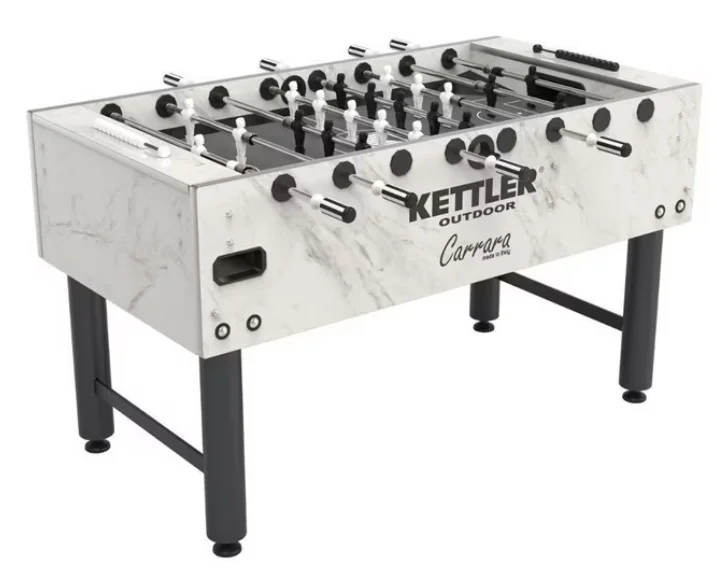
Official specifications show that Carrara and Marquina share the same listed dimensions, assembled weight, KETT-TEC field, warranty periods, accessories, and main playing hardware. Their most obvious difference is cabinet appearance.
It is lighter, shorter, and built around a glass playing surface. That makes it more than a color variation, but not necessarily a better Kettler value. er Carrara Outdoor Foosball Table Review
Carrara is the clearest expression of Kettler’s approach.
It combines outdoor-capable construction with a decorative cabinet, telescopic rods, European play geometry, and enough physical weight to feel substantial in a residential setting.
Why Carrara Represents Kettler Best
Carrara includes:
- KETT-TEC weather-resistant playing field
- Anti-rust chromium-plated telescopic rods
- Molded resin players
- Nylon rod bushings
- Rubber-inlay elongated handles
- Single 360-degree rotating goalie
- Raised side and corner rails
- Integrated ball entry
- Side ball-return pockets
- Resin scoring blocks
- Powder-coated steel legs
- Adjustable floor levelers
- Five cork balls
- Five resin balls
- Protective weather cover
Kettler lists the assembled table at 58 inches long, 46 inches wide, 34 inches high, and 135 pounds. It requires assembly and carries both residential and commercial warranty coverage. The feature set is more complete than Milano’s in several small but meaningful areas.
The rubber-inlay handles improve grip. The heavier cabinet should resist movement better. The KETT-TEC field also fits the table’s outdoor purpose more naturally than Milano’s glass surface.
How Carrara’s KETT-TEC Field Changes the Game
KETT-TEC is Carrara’s defining performance feature.
Kettler describes it as an all-weather playing field, paired with rails that keep the ball away from dead corners. With Milano’s glass, the surface should provide a less slippery playing experience.
Cork balls are the better starting point for buyers who value catches, short passes, pins, and measured possession. Resin balls produce a quicker game and may suit families who prefer constant rebounds over technical control.
The raised corners support Carrara’s single-goalie system, but buyer feedback suggests the geometry is not flawless.
One owner praised the rods while criticizing limited goalie reach, dead spots, table movement, and leg holes that did not align correctly. Another reviewer disliked how the ball played off the corners.
Those reports matter because they concern the play system itself.
Carrara can still provide enjoyable family table soccer, but serious players may notice compromises around defensive coverage and ball recovery.
Where Carrara Feels Worth Its Premium Position
Carrara has several advantages within the Kettler range.
- It has the heavier cabinet: At 135 pounds, it carries 20 pounds more assembled weight than Milano. That does not guarantee zero movement, but it gives Carrara the stronger starting point.
- The handles receive more attention: Kettler includes rubber inlays, which can improve comfort and grip during longer matches.
- The field suits its intended environment: KETT-TEC is presented specifically as a weather-resistant playing surface.
- It receives better warranty positioning: Carrara has a listed commercial warranty in addition to residential coverage.
- The supplied review signal is stronger: The Amazon data provided for this review showed a higher rating and more customer feedback for Carrara than Milano.
Owners have also praised Carrara’s appearance, sturdy frame, smooth telescopic rods, packaging, and ability to withstand active family or community use.
Where Carrara Falls Short
Carrara still attracts complaints that should concern demanding buyers.
Reported problems include:
- Leg mounting holes not aligning
- Cabinet movement during hard shots
- Goalie travel that does not fully cover the goal
- Dead spots around raised corners
- Sticky rods after outdoor exposure
- Warped rail material
- Freight or cabinet damage
- Ball behavior that feels weaker than expected
These issues come from individual customer experiences, not controlled product testing. However, they cover several different ownership stages, including delivery, assembly, outdoor exposure, and actual gameplay.
The movement complaint deserves context.
A 135-pound table is not light, but hard pull shots and aggressive lateral movements can still shift a cabinet if the floor levelers are poorly adjusted or the surface is slick. A rubber mat may help, but buyers should not need accessories to correct severe instability.
Sticky rods also require immediate attention.
Before applying any lubricant, consult the Kettler manual. Avoid household oils or corrosive cleaners that may damage bushings, collect dirt, or conflict with warranty requirements.
Carrara Pros and Cons
Pros
- Purpose-built outdoor-capable field
- Safer telescopic rod system
- Heavier than Milano
- Comfortable rubber-inlay handles
- Attractive marble-style cabinet
- Cork and resin balls included
- Protective cover included
- Residential and commercial warranty periods
- Better-supported choice within the Kettler range
Cons
- Some reports of difficult leg alignment
- Corner system may leave dead areas
- Goalie reach can feel restricted
- Hard shots may move the table
- Outdoor exposure still requires active protection
- Mixed durability reports
- Not a substitute for a tournament-focused indoor table
Carrara Verdict
Carrara is the best Kettler foosball table in this comparison.
It delivers the brand’s outdoor identity more convincingly than Milano. The KETT-TEC surface, heavier frame, rubberized handles, and stronger warranty positioning make its compromises easier to accept.
It is best suited to a protected patio or screened recreation area where owners will use the supplied cover.
Competitive players should remain cautious. Carrara looks substantial, but reported dead spots, goalie limitations, and cabinet movement keep it from becoming an automatic performance recommendation.
Kettler Milano Outdoor Foosball Table Review
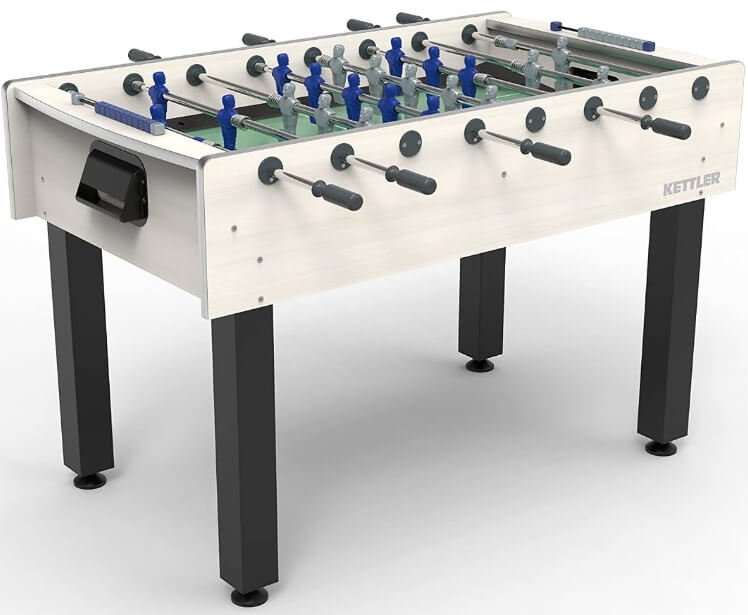
Milano follows the same basic Kettler blueprint but changes one major component.
Its tempered-glass field creates a faster and visually cleaner playing surface. That difference defines both its appeal and its limitations.
Milano’s Main Difference Is Its Glass Field
Milano includes:
- High-speed tempered-glass playing field
- Chromium-plated telescopic rods
- Nylon bushings
- Molded resin players
- Elongated handles
- Single rotating goalie
- Raised corner ramps
- Powder-coated steel legs
- Adjustable floor levelers
- Navarra Pine-look cabinet
- Resin scoring blocks
- Ball-return pockets
- Five cork balls
- Five resin balls
- Protective cover
The official assembled dimensions are 52 inches long, 46 inches wide, and 35 inches high. Milano weighs 115 pounds and requires assembly. Therefore has a smaller and lighter cabinet than Carrara.
Its pale wood-look finish may blend more naturally with coastal patios, Scandinavian interiors, or lighter outdoor furniture. For some buyers, that appearance will be the primary attraction.
The Glass Field Is Both Its Feature and Its Compromise
Glass creates a distinct playing character.
The surface is hard, smooth, and fast. Passes can travel quickly, rebounds stay lively, and poorly controlled balls escape more easily.
That can make casual games exciting.
It can also make possession more difficult, especially for players learning controlled catches and lateral passes. Cork balls should provide the calmer of the two supplied options, while resin balls will emphasize speed.
Milano’s field is easier to wipe clean than a textured surface, but owners must inspect it carefully after freight delivery.
Kettler explicitly states that the glass playing field is not suitable for commercial use. This limits the table’s appeal for offices, rental properties, clubs, hospitality areas, or other high-traffic locations.
Why Milano Is Hard to Recommend at Full Retail
Milano is difficult to recommend unconditionally for four reasons.
- It is lighter than Carrara: The 20-pound difference may be noticeable during aggressive games.
- It lacks Carrara’s listed commercial warranty: That matters even for residential buyers because it reflects how Kettler positions each model.
- Its defining field has a usage restriction: The glass surface is fast, but Kettler does not approve it for commercial use.
- The supplied customer evidence is limited: The Amazon snapshot provided for this review showed a 3.6 rating from only eight reviews. That is a weak evidence base for a premium purchase.
A small review count does not prove that Milano is unreliable.
It means buyers have less owner evidence available to offset the risks of freight delivery, assembly, long-term outdoor exposure, and glass-field performance.
When Milano Might Still Make Sense
Milano may suit a buyer who:
- Strongly prefers the Navarra Pine appearance
- Wants a faster playing field
- Plans to use cork balls for added control
- Will place the table under a roof
- Needs telescopic rods around children
- Expects residential rather than commercial use
- Finds it at a meaningful discount
- Accepts limited customer-review evidence
It works best as a design-led purchase.
Someone buying primarily for competitive control, maximum stability, or proven durability should choose a different direction.
Milano Pros and Cons
Pros
- Distinctive Navarra Pine-look cabinet
- Fast tempered-glass field
- Telescopic safety rods
- Raised corners for single-goalie play
- Ten balls included
- Protective cover included
- Floor levelers for uneven surfaces
- Suitable for indoor or managed outdoor placement
Cons
- Lighter than Carrara
- Glass is less forgiving for controlled play
- Field is officially unsuitable for commercial use
- No listed commercial warranty
- Limited review evidence
- Still requires careful outdoor protection
- Glass should be inspected closely after delivery
Milano Verdict
Milano is attractive, fast, and clearly different from Carrara.
Its problem is not a lack of features. The problem is that its most important feature creates another compromise.
The glass field adds speed, yet Kettler limits it to noncommercial use. The cabinet is also lighter, and available customer evidence remains thin.
Milano can make sense for a protected residential patio where appearance matters greatly. It is not the strongest Kettler value for buyers prioritizing proven performance.
Carrara vs. Milano: Which Kettler Compromise Is Easier to Accept?
Neither model gives every buyer everything.
Carrara asks buyers to accept some reported play and assembly issues in exchange for a heavier, more outdoor-focused design.
Milano asks buyers to accept a lighter cabinet, limited review evidence, and a noncommercial glass field in exchange for faster play and different styling.
Choose Carrara For
- KETT-TEC playing surface
- Heavier assembled cabinet
- Rubber-inlay handles
- Better warranty positioning
- More available owner feedback
- Stronger alignment with outdoor residential use
- A marble-look cabinet
Choose Milano For
- Navarra Pine appearance
- Fast glass-field play
- A slightly smaller cabinet
- Residential use only
- A design-led patio installation
- Buyers who prefer speed over controlled possession
Honest Winner
Carrara is the safer Kettler purchase.
Its field, weight, handles, and warranty support the brand’s outdoor promise more convincingly.
Milano is different, but different does not automatically mean better value.
Neither model should be promoted primarily to competitive players. Buyers seeking tournament-style control should compare purpose-built indoor tables before committing to an outdoor design.
Kettler Foosball Assembly: What Owners Should Expect
Both Carrara and Milano require assembly.
Carrara’s item number is 7399-600. Its shipping package weighs about 190 pounds, while the assembled table weighs 135 pounds.
Milano’s item number is 7099-200. Its package weighs about 172 pounds, while the assembled table weighs 115 pounds. Shipping weights make this a two-adult job.
The main challenge is not understanding where every screw goes. It is safely handling a large cabinet while protecting its finish, field, rods, and mounting points.
Inspect the Delivery Before Assembly
Kettler advises customers to check the packaging and product condition during delivery.
Visible damage should be noted on the delivery notice. Shipping damage claims should be reported promptly, and Kettler’s current policy requests reports within three days for purchases made through its website. Discarding the packaging, inspect:
- Cabinet corners
- Side panels
- Playing field
- Glass surface on Milano
- Rods and handles
- Leg mounting points
- Corner ramps
- Score counters
- Ball pockets
- Included hardware
- Cork and resin balls
- Protective cover
Photograph any damage before starting assembly.
This evidence may be important if the table arrived with a cracked panel, bent component, damaged field, or missing hardware.
Check Carrara’s Leg Mounting Points
One Carrara owner reported that the holes in the legs did not align with the mounting positions on the cabinet. The reviewer used a rubber mallet to force the legs into place.
Do not immediately force misaligned components.
First confirm:
- Each leg is in the correct position.
- The cabinet has not been twisted during handling.
- Bolts have not been fully tightened too early.
- Packaging material is not blocking a joint.
- The mounting plate is not bent.
Loosely start all bolts before tightening them in sequence. This allows minor movement while the legs settle into position.
Contact the seller or Kettler if the holes remain significantly misaligned. Forcing a structural component may damage the finish, threads, or mounting plate.
Level the Table Before Judging Its Play
Uneven flooring can create false dead spots and make the cabinet feel unstable.
Place the assembled table in its final location before adjusting the levelers.
Use a bubble level across:
- Both cabinet ends
- Both long side rails
- The center of the playing field
Make small adjustments, then test the ball from several positions.
A properly leveled field will not correct every raised-corner issue, but it prevents the floor from adding new problems.
Test Every Rod Immediately
Move each telescopic rod through its complete range.
Check for:
- Sticking
- Scraping
- Bent movement
- Uneven resistance
- Loose handles
- Restricted goalie travel
- Contact between players and the field
One owner reported sticky rods after outdoor exposure, while another praised the telescopic movement.
That contrast makes early testing important.
Report a damaged or severely binding rod before the return or claim period closes. Do not assume it will correct itself after months of use.
Kettler Problems to Inspect Before the Return Window Closes
A large freight-delivered game table is much easier to evaluate before the packaging disappears.
Use this checklist during the first days of ownership.
Cabinet and Freight Damage
Inspect every corner and edge under good lighting.
One Carrara reviewer received a table with frame damage but kept it because the game remained playable.
Keeping a damaged table is a personal decision, but buyers should still document the problem immediately.
Misaligned Leg Hardware
Confirm that every bolt enters cleanly without extreme force.
Uneven mounting can affect stability, level, and long-term cabinet stress.
Sticky or Damaged Telescopic Rods
Each rod should extend and retract smoothly.
Check that the opposite side remains safely enclosed and that the handles do not wobble.
Warped Rails or Corner Ramps
Look along the rails from a low angle.
A warped ramp may create unpredictable rebounds, new dead areas, or gaps where the ball settles.
Milano Glass Damage
Inspect the entire glass field for:
- Chips
- Cracks
- Deep scratches
- Edge damage
- Separation from surrounding components
- Unusual flex or movement
Do not assemble or play on a visibly damaged glass field.
Restricted Goalie Reach
Move each goalie from one side of the goal to the other.
Confirm that springs, bumpers, or rod position do not create unnecessary restrictions.
Incorrectly Adjusted Floor Levelers
All legs should carry weight.
A leveler that barely touches the floor can allow rocking during hard shots.
Missing Accessories
Confirm that the package contains:
- Five cork balls
- Five resin balls
- Protective cover
- Required hardware
- Scoring pieces
- Assembly documentation
Missing accessories are easier to report while the order details and packaging remain available.
The Real Reason to Buy Kettler
Buy Kettler because you have a specific problem that ordinary indoor tables do not solve.
A Kettler table makes sense when:
- The table must live in a protected outdoor area.
- Telescopic rods matter around children.
- Side clearance is limited.
- Decorative styling matters.
- The owner accepts regular covering and maintenance.
- Family entertainment matters more than tournament replication.
Do not buy one solely because “Made in Italy” sounds professional.
Do not buy one solely because the cabinet is described as tournament-style.
And do not assume that weatherproof means it can live uncovered on a lawn through every season.
For buyers searching for where to buy Kettler indoor outdoor foosball equipment, start by comparing the official warranty, current return policy, freight-damage procedure, and replacement-parts support. The seller matters almost as much as the model when a table arrives by truck.
A cheaper seller is not automatically a better seller if reporting damage becomes difficult.
Final Kettler Verdict
Kettler has a clear place in the foosball market.
Its tables combine Italian manufacturing, decorative cabinets, outdoor-capable materials, telescopic rods, raised corners, and family-friendly accessories.
Carrara delivers that identity most convincingly.
It has the heavier cabinet, the more suitable outdoor field, rubber-inlay handles, and stronger warranty positioning. Mixed owner reports prevent an unconditional recommendation, but it remains the better Kettler foosball table.
Milano is a more conditional purchase.
Choose it for the Navarra Pine finish and fast glass surface, not because it offers stronger proven value. Its lighter cabinet, limited owner evidence, and noncommercial field restriction weaken the case.
- Best Kettler model: Carrara
- Best use: Covered patio or screened recreation area
- Best buyer: A family prioritizing placement, safety, and design
- Poor fit: A competitive player seeking tournament response
- Most important ownership rule: Keep it covered, dry, level, and regularly inspected
Kettler solves a real outdoor-placement problem.
It simply does not solve every foosball problem.
Kettler Foosball Table FAQs
Is the Kettler Carrara actually weatherproof?
Kettler describes Carrara as an indoor and outdoor table with a weather-resistant KETT-TEC field, plated rods, powder-coated legs, and an included cover. Kettler’s warranty excludes damage from improper storage, wind, freezing, mildew, corrosive products, and sun-related fading. should therefore be considered outdoor-capable rather than maintenance-free. It is best placed under a roof and covered after use.
Does the Kettler Milano need its supplied cover?
Yes.
Milano’s weather-resistant construction does not remove the risks created by sun, moisture, dirt, freezing conditions, or prolonged exposure. The supplied cover should be treated as essential ownership equipment, not an optional accessory.
Dry and clean the table before covering it.
Why does Kettler include both cork and resin balls?
The two ball types create different playing experiences.
Cork favors grip and controlled possession. Resin generally creates a faster, livelier game.
The contrast is particularly noticeable on Milano’s smooth glass field. Carrara’s KETT-TEC surface should feel more manageable with either option.
Is the Kettler Milano glass field suitable for commercial use?
No.
Kettler specifically states that Milano’s glass playing field is not suitable for commercial use. The model is positioned for residential indoor or outdoor play. is the difference between KETT-TEC and Milano’s glass field?
KETT-TEC is the weather-resistant playing surface used on Carrara and Marquina.
Milano uses tempered glass, which creates a faster and slicker game. The glass is visually distinctive but less forgiving during controlled possession.
Kettler also gives Carrara and Marquina commercial warranty coverage, while Milano’s glass field is restricted to noncommercial use. Kettler Carrara better than Kettler Milano?
Carrara is the better all-around Kettler choice.
It is heavier, uses the KETT-TEC field, has rubber-inlay handles, carries stronger warranty coverage, and has more available customer feedback.
Milano makes more sense for buyers who specifically prefer its lighter finish and fast glass play.
Are Kettler foosball tables made in Italy?
Kettler officially describes Carrara, Milano, and Marquina as made in Italy. It supports their European-style construction, but buyers should still judge each table by its field, stability, rod response, warranty, and intended use.
What problems can occur during Kettler Carrara assembly?
Reported concerns include misaligned leg mounting holes, delivery damage, leveling difficulty, and the need to inspect rod movement and goalie travel.
One owner reported forcing the legs into position because the mounting holes did not align. Another received a damaged frame.
Inspect and photograph the table before fully assembling it. Contact the seller rather than forcing severely misaligned parts.