Barrington Richmond 58-Inch Foosball Table
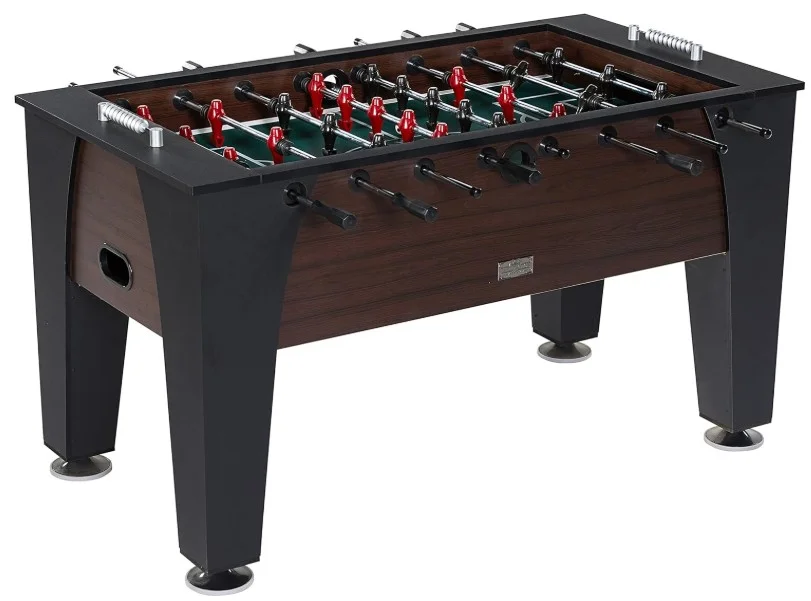
The Richmond focuses less on furniture versatility and more on conventional full-size family play. It provides the largest playfield in this four-model comparison.
It also gives four players more room to stand and operate their rods.
Size and construction
Model FS058Y21009 measures 58 × 30 × 34 inches and weighs approximately 100.32 pounds.
Its main components include:
- A 46.75 × 26.75-inch playfield
- Wood-grain PVC laminate over MDF
- Five-eighth-inch hollow steel rods
- Plastic bearings
- Octagonal non-slip handles
- Adjustable 5-inch hidden levelers
- Traditional bead scorers
- Weighted black and burgundy players
- Sideline ramps
- Two soccer-style balls
The manufacturer describes the playing surface as 9 mm thick. The wider field provides slightly more lateral space than the Allendale, although both use a similar playing length.
Playing experience
The Richmond suits conventional standing play. Its larger cabinet gives adults more comfortable spacing than compact models and supports four-player matches.
Weighted robot-style figures can return toward an upright position more consistently than unweighted figures. That may reduce blocked lanes when a defensive rod is released.
Sideline ramps keep the ball away from the cabinet edges. Goal boxes return it after a score, while bead scorers keep tracking simple.
The Richmond does not offer the oak veneer or metal A-leg structure of the Allendale. Instead, it emphasizes a familiar dark wood-grain appearance, a spacious field, and substantial hidden levelers.
Customer feedback patterns
Retailer review summaries commonly praise the Richmond for:
- An attractive cabinet
- A solid feel after assembly
- Enjoyable family play
- Good perceived value
- Enough space for children and adults
Reported concerns include:
- Time-consuming assembly
- Misaligned holes
- Scratched panels
- Cracked or damaged components
- Inconsistent durability between units
These reports should be treated as ownership patterns, not guaranteed defects. Shipping conditions, assembly technique, floor level, and individual quality control can all affect the final result.
Who should buy it?
The Barrington 58-inch Richmond foosball table is best suited to dedicated game rooms, basements, larger households, and buyers expecting four-player games.
It is less attractive for apartments, frequent movers, or anyone wanting a table that can disappear after the weekend.
Barrington Brooks 48-Inch Foosball Table
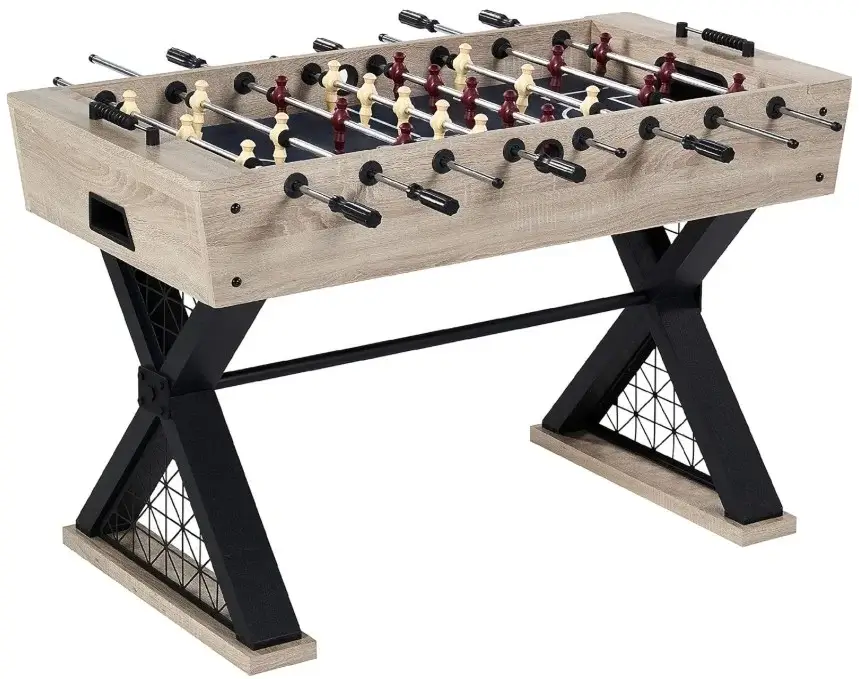
The Brooks sits between the low Coffee Table and Barrington’s larger furniture models. It provides a conventional standing position without demanding the floor space of a 56-inch or 58-inch cabinet.
Where Brooks fits in the range
Model FS048Y20021 measures 48 × 24 × 32 inches and weighs about 79.4 pounds. Its playing surface measures 40.25 × 22 inches.
The Brooks includes:
- Half-inch hollow steel rods
- Plastic bearings
- Octagonal non-slip handles
- A 9 mm playfield
- Sideline ramps
- Wood-grain cabinet styling
- X-shaped legs with mesh covers
- A metal reinforcement bar
- Hidden 1.5-inch leg levelers
- Beige and maroon robot-style players
The X-leg design gives the Brooks a more industrial appearance than the Coffee Table. Its metal connection bar also helps tie the leg structure together.
Who should consider it?
The Brooks is a practical choice for smaller game rooms, teenagers, young families, and casual adults. It feels more like a regular football table than the Coffee Table, but remains easier to place than the Allendale or Richmond.
Its narrower cabinet also leaves less room between opposing rods. Taller adults should measure their available space carefully, particularly when furniture or walls sit close to the playing sides.
Barrington Allendale 56-Inch Foosball Table
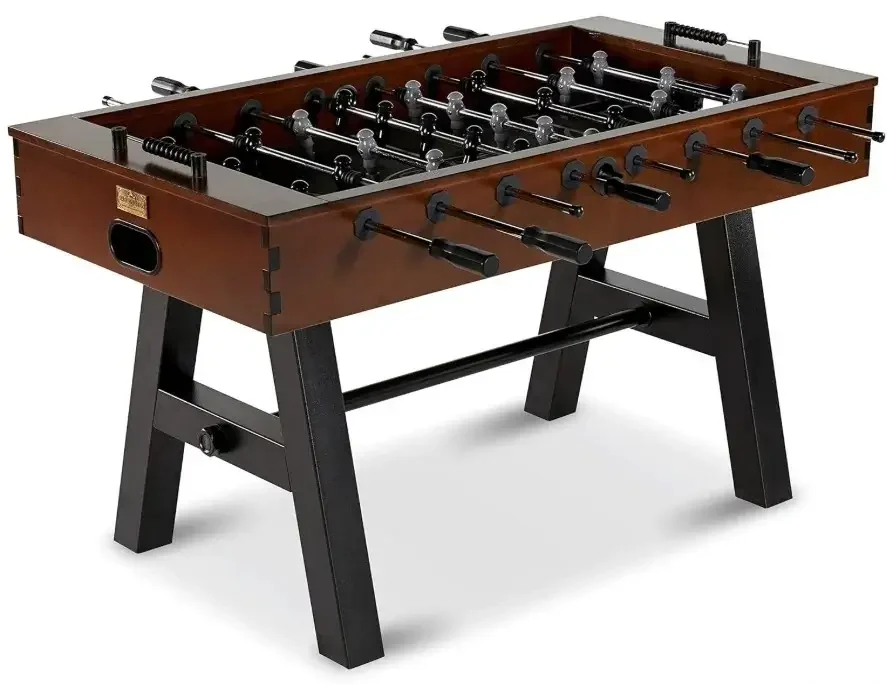
The Allendale occupies the furniture-focused end of this comparison. It is built for buyers who expect the table to remain assembled and visible as part of a finished room.
Its extra weight and metal legs also change how it feels during active play.
Furniture design and construction
Model FS056Y21025 measures 56 × 29 × 34 inches. The official manufacturer page currently lists its assembled weight as 116.16 pounds, although some retailer listings show a higher figure.
The Allendale combines:
- Oak wood veneer on the top rails and aprons
- An MDF structural base
- Brown and black styling
- Reinforced A-style metal legs
- Hidden 1.5-inch levelers
- Traditional bead scorers
- Five-eighth-inch rods
- Octagonal wood handles
- Robot-style balanced players
- Two included balls
The larger playfield measures approximately 46.75 × 26.5 inches, with a 12 mm MDF playing surface according to retailer specifications. The official product page confirms the oak veneer, metal-leg structure, dimensions, model number, and furniture-oriented positioning.
Playing experience
The Allendale’s weight helps it resist movement during aggressive family matches. Its A-style metal legs also create a more direct support structure than decorative MDF legs.
Five-eighth-inch rods feel more substantial than the half-inch rods used on the Coffee Table and Brooks. The larger playfield provides more passing space and a less crowded game.
Ball-return goal boxes bring scored balls back to the ends. Hidden levelers help correct minor floor variation without interrupting the cabinet’s appearance.
The Allendale remains a recreational home table. Oak veneer and metal supports improve its presentation and stability, but they do not make it a commercial or tournament-certified cabinet.
Best use cases and drawbacks
The Allendale works best in:
- Finished game rooms
- Home bars
- Larger recreation rooms
- Adult households
- Families that play regularly
- Rooms where appearance is a priority
Potential disadvantages include:
- Heavy lifting
- More involved assembly
- A large permanent footprint
- MDF beneath the decorative veneer
- Greater difficulty moving between rooms
Measure doorways, stair turns, and the final playing area before assembly. A beautiful table trapped sideways in a hallway has very limited entertainment value.
Barrington 42-Inch Foosball Coffee Table
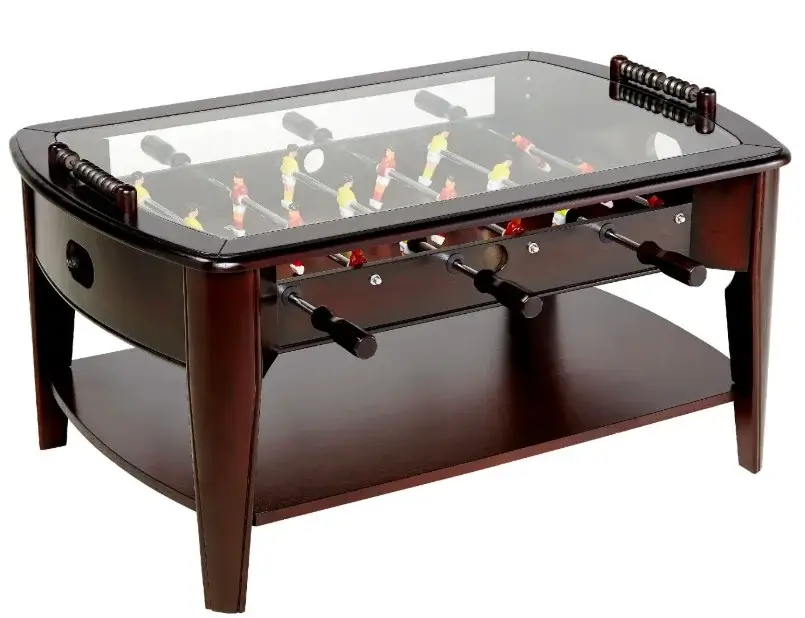
The Barrington 42-inch foosball coffee table is not a shortened version of a conventional table. Its height, glass surface, storage shelf, and seating position create a completely different ownership experience.
That difference can be valuable, provided you actually need the furniture function.
Design and construction
Model FS042Y23005 measures 42 inches long, 28 inches wide, and 20 inches high. It weighs approximately 77 pounds.
Its 30 × 20-inch playfield sits beneath a transparent, heat-treated tempered-glass surface. The glass allows the table to hold drinks, books, or living-room items when nobody is playing.
The cabinet also includes:
- A lower storage shelf
- Dark wood-style rails and aprons
- Solid wood handle grips
- Solid wood scoring beads
- Half-inch steel rods
- Plastic bearings
- Hidden 0.75-inch leg levelers
- Two soccer-style balls
These specifications are confirmed on the official product page for model FS042Y23005.
The glass provides a finished furniture surface while helping keep dust and loose objects away from the playfield. However, fingerprints, glare, and access during maintenance require consideration.
Playing experience
The Coffee Table encourages seated or crouched play. That works well for children, relaxed family matches, and occasional adult games.
It does not recreate full-height standing ergonomics.
Players accustomed to conventional table soccer may find the low rod position less natural during longer sessions. The smaller playfield also produces tighter spacing and shorter passing lanes.
Nine red and nine yellow figures create a lighter layout than the 26-player configuration used on larger Barrington tables. The half-inch rods suit the table’s compact dimensions, while octagonal wooden handles provide a firmer grip than smooth round plastic handles.
The result is casual and social, not competition-focused.
Who should buy it?
The Barrington foosball coffee table makes sense for:
- Apartments
- Living rooms
- Multipurpose family rooms
- Buyers with limited furniture space
- Families wanting occasional play
- Homes where a full-height cabinet would look intrusive
It is less suitable for:
- Competitive practice
- Long-standing matches
- Fast four-player games
- Buyers who dislike cleaning glass
- Homes where people may sit on the tabletop
The official manual specifically warns users not to sit, climb, or lean on the product. A coffee-table shape may invite that behavior, but its appearance does not turn it into a bench.
Which Barrington Foosball Table Is Right for You?
The strongest model is not automatically the longest or heaviest. Choose according to the room, playing position, and how often the table must serve another purpose.
| Buyer situation | Most suitable model | Why it fits |
| Limited living-room space | Coffee Table | Combines entertainment with functional furniture |
| Smaller game room | Brooks | Offers standing play with a compact footprint |
| Appearance is the priority | Allendale | Uses oak veneer and reinforced metal legs |
| Larger playing area | Richmond | Provides a spacious field and four-player layout |
| Young family and casual play | Brooks or Coffee Table | More manageable size and format |
| Permanent dedicated game room | Allendale or Richmond | Larger, heavier cabinets suit fixed placement |
Choose the Coffee Table only when its furniture function matters. Otherwise, the Brooks provides more conventional ergonomics.
Choose the Allendale when cabinet appearance and structural support lead your decision. Pick the Richmond when the larger playing area and four-person layout matter more.
Barrington Foosball Table Assembly
Barrington foosball table assembly varies considerably by model. A coffee table with glass, a compact X-leg cabinet, and a heavy A-leg model will not share one universal process.
Always follow the Barrington owner’s manual matching your exact product code.
What may require assembly?
Depending on the model, assembly may involve:
- Mainframe or cabinet panels
- Bottom panels
- Legs and braces
- Metal connection bars
- Support rods
- Leg levelers
- Rod bushings
- Rod bumpers and washers
- Handles
- Player figures
- Slide scorers
- Goal boxes
- Glass surfaces
Some figures arrive preinstalled on short rod sections. Others must be placed onto longer rods in a specific order and direction.
The Coffee Table manual identifies its mainframe, bottom panel, glass surface, three-player rods, slide scorers, L-brackets, leg levelers, support rods, bushings, bumpers, washers, spring-lock washers, Allen key, and wrench.
Recommended assembly process
- Confirm the model number. Match it to the manual before opening every bag.
- Inventory the components. Compare each part with the parts identifier.
- Inspect finished panels. Photograph scratches, cracks, or misdrilled holes immediately.
- Build the cabinet or mainframe. Keep fasteners slightly loose until adjoining panels align.
- Attach legs and supports. Install levelers before turning a heavy cabinet upright.
- Fit the rods correctly. Check player color, direction, bumpers, washers, and handles.
- Install scorers and goal parts. Confirm both sides move freely.
- Level the playfield. Use a spirit level rather than judging by eye.
- Install glass last. This applies to the Coffee Table and similar covered designs.
The Coffee Table instructions recommend at least two adults and advise using power tools only on a low-torque setting.
Practical assembly advice
Assemble larger models near their permanent location. Protect finished panels with clean cardboard or a blanket.
Avoid overtightening fasteners into MDF. Excessive torque may crush the material around an insert, strip a hole, or pull panels out of alignment.
Keep hardware separated by part number. Do not rely on visual similarity because two almost identical bolts may have different lengths.
Check every player’s orientation before closing the rods. The only spin you want during assembly should come after the handles are attached.
Finally, retighten structural hardware after several playing sessions. New joints may settle slightly during early use.
Common Barrington Problems, Replacement Parts and Warranty
Most Barrington ownership problems fall into four categories: alignment, leveling, rod movement, and shipping damage.
Early inspection and careful assembly can prevent a minor issue from becoming permanent.
Misaligned holes or cabinet panels
Before declaring a panel defective, check whether it has been reversed or rotated.
Loosen nearby fasteners and realign the structure. Fully tightening one corner too early can pull the opposite holes out of position.
Never force a bolt through MDF. Cross-threading or enlarging a hole may make a valid warranty request harder to document.
Photograph the affected part, its identifier, and the model label before contacting support.
Uneven playing surface
An uneven field can make the ball drift toward one side and turn every close match into an argument about gravity.
Use a spirit level across the length and width. Adjust the hidden leg levelers in small increments.
Also check:
- Whether the floor itself slopes
- Whether the table sits partly on a thick rug
- Whether leg bolts are tightened evenly
- Whether the cabinet twisted during assembly
Recheck the level after moving the table.
Rods that feel stiff
A rod should travel without scraping or binding.
If movement feels uneven:
- Confirm the rod uses the correct bushings.
- Check bumper and washer placement.
- Inspect the cabinet for twisting.
- Remove dust or residue from the rod.
- Confirm the handle is not rubbing against the cabinet.
- Use only a lubricant permitted by the manual.
Do not use heavy household grease. It can attract dirt and create a sticky layer around plastic bearings.
For ongoing care, see our guides to foosball table maintenance.
Scratches, cracks, and shipping damage
Furniture-style finishes can make cosmetic damage more noticeable. Inspect every panel before assembly, particularly corners, leg mounting points, and finished top rails.
A cracked base or deeply scratched apron is easier to identify and photograph while the parts remain separate.
Do not continue building around a structurally damaged component unless support advises you to do so.
Replacement parts and manuals
Keep the following information:
- Product model number
- Part number or parts identifier
- Purchase receipt
- Owner’s manual
- Photographs of the problem
- Retailer order details
Similar-looking Barrington foosball tables may use different rods, panels, brackets, or leg hardware.
The official MD Sports support center provides access to assembly manuals, replacement-parts ordering, support tickets, warranty records, and troubleshooting resources. Availability still depends on the exact model and component.
Warranty expectations
Medal Sports currently lists a 90-day limited warranty for North America. Coverage periods differ by region.
The official policy states that proof of purchase is required. It also lists exclusions involving mainframes, tabletops, playing surfaces, tools, improper use, accidental damage, alterations, and neglect. Buyers should verify the policy applies to their country, retailer, and model before purchase.
A warranty is not a substitute for inspecting the carton promptly. Waiting several months to report concealed shipping damage may reduce the available options.
Are Barrington Foosball Tables Worth It?
Barrington is worth considering when the table must look at home in a furnished room. The brand provides more visual variety than many basic recreational manufacturers.
Its strongest qualities include:
- Furniture-oriented cabinet designs
- Compact and full-height options
- Wood-look finishes
- Adjustable leg levelers
- Model-specific manuals
- Replacement-parts support
- Family-friendly layouts
- Coffee-table and conventional formats
Its main limitations include:
- Extensive MDF construction
- Veneer or laminate rather than solid hardwood
- Heavy larger models
- Potentially lengthy assembly
- Differences in quality between collections
- Reported shipping and alignment problems
- Recreational rather than specialist positioning
The Coffee Table makes sense for multipurpose living spaces. The Brooks works for smaller rooms needing regular standing play. The Allendale suits buyers prioritizing appearance and stability. The Richmond favors a larger field and four-player games.
Barrington is less suitable for commercial venues, intensive competitive training, or buyers wanting tournament-grade components with minimal assembly.
The brand’s real strength is not maximum performance. It is making a home foosball table easier to live with.
Frequently Asked Questions
These answers address the concerns buyers most often face before choosing a Barrington collection foosball table.
Is Barrington a good foosball table brand?
Barrington is a good option for recreational buyers who value furniture styling, multiple size choices, and family-friendly play. Its quality varies by collection, so compare cabinet materials, leg construction, playfield thickness, and model-specific feedback. Buyers seeking commercial durability or specialist tournament components should consider heavier performance-focused brands.
Who makes Barrington foosball tables?
Barrington Billiards Company is presented as a brand within the Medal Sports and MD Sports product network. Medal Sports hosts Barrington listings, while MD Sports provides manuals, support tickets, warranty information, and replacement-parts services. Always use the exact Barrington model number when requesting help.
Are Barrington foosball tables made from solid wood?
Most Barrington tables are not made entirely from solid wood. Many use MDF with wood-grain PVC laminate or decorative wood veneer. Selected components may use wood, including handles, legs, or scoring beads. Read the material description carefully because “wood finish” and “wood design” do not necessarily mean solid timber.
How difficult is Barrington foosball table assembly?
Difficulty depends on the model. Compact tables may have fewer large panels, while the Allendale and Richmond require more working space and lifting assistance. Coffee-table models add bottom shelves and glass installation. Two adults are recommended for heavier assemblies, and a low-torque screwdriver setting helps protect MDF components.
Where can I find Barrington foosball table assembly instructions?
Find the model number on the carton, cabinet label, receipt, or product listing. Then download the matching manual from the official MD Sports support center. Do not use instructions from a similar-looking model because rod layouts, brackets, panels, and hardware can differ.
Can you buy replacement parts for Barrington foosball tables?
Model-specific Barrington replacement parts may be available through Medal Sports support. Compatibility should be checked using the product code and part number from the owner’s manual. Availability is not guaranteed, especially for older collections, so keep the receipt and parts list after completing assembly.
Which Barrington foosball table is best for a small room?
The Coffee Table is best when furniture must serve two purposes. It measures only 20 inches high and includes a storage shelf. The Brooks is better for buyers wanting conventional standing table soccer in a smaller footprint. Remember to allow extra room for extended rods and player movement.
Conclusion
Barrington Billiards builds recreational tables for buyers who care about both play and room appearance. Its range moves from a dual-purpose Coffee Table to the compact Brooks, furniture-focused Allendale, and larger Richmond.
Choose by format rather than length alone. Measure the room, consider playing height, and decide whether furniture styling or field size matters more.
Keep the exact model number for manuals, replacement hardware, and warranty support. The Coffee Table suits multipurpose rooms, the Brooks fits compact conventional play, the Allendale emphasizes design, and the Richmond supports larger family matches.