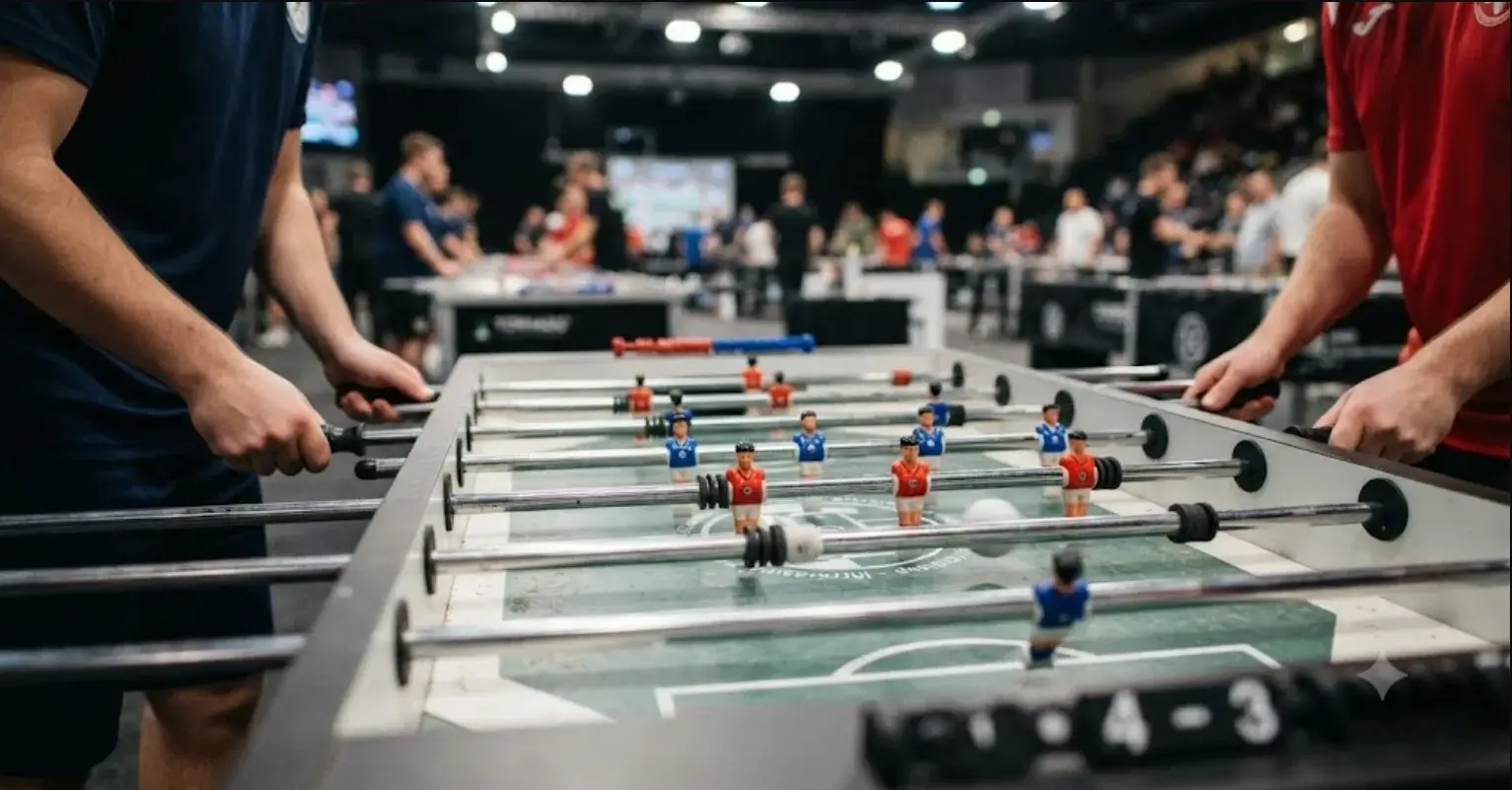
Finding a good foosball tournament can feel harder than learning a new passing technique. Many players know they enjoy competitive games but do not know where casual matches end and organized competition begins.
Foosball tournaments bring structure to the game. They connect beginners, hobby players, and professionals through organized foosball events at local, national, and international levels.
Whether you play on a home football table, practice at a local club, or dream of competing globally, there is a tournament level that fits your experience.
Types of Foosball Tournaments
Foosball tournaments exist at different levels, from small community gatherings to major international championships. The biggest difference is usually the player skill level, event size, and qualification requirements.
Many competitive players start locally before moving into larger events. It is common for experienced players to recommend building tournament confidence first rather than jumping straight into professional divisions.
Local Foosball Tournaments
Local foosball tournaments are the starting point for many competitive players.
These events are usually organized by:
- Local foosball clubs
- Recreation centers
- Bars and gaming communities
- Independent tournament organizers
They are ideal for beginners because the environment is usually more relaxed. Players can learn tournament etiquette, improve their skills, and meet other competitors.
Local events often include:
- Beginner divisions
- Amateur divisions
- Open categories
- Singles and doubles competitions
Many players discover that tournament pressure feels completely different from casual games at home. A shot that feels automatic during practice can suddenly disappear when a bracket and audience are involved.
That experience is part of the learning process.
Local foosball tournaments are often the best entry point for players who want to move from casual games into competitive foosball.
Regional Foosball Tournaments
Regional foosball tournaments bring together players from multiple cities or areas.
These competitions usually attract stronger competition than local events. They can act as stepping stones for players who want to enter national competitions later.
Regional events often include:
- Larger player pools
- More competitive divisions
- Experienced tournament players
- Club-level rivalries
For many players, regional championships are where the competitive foosball scene starts becoming more serious.
You begin seeing players who specialize in certain styles, such as aggressive offense, defensive control, or fast passing combinations.
National Foosball Tournaments
National foosball tournaments represent the highest level of competition within a country.
These events often determine national rankings and championship winners. Players compete for national titles across different categories.
Common categories include:
| Category | Description |
| Singles | Individual players compete against each other |
| Doubles | Two-player teams compete together |
| Team Events | Clubs or groups compete as a unit |
| Skill Divisions | Players compete based on experience level |
A national foosball championship usually attracts experienced competitors who have already built tournament experience through regional and local events.
International Foosball Tournaments
International foosball tournaments bring together players from different countries.
These events represent the global side of table soccer competition. They feature highly skilled players, official formats, and internationally recognized rankings.
International competitions often include:
- Professional divisions
- National representatives
- Elite doubles teams
- World ranking participants
The biggest international events create a unique atmosphere because players bring different playing styles from around the world.
A defensive player from one country may approach the game completely differently from an attacking player from another.
Major Foosball Championships and Tournament Events
Foosball championships are where competitive table soccer reaches its highest level. Instead of focusing on yearly winners, it is more useful to understand the types of championship events and what makes them important.
Foosball World Championships
The foosball world championship represents the highest level of competition in the sport.
World-level events bring together top-ranked players from different countries. Competitors usually participate in multiple categories, including:
- Singles championships
- Doubles championships
- Team championships
- Junior or amateur categories
The global governing organization for many international competitions is the International Table Soccer Federation (ITSF).
Players competing at this level typically have years of tournament experience. They understand table differences, tournament pressure, partner communication, and advanced strategies.
The world championship environment is very different from casual play. Small mistakes matter because opponents are often capable of punishing a single missed opportunity.
National Foosball Championships
National championships give players the chance to compete for country-level recognition.
These events usually feature:
- National rankings
- Championship divisions
- Experienced competitors
- Qualification pathways
A national title is often considered one of the biggest achievements for competitive players because it represents success against the strongest players in their country.
Foosball Table Championships
Foosball tables can influence competitive play significantly.
Different tournament tables have different characteristics, including:
- Rod movement
- Ball control
- Surface speed
- Passing difficulty
- Shooting style
A player who dominates on one table may need adjustment time on another.
Popular competitive tables include:
- Tornado tables
- Warrior tables
- Other tournament-approved tables
This is why experienced competitors usually practice on the same table style used during major events.
A football table is not just a piece of equipment in competitive play. It becomes part of the challenge.
Professional Foosball Tournaments
Professional foosball tournaments separate elite competition from casual and beginner events.
These tournaments attract players who dedicate significant time to improving technique, strategy, and tournament performance.
Professional competitions usually involve:
- Highly ranked players
- Advanced divisions
- Official tournament formats
- Experienced doubles teams
- Championship-level pressure
Professional foosball players often spend years developing skills such as:
- Accurate passing
- Ball control
- Defensive positioning
- Fast transitions
- Team coordination
One common misconception is that professional tournaments are only for famous players.
In reality, many professional competitors started in local events. Progress usually happens through consistent participation, learning from stronger opponents, and improving tournament habits.
What Makes Professional Foosball Different?
The biggest difference is consistency.
A casual player may score impressive goals occasionally. A professional player can repeat effective techniques under pressure.
Professional tournaments also require players to understand:
- Tournament seeding
- Match strategy
- Opponent tendencies
- Equipment differences
- Mental preparation
Many competitors say the mental side of tournament play is just as important as physical skill.
A player who stays calm after losing a close match often performs better than someone who relies only on natural ability.
Who Should Play Professional Foosball Tournaments?
Professional events are suitable for players who:
- Regularly compete in tournaments
- Understand competitive rules
- Practice consistently
- Want ranking-based competition
They may not be the best starting point for someone who has never played in an organized event.
A better path is usually:
Local tournament → Regional event → National competition → Professional level
This allows players to build experience without unnecessary pressure.
Foosball Tournament Formats Explained
Tournament formats decide how players move through an event and how winners are determined. Understanding the structure helps players prepare properly before entering a competition.
A common mistake among new competitors is focusing only on skill and ignoring the tournament format. A player who understands the bracket system can manage energy, prepare mentally, and avoid unnecessary mistakes.
Most competitive foosball tournaments use a combination of elimination rounds, qualification stages, and seeded matches.
Elimination Formats
Elimination formats are among the most common structures in foosball tournaments.
Players or teams compete in scheduled matches, and winners advance while others are removed from the bracket.
Single Elimination Format
In a single-elimination format, one loss usually ends a player’s run in that category.
Advantages:
- Faster tournament completion
- Easy-to-follow brackets
- Creates high-pressure matches
Limitations:
- One bad game can end the tournament
- Less room for recovery after mistakes
This format rewards consistency because every match matters.
A player who starts slowly may not get another chance.
Double Elimination Tournament
Double elimination gives players more opportunity to recover.
Competitors usually remain in the event after their first loss and move into a different bracket.
Benefits include:
- More matches for players
- Better evaluation of skill
- Less impact from one unlucky game
Many players prefer this format because it creates a more balanced competitive environment.
It recognizes that even strong players can have an off match.
Group and Qualification Formats
Some larger foosball tournaments begin with qualification stages before elimination rounds.
These formats help organizers manage large numbers of competitors.
Round Robin Format
In a round-robin format, players compete against multiple opponents.
The player with the strongest overall record usually advances.
Benefits:
- More games for participants
- Better ranking accuracy
- More opportunities to learn from opponents
The downside is that round-robin stages require more time and scheduling.
Qualification Rounds
Qualification rounds determine which players move into the main tournament bracket.
They are often used when an event has many participants.
Qualification can involve:
- Group matches
- Ranking points
- Preliminary games
- Seeding systems
Strong performance during qualification can create easier paths later in the tournament.
Tournament Seeding
Tournament seeding organizes players based on rankings, previous results, or qualification performance.
The goal is usually to prevent the strongest players from meeting too early.
Seeding helps create a more balanced competition and gives organizers a structured way to build brackets.
Foosball Tournament Categories and Divisions
Foosball tournaments are designed for different skill levels and playing styles. This allows beginners to compete without immediately facing the most experienced players.
Most organized events include multiple categories so players can find the right competitive environment.
Singles Competition
The singles competition features individual players competing against each other.
This format tests:
- Personal technique
- Ball control
- Defensive ability
- Decision-making
Singles matches can be challenging because players cannot rely on a partner to cover weaknesses.
Many competitors use singles events to improve their overall game.
Doubles Competition
Doubles competition is one of the most popular formats in competitive foosball.
Two players form a team and usually specialize in different roles.
A common setup includes:
- Offensive player
- Defensive player
However, strong teams are flexible. Good communication often matters more than having fixed positions.
Many experienced players believe a good doubles partnership can outperform two individually talented players who do not work well together.
Team Competition
Team competitions allow multiple players to represent a club, region, or country.
These events create a different atmosphere because teamwork becomes the focus.
Players may compete across:
- Singles matches
- Doubles matches
- Multiple table formats
Team events are especially popular in larger championships because they build community and rivalry.
Mixed Doubles
Mixed doubles events combine players into mixed-gender teams.
These competitions help expand participation and create more opportunities for players across different experience levels.
Skill Divisions
Skill divisions help create fair competition.
Common divisions include:
| Division | Typical Participants |
| Beginner Division | New tournament players learning competition |
| Amateur Division | Regular players improving skills |
| Open Division | Strong players with competitive experience |
| Professional Division | Elite-ranked competitors |
Not every tournament uses the same division system, so players should always check event details before registering.
Famous Tournament Tables and Competitive Equipment
Competitive foosball is influenced by equipment more than many beginners expect.
A player who practices only on one football table may need adjustment time when entering a tournament with different equipment.
Tournament organizers usually select approved tables to maintain consistency.
Tornado Foosball Tournaments
Tornado Foosball tables are among the most recognized tables in competitive foosball.
Tornado events have played an important role in tournament history, especially in North American competitions.
Players often appreciate Tornado tables because they provide:
- Reliable construction
- Competitive ball control
- Consistent playing conditions
The Valley-Dynamo brand has been closely associated with Tornado tournament tables.
Warrior Foosball Tournaments
Warrior Foosball tables are also used in competitive environments.
Warrior tables are known among players looking for tournament-style equipment with a different playing feel.
Different tables can change:
- Passing speed
- Shooting angles
- Defensive techniques
- Ball handling
This is why serious competitors practice on tournament-approved equipment whenever possible.
Competition-Grade Foosball Tables
A competition-grade foosball table usually focuses on:
- Durable construction
- Consistent playing surface
- Reliable rods and players
- Tournament-standard design
For home players planning to compete, practicing on quality equipment can help build better habits.
However, equipment alone does not create a tournament player.
Strong fundamentals still matter most.
How to Participate in a Foosball Tournament?
Joining your first tournament can feel intimidating, especially if you have only played casually.
The good news is that most competitive players started exactly there.
The goal is not to win your first event. The goal is to learn the environment, understand competition, and improve.
Find a Tournament
Start by looking for:
- Local foosball clubs
- Community competitions
- Regional events
- Official tournament calendars
Many beginners prefer smaller events because they provide a more comfortable introduction.
Choose Your Division
Select a category that matches your experience.
If you are new:
- Beginner or amateur divisions are usually better choices.
- Open divisions may be challenging.
Choosing the right division creates a better experience and helps you improve faster.
Complete Tournament Registration
Registration usually includes:
- Selecting events
- Providing player information
- Choosing partners for doubles
- Reviewing tournament rules
Some events also require:
- Competitor check-in
- Registration deadlines
- Specific equipment requirements
Always read tournament details before arriving.
Prepare for Competition
Tournament preparation is different from casual practice.
Helpful preparation includes:
- Practicing common tournament shots
- Learning defensive positioning
- Playing with different opponents
- Practicing on similar equipment
Many players underestimate the pressure of a real match.
A friendly game at home and a tournament match at 9 a.m. with a bracket waiting are very different experiences.
How to Find Upcoming Foosball Tournaments
Keeping track of every event worldwide is difficult, so the best approach is to use official sources and tournament communities.
Reliable places to look include:
- ITSF tournament calendars
- National foosball associations
- Local foosball clubs
- Tournament registration platforms
The International Table Soccer Federation official website is a useful resource for international events, rankings, and official information.
Players can also follow regional organizations and clubs because many local foosball tournaments never receive international coverage.
How to Follow Foosball Tournament Results
The following results help players understand the competitive scene and track top performers.
Tournament results usually include:
- Match outcomes
- Final standings
- Division winners
- Player rankings
The best sources are generally:
- Official tournament pages
- Federation result pages
- Event organizers
- Ranking databases
The ITSF website provides information about international competitions, rankings, and championship events.
The following results are also useful for players preparing for future events. Watching stronger competitors can reveal strategies, table preferences, and advanced techniques.
Frequently Asked Questions
What is the biggest foosball tournament?
The biggest events are generally world-level championship competitions organized through international table soccer organizations.
These events bring together elite players from different countries across multiple categories.
How do beginners join foosball tournaments?
Beginners usually start with local foosball tournaments or amateur divisions.
Joining a local club is often the easiest way to discover events and meet experienced players.
Are foosball tournaments only for professional players?
No.
Foosball tournaments include beginners, amateurs, experienced competitors, and professionals.
Most players progress through different levels over time.
What types of foosball tournaments exist?
Common types include:
- Local tournaments
- Regional competitions
- National championships
- International events
- Professional tournaments
Players can choose based on their experience level and goals.
How are foosball tournaments organized?
Most tournaments use formats such as:
- Single elimination
- Double elimination
- Round robin stages
- Qualification rounds
Events are also divided into categories like singles, doubles, teams, and skill levels.
Where can I find upcoming foosball tournaments?
You can find events through:
- Official federation calendars
- National associations
- Local clubs
- Tournament organizers
Checking community groups is also useful because smaller events are often announced locally.
Conclusion: Foosball Tournaments Offer a Path for Every Player
Foosball tournaments are not only for professionals chasing championship titles.
They provide a path for anyone who enjoys competitive play, from beginners entering their first local event to experienced players competing internationally.
The best way to improve is simple:
Play more matches, learn from stronger opponents, and gradually challenge yourself with bigger competitions.
Whether your goal is joining a community event, winning a national championship, or following the world foosball championship scene, competitive table soccer offers a place to grow.
At Foosball Junkie, the focus is on helping players understand the game beyond casual matches and discover the competitive side of foosball with confidence.