Measure These Five Things Before Buying Foosball Men
A ruler and caliper can prevent you from dismantling half your table for a replacement that never had a chance.
Measure an undamaged player whenever possible. Photograph its position and hardware before removing anything.
A 1/16-inch difference looks tiny on paper. On a foosball rod, it can turn a simple repair into an afternoon of frustration.
1. Rod Diameter
Measure the bare rod rather than the existing player body.
A digital caliper gives the clearest reading. Close its jaws gently around the rod without tilting them.
| Nominal size | Approximate metric size |
| 9/16 inch | 14.3 mm |
| 5/8 inch | 15.9 mm |
| 0.63 inch | About 16 mm |
| Tornado 0.62 inch | About 15.75 mm |
The Hotusi player lists a 0.63-inch or 16 mm bore diameter. That is close to 5/8 inch, but closeness does not guarantee replacement fitment.
Manufacturing tolerance, paint buildup, rod wear, and bore shape can change the final fit.
Do not automatically call a 16 mm figure an exact-fit replacement for every 5/8-inch rod. Measure the actual rod and confirm the seller’s tolerance.
Tornado presents another complication. Its official FAQ says the Tornado rod is 0.62 inch, while a true 5/8-inch rod is 0.625 inch. The manufacturer warns that a Tornado man may fit extremely tightly on a true 5/8-inch rod.
2. Mounting Method
A correct rod opening is only the first checkpoint.
The figure must also use the same attachment system and place its mounting hole in the correct location.
The three relevant systems are:
Roll pin
A tensioned metal pin passes through the figure and the rod. Tornado uses roll-pin mounting on its players.
Nut and bolt
A bolt passes through the player and rod, then tightens into a nut or shaped recess. The Billiard Evolution figures use this general system.
Molded directly onto the rod
Some tables do not use removable individual figures. Garlando confirms that players on models such as the G-500 are molded directly onto the bars.
Look for:
- A hollow roll pin
- A screw head
- A hexagonal nut recess
- Different front and rear hole sizes
- A seamless figure with no removable hardware
A pin-mounted figure cannot simply replace a screw-mounted figure. The hole diameter and center position must match the rod.
3. Rod Center to Bottom of Foot
The total figure height can be misleading.
The more useful measurement runs from the rod center, or lower rod opening, to the bottom of the player’s foot.
This determines whether the replacement:
- Reaches the ball correctly
- Clears the playing surface
- Matches neighboring players
- Allows the ball to pass beneath the foot
- Strikes the same contact point as the original figure
The Billiard Evolution robot-style player lists approximately 2.4 inches from the lower edge of its rod hole to the bottom of its foot.
A player hanging too low may scrape the playfield. One hanging too high may glide over the ball like it has forgotten its job.
4. Player Width and Spacing
A replacement can fit the rod and still interfere with the table.
Measure the existing players:
- Body width
- Leg width
- Foot width
- Distance from neighboring figures
- Clearance near the bumper
- Clearance near the table wall
An overly wide player may collide with another figure during rotation.
It can also reduce lateral movement by pressing against bumpers or neighboring players. Check spacing on each rod separately.
5. Hole Position and Hardware Size
The mounting hole must align with the hole already drilled through the rod.
Check:
- Pin-hole diameter
- Front screw-hole diameter
- Rear screw-hole diameter
- Bolt length
- Nut shape
- Nut recess depth
- Whether hardware is included
The Hotusi description lists an approximately 10 mm front hexagonal opening and a 5 mm rear round opening.
The 26-player old-style set lists a 1/4-inch front screw hole and a 3/16-inch rear hole. Its mounting nuts and bolts are not included.
Do not assume your old hardware will transfer. A worn bolt, stripped nut recess, or incorrect length can leave the replacement loose.
“Will It Fit?” Compatibility Checklist
| Check | Your measurement | Product measurement | Match? |
| Rod diameter | |||
| Rod-center-to-foot distance | |||
| Player width | |||
| Foot width | |||
| Mounting-hole location | |||
| Pin or bolt diameter | |||
| Front and rear hole shape | |||
| Included hardware | |||
| Counterbalanced or standard | |||
| Existing table model |
Measure twice, order once, and save the spinning for the match.
1. Hotusi 4-Piece Foosball Soccer Table Players
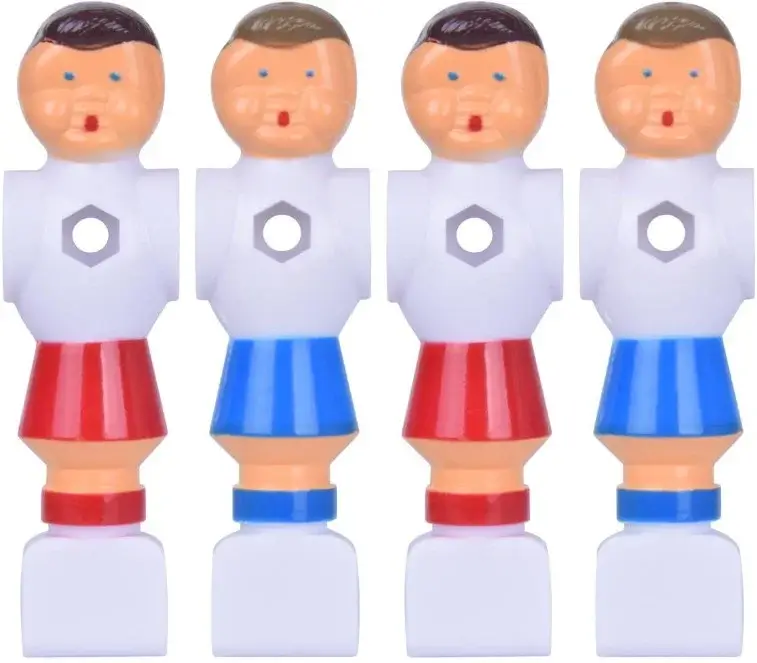
The Hotusi set targets buyers who need a few generic replacement foosball players rather than a complete team.
Its measurements suit some recreational tables. However, its “standard table” language should not replace physical measurements.
Best For
This set makes the most sense for:
- Replacing several cracked or missing figures
- Recreational tables using approximately 16 mm rods
- Owners who need only two figures per team
- Basic home tables with similar screw-mounted players
It is less appropriate for someone replacing every figure on a heavily worn table.
Confirmed Measurements
The pack includes two red players and two blue players.
The published specifications include:
- Four figures
- Hard-plastic construction
- Approximately 4.2-inch player height
- Approximately 0.63-inch or 16 mm rod opening
- Front hexagonal hole around 10 mm
- Rear round hole around 5 mm
- Compatibility claim for a standard 1.4-meter soccer table
These dimensions do not establish universal brand or model compatibility.
Why It Works
A four-player pack is practical when damage is limited.
You avoid buying a full foosball players set when only a few figures have cracked, faded, or disappeared during a move.
Its lightweight hard-plastic construction suits basic recreational repairs. There is no confirmed internal counterweight, so buyers should treat it as a non-counterbalanced figure.
Compatibility Warning
Table length does not determine:
- Rod diameter
- Mounting-hole alignment
- Bolt size
- Player spacing
- Foot clearance
- Figure weight
Two 1.4-meter tables can use completely different figure attachments.
The replacement should slide onto the rod without severe force. It should not wobble after the mounting screw is tightened.
Installation Requirements
Compare the new player’s front and rear holes with your existing figure.
Confirm that the mounting screw:
- Passes through the rod cleanly.
- Seats correctly in the hexagonal side.
- Does not protrude into neighboring space.
- Holds the figure without rotational movement.
Support the rod during installation. Never force the player onto a rod with heavy hammer strikes.
A cracked player is annoying. A bent rod is a much more expensive punchline.
Final Verdict
The Hotusi set is a practical small repair pack for approximately 16 mm rods.
Its main limitation is uncertain table-specific compatibility. Verify the rod opening, mounting-hole location, and hardware before ordering.
Do not buy this product when: Your table uses roll pins, molded-on figures, counterbalanced players, or a clearly smaller rod.
2. 6 Tornado Foosball Men Counterbalanced Roll Pin
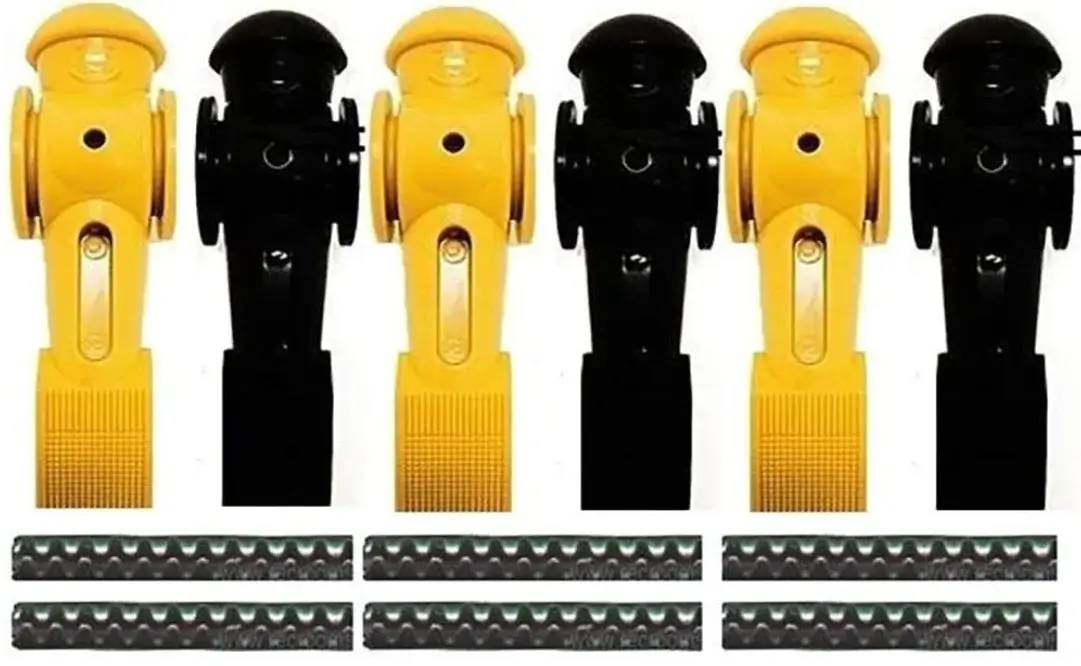
These are the most performance-focused foosball table players in this comparison.
They are also easy to order incorrectly. Tornado fit depends on the table model, player generation, rod size, and roll-pin alignment.
Best For
These Tornado foosball replacement players suit:
- Compatible Tornado coin-operated tables
- TP-2000 tables
- Cyclone II tables
- Storm II tables
- Owners replacing existing weighted Tornado figures
- Players seeking consistent Tornado-style feet and rod balance
Owners of older, entry-level, or modified tables should verify their existing figures first.
Confirmed Measurements
The package includes:
- Three yellow figures
- Three black figures
- Counterweighted construction
- Roll-pin attachment
- Roll pins
- Approximately 4.3-inch player height
- Approximately 1.3-inch depth
- Approximately 1.25-inch width
- Approximately 7/8-inch leg width
Published rod-opening information conflicts.
Amazon’s feature section states 9/16 inch, while its product description states 5/8 inch. Tornado’s official FAQ identifies its rod diameter as approximately 0.62 inch.
Because these figures use a tight fit, the actual table model matters more than one marketplace measurement.
Why Counterbalanced Players Matter
A counterbalanced foosball man contains weight inside its upper body or head.
That changes the figure’s center of gravity and helps the players remain horizontal.
Practical benefits include:
- Unused rows stay out of passing lanes
- Defensive figures hold positions more effectively
- Rod rotation feels more controlled
- Overhead clearance improves
- Passing between rows becomes less obstructed
One counterweighted figure will not necessarily balance an entire rod. Every figure on that rod should use the same design and weight.
Tornado Compatibility Warning
Do not buy Tornado foosball men simply because your rod looks close to 5/8 inch.
Tornado’s manufacturer FAQ says its rod measures about 0.62 inch. A true 5/8-inch rod measures 0.625 inch.
Mounting-hole alignment and foot design must also match.
Tornado changed its foot geometry over time. Newer feet have sharper vertical edges and a larger textured striking area.
Replacing one old player with a newer foot can create an uneven ball response on the same rod.
Installation Requirements
You will need:
- A correctly sized roll-pin punch
- A small hammer
- A solid support block
- A cloth to protect the playfield
- Eye protection
Support the rod close to the player before tapping the pin. Use controlled strikes to avoid bending the rod.
Published instructions differ on which direction the pin teeth should face. Follow the instructions supplied with your specific pins or confirm the correct orientation with the seller.
Foot Design and Ball Control
The Tornado-style foot offers a broader contact area than many basic molded figures.
Sharper edges and a textured surface can support:
- Bank shots
- Brush passes
- Chipping
- Controlled pinning
- Pull shots
- Push shots
- Rollover setups
The final playing result also depends on the ball, playfield, rod movement, and whether every figure uses matching geometry.
Final Verdict
These are the strongest options for compatible Tornado tables.
They provide counterweighted construction, roll-pin mounting, and Tornado-style playing characteristics.
They are not a universal performance upgrade. Confirm the table model, rod size, mounting holes, and player generation before ordering.
Do not buy this product when: Your table uses nut-and-bolt players, molded figures, non-Tornado rods, or misaligned mounting holes.
3. Billiard Evolution 4 Robotic Foosball Men and 2 Balls
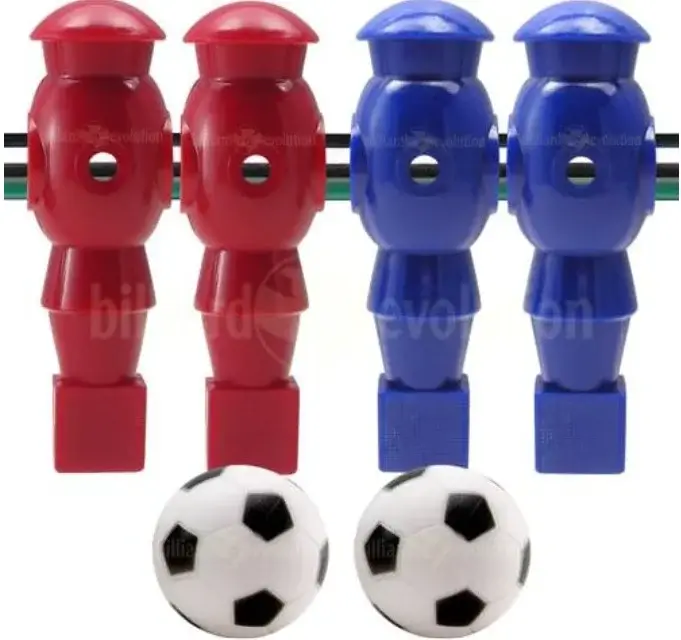
This set offers a small repair solution for common 5/8-inch tables.
It is especially useful when one or two figures from each team have broken, and the remaining players share the same robot-style body.
Best For
This kit works best for:
- Replacing a few damaged figures
- Recreational tables with 5/8-inch rods
- Tables already using robot-style players
- Owners who also need spare soccer-style balls
- Red and blue team configurations
- Nut-and-bolt mounting systems
Matching appearance does not always mean matching dimensions. Compare the original figure before installation.
What “Robotic” Means
“Robotic” describes the molded appearance.
These are not powered, automated, sensor-controlled, or electronically assisted foosball guys.
The only artificial intelligence involved is still the person holding the handle.
Confirmed Measurements
The set includes:
- Two red robotic figures
- Two blue robotic figures
- Two soccer-style balls
- Compatibility with 5/8-inch rods
- Approximately 4.25-inch figure height
- Approximately 1.25-inch figure width
- Approximately 1.6 ounces per figure
- About 2.4 inches from the lower rod opening to the foot
- Nut-and-bolt mounting
- No mounting hardware
The 2.4-inch hole-to-foot measurement is particularly helpful because many replacement listings provide only total height.
Why It Works
The four-figure quantity suits partial repairs.
You can replace one or two broken players on each team without changing every figure on the football table.
The included balls add practical value for tables missing their original ball or needing a backup.
What to Check Before Mixing Players
Compare these details with your original figure:
- Foot profile
- Body thickness
- Figure weight
- Rod-center-to-foot distance
- Mounting-hole position
- Nut recess
- Bolt diameter
- Player width
A rounded foot and a square foot contact the ball differently.
Mixing them on the same rod can affect ball capture, passing control, and shot consistency.
Installation Requirements
The mounting nut and bolt are not included.
Replace old hardware when you find:
- Stripped threads
- A rounded bolt head
- A cracked nut recess
- Rust
- A bent bolt
- Excessive side movement
After tightening, rotate the rod through a complete revolution and slide it through its full lateral range.
Final Verdict
This is a useful partial repair kit for common 5/8-inch tables.
It works best when the table already has figures with matching robot-style dimensions. The missing mounting hardware must be included in your repair plan.
Do not buy this product when: Your players use roll pins, your rods are not 5/8 inch, or the hole-to-foot measurement differs significantly.
4. Billiard Evolution 26 Old-Style Red and Blue Foosball Men
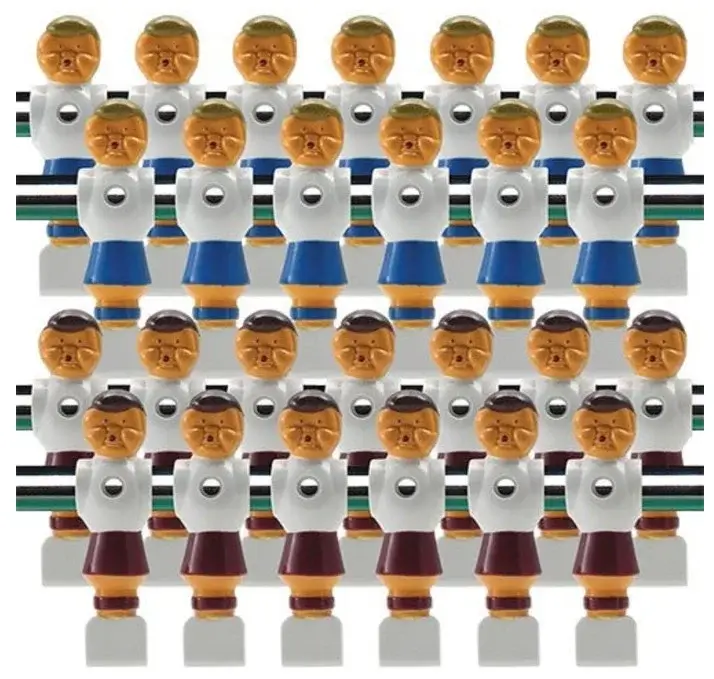
Replacing one damaged figure makes sense when you can find an exact match.
When a table has faded, cracked, and mismatched figures, a complete set can produce a cleaner result.
Best For
This full set suits:
- Older recreational tables
- Complete 5/8-inch restorations
- Tables with many missing or cracked figures
- Owners replacing mixed player styles
- Red and blue team layouts
- Tables using thirteen figures per team
Count every existing player before ordering. Some goalie configurations use different totals.
Confirmed Measurements
The package includes:
- Thirteen red figures
- Thirteen blue figures
- Twenty-six figures total
- 5/8-inch rod compatibility
- Approximately 4.5-inch player height
- Old-style tournament appearance
- Nut-and-bolt mounting
- Front screw hole around 1/4 inch
- Rear screw hole around 3/16 inch
- No mounting nuts or bolts
Why It Works
A complete figure set gives every player:
- Matching foot geometry
- Consistent height
- Similar weight
- Uniform mounting style
- Matching team colors
- Comparable ball contact
- Predictable rod movement
That consistency matters more than appearance alone.
A full set also reduces the chance of searching for the same discontinued foosball man replacement part later.
Hardware Warning
Before removing the existing players, verify:
- Rod diameter
- Front bolt-hole size
- Rear bolt-hole size
- Bolt length
- Nut shape
- Nut-recess depth
- Hole position
- Rod-center-to-foot measurement
- Player spacing
The set uses different front and rear hole diameters. Your hardware must seat correctly on both sides.
Test one figure before dismantling the entire table.
Installation Requirements
You may reuse old nuts and bolts when they remain straight, clean, and correctly sized.
Before continuing with the full installation:
- Install one figure.
- Confirm its direction.
- Test complete rotation.
- Check playfield clearance.
- Compare its height with the original.
- Slide the rod through its entire range.
- Confirm that the ball contacts the foot correctly.
Only continue after the sample figure passes every check.
Durability Discussion
Buyer feedback is mixed.
Many users report a good fit, useful value, and successful repairs. Others report weaker durability or broken figures.
Inspect each figure for:
- Hairline cracks
- Incomplete molding
- Thin areas around the mounting hole
- Warped feet
- Uneven holes
- Chipped surfaces
Complete this inspection before dismantling the table.
Final Verdict
This is the most logical option for replacing a complete 5/8-inch figure setup.
Its main limitations are missing hardware and mixed durability feedback. Test one player and inspect the complete set before installation.
Do not buy this product when: Your table uses roll pins, molded-on players, telescopic rods, or a different number of figures.
Why Two Foosball Men That Fit the Same Rod Can Play Differently
Rod compatibility only proves that the player can physically mount.
It does not prove that the replacement will feel or perform like the original.
Foot shape, weight, spacing, and vertical position influence how the figure meets the ball.
Foot Shape
| Foot profile | Typical playing effect |
| Rounded foot | Smooth contact but less defined edge control |
| Square foot | More predictable flat striking area |
| Tapered foot | Narrower contact and easier angled access |
| Angled foot | Different front-pin and back-pin behavior |
| Textured foot | Increased grip during controlled contact |
| Crosshatched foot | More friction for passing and pinning |
A textured or crosshatched foot can support ball capture and brush passing.
Sharper edges can improve banking and chipping. Rounded edges may feel more forgiving but less precise.
These differences become noticeable when one replacement sits beside figures with another foot profile.
Hole-to-Foot Distance
When a figure hangs too low:
- The foot may strike the playfield
- Rotation becomes restricted
- The table surface may become scratched
When it hangs too high:
- The ball can pass underneath
- Toe shots become unreliable
- Pinning ability decreases
- Defensive coverage becomes weaker
Total player height does not reveal this relationship. Measure from the rod center to the foot.
Figure Weight
Mixing figure weights on the same rod can create:
- Uneven rotational balance
- Different recovery speed
- Inconsistent horizontal positioning
- More effort during controlled rotation
Replacing every figure on one rod often produces a better result than mixing different weights.
Body and Leg Width
Excessive body or leg width can cause:
- Reduced lateral travel
- Player-to-player contact
- Compressed bumpers
- Incorrect spacing
- Limited defensive reach
Measure the figure width before assuming the rod opening is the only compatibility concern.
Counterbalanced vs Non-Counterbalanced Foosball Players
Counterbalanced does not simply mean heavier.
The figure’s internal weight and center of gravity allow it to hold a horizontal position more effectively.
That can clear passing lanes and make defensive positioning easier.
A Simple Counterbalance Test
- Rotate the figures until their bodies are horizontal.
- Release the handle gently.
- Watch whether the players remain horizontal.
- Compare the result with another rod.
A properly counterbalanced set should hold its position more effectively.
Rod friction can influence this test. Dirty bearings or tight rods may temporarily hold non-balanced figures in place.
Can You Mix the Two Types?
A counterbalanced figure may physically fit beside standard players, but the rod can feel uneven.
Different weights alter:
- Rotational response
- Resting position
- Weight distribution
- Recovery after a shot
For consistent rod control, replace every figure on that rod with the same style.