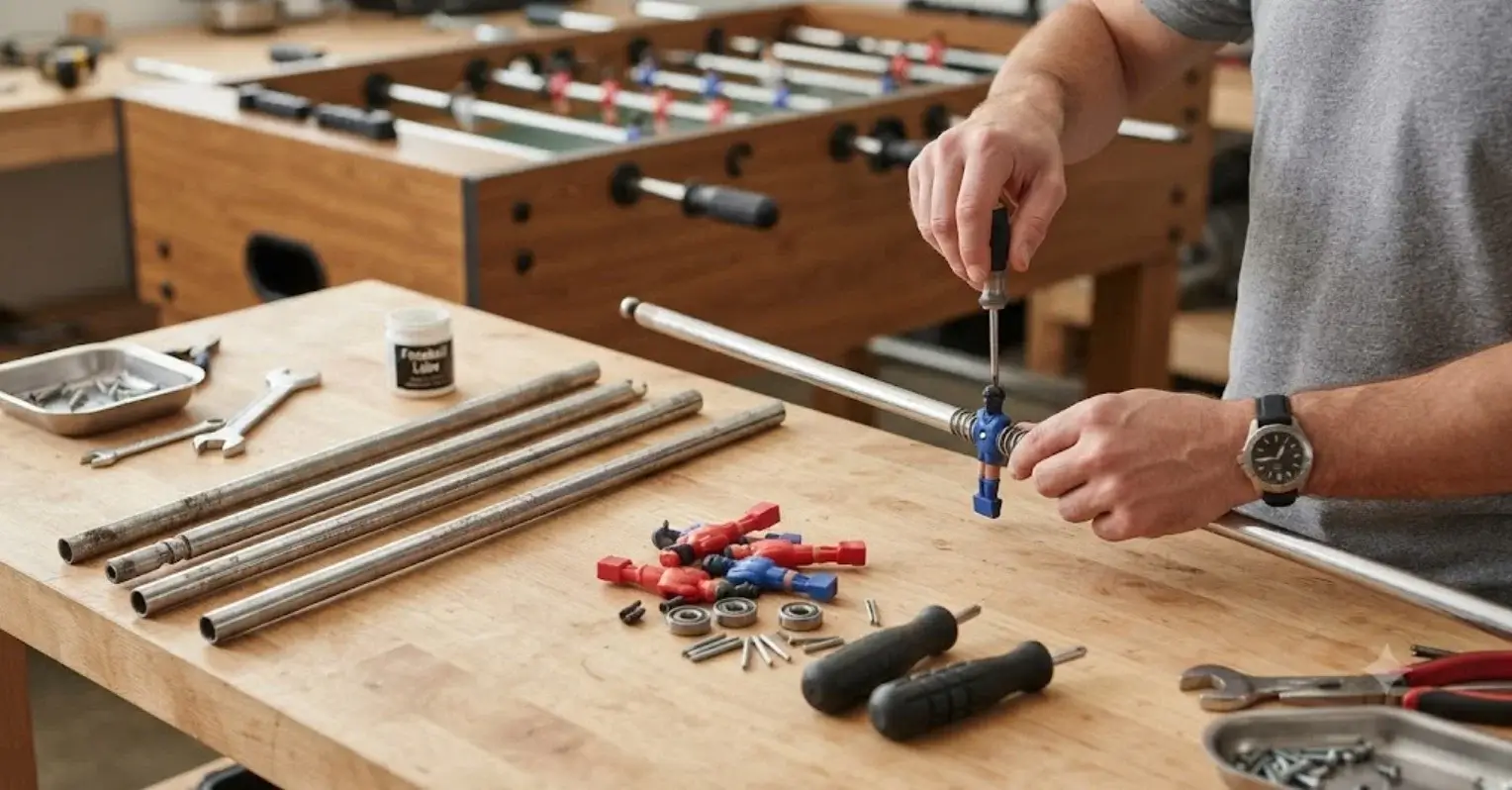
A foosball table rarely breaks all at once. It usually complains first.
- A sticky rod here.
- A loose handle there.
- One cracked player who suddenly performs like a retired goalie.
The good news is that most foosball repair jobs are smaller than they look. Many buyers assume a damaged table is done for, but worn bearings, loose cabinet bolts, broken men, dirty rods, and tired bumpers are often easy to fix with basic tools and the right replacement parts.
This guide walks you through practical foosball table repair without turning your game room into a parts explosion.
Quick Diagnosis: What’s Wrong With Your Foosball Table?
Before you grab a screwdriver, diagnose the problem. Guessing can lead to unnecessary disassembly, wrong parts, or damaged rods.
Use this table as your shortcut. It helps you spot the likely issue and decide where to start.
| Problem | Common Cause | What to Check First | Likely Fix |
| Sticky rods | Dirty rods, gunky rods, dry bearings, too much lubricant | Rod surface, split bearings, bearing nuts | Clean rods, clean bearings, and apply a small amount of silicone lubricant |
| Bent rods | Hard play, table abuse, moving damage | Rod straightness, rod scraping cabinet wall | Replace damaged foosball rods if badly bent |
| Broken foosball man | Cracked player, loose roll pin, impact damage | Player body, roll pin, player spacing | Replace the broken men or re-pin the player |
| Loose handle | Worn handle, loose pin, stripped fit | Wooden handles, plastic handles, pinned handles | Tighten, re-pin, or replace the handle |
| Worn bearings | Bearing wear, cracked bearing halves | Rod movement, split bearings, bearing nuts | Replace worn bearings and refit bearing nuts |
| Table wobble | Loose cabinet bolts, uneven legs, loose levelers | Leg levelers, table feet, cabinet screws | Tighten the hardware and level the table |
| Stuck ball return | Jammed ball return, debris, damaged tray | Ball return tray, ball entry cup, goal box | Clear the jam and repair or realign the return |
| Warped playfield | Moisture, age, poor storage | Playfield surface, dead spots, lifted laminate | Repair if minor, replace if severe |
| Loose cabinet bolts | Regular play, moving the table, weak hardware | Side rails, cabinet walls, washers, and nuts | Tighten bolts or replace stripped hardware |
Many buyers shopping for a used football table should check this list before purchase. A loose handle is minor. A warped playfield can be a deal breaker.
Tools and Replacement Parts You May Need
You do not need a professional shop for basic foosball table repair. You do need the right tool for the right part.
Using pliers on a roll pin, for example, is how a small repair becomes a long afternoon.
Common tools and parts include:
| Tool or Part | Why You May Need It |
| Roll pin punch | Taps out old roll pins without crushing the rod |
| Hammer and punch | Removes stuck pins with controlled force |
| Bearing wrench | Loosens or tightens bearing nuts on compatible tables |
| Allen wrench | Removes certain handles, legs, or cabinet hardware |
| Socket wrench | Tightens cabinet bolts, washers, and nuts |
| Screwdriver set | Handles scoring beads, cabinet screws, and accessories |
| Rubber mallet | Helps with gentle fitting without metal-on-metal damage |
| Silicone lubricant | Reduces rod friction when used sparingly |
| Replacement roll pins | Secures foosball men and some handles |
| Split bearings | Replace cracked or worn bearing halves |
| Rubber bumpers | Protect players, walls, and bearings from impact |
| Replacement men | Fixes cracked players or missing foosball guys |
| Replacement rods | Needed for bent rods, rusted rods, or damaged rod holes |
| Leg levelers | Fixes uneven table legs and table wobble |
| Cabinet screws | Repairs loose sidewalls, strips, and accessories |
Tip: Keep a microfiber cloth nearby. Rods collect grime faster than players collect excuses after missing an open goal.
Before You Start: Check the Brand, Rod Size, and Part Compatibility
Foosball parts are not universal. A part that fits one table may not fit another, even if it looks close online.
This matters most with Tornado foosball table repair because Tornado tables use specific men, rods, bearings, handles, and roll pins depending on the model and cabinet style.
Before ordering foosball replacement parts, confirm:
- Table brand
- Model name or model number
- Rod diameter
- Bearing type
- Player attachment type
- Counterbalanced men or non-counterbalanced men
- Hollow rods or solid rods
- Handle style
- Cabinet wall thickness
- Tornado vs generic replacement parts
A football table can look simple from the outside, but small sizing differences can cause big problems. Wrong bearings may not seat properly. Wrong men may not align with the ball. Wrong roll pins may fit loosely or damage the rod hole.
For Tornado tables, check whether your table uses snap-in bearings, split bearings, bearing nuts, or a specific Tornado bearing wrench. Tornado commercial table parts are usually more precise than generic parts, so compatibility matters.
Best practice: Measure the old part before buying the new one. Do not rely only on the picture.
How to Disassemble a Foosball Table Without Creating More Problems
Disassembly should feel organized, not like a mystery box of rods, screws, and regrets.
Take your time here. Most repair mistakes happen when people pull rods too quickly, remove handles unnecessarily, or forget where spacers and bumpers were placed.
Before starting foosball table disassembly:
- Take photos from every side
- Photograph player direction and spacing
- Remove balls, score markers, and loose accessories
- Label rods by position if needed
- Keep small hardware in bags or cups
- Work on one rod at a time when possible
To disassemble a foosball table safely:
- Remove accessories first.
Take off scoring beads, ball entry cups, trim pieces, or loose parts that block access. - Remove handles only if needed.
Some repairs can be done without handle removal. Do not create extra work. - Remove bearings or bearing nuts.
Split bearings may separate into bearing halves. Keep matching parts together. - Pull rods out carefully.
Support the rod as it exits the cabinet wall. Watch for bumpers, spacers, and players. - Remove legs last if needed.
Only remove legs for major cabinet repair, storage, or transport.
Large football table cabinets are easier to manage with two people. Do not drag the table across the floor. Sliding can loosen legs, stress cabinet bolts, and create table wobble.
How to Fix Sticky, Rough, or Hard-to-Move Rods
Sticky rods are one of the most common foosball repair issues. They make even a quality table feel cheap.
The cause is usually simple: dirt, dried lubricant, bearing wear, or over-tightened bearing nuts.
Start with cleaning before replacing parts.
To fix sticky rods:
- Wipe each rod with a microfiber cloth.
- Use a mild degreaser if the rods feel gunky.
- Clean inside split bearings or bearing halves.
- Check for bearing wear or cracked bearings.
- Loosen bearing nuts slightly if they are over-tightened.
- Apply a small amount of silicone lubricant.
- Slide the rod back and forth to spread it evenly.
- Wipe off excess lubricant.
Do not over-lubricate. More lubricant can attract dust and create sticky rods again.
Also, avoid heavy oils. Many table owners use silicone lubricant because it reduces rod friction without leaving the same heavy residue as some general-purpose oils.
Check for bent rods if cleaning does not help. A rod that scrapes the cabinet wall or moves roughly in one section may be bent, rusted, or misaligned.
Quick test: Roll the rod on a flat surface after removal. If it wobbles badly, replacement may be better than trying to straighten it.
How to Remove and Replace Foosball Rods
Rod removal is straightforward when you keep the order of parts intact. The challenge is remembering where every bumper, spacer, washer, and player belongs.
This is especially important on the goalie rod, two-man rod, three-man rod, and five-man rod because each rod has a different layout.
To remove foosball rods:
- Take a photo of the rod before disassembly.
- Remove the handle if it blocks the rod.
- Loosen or remove bearing nuts.
- Separate split bearings if your table uses them.
- Remove roll pins from players if needed.
- Slide players, rubber bumpers, and plastic spacers off the rod.
- Pull the rod out slowly through the cabinet wall.
Replace the rod if you notice:
- Bent rods
- Rusted rods
- Deep scratches
- Damaged rod holes
- Rod scraping the cabinet wall
- Rough movement after cleaning
- A rod that will not stay aligned
When installing a replacement rod, match the rod type carefully. Some tables use hollow rods, while others use solid rods. Mixing the wrong type can change the feel of the table and cause parts compatibility issues.
After installation, test rod movement before re-pinning every player. It is easier to fix alignment now than after full reassembly.
How to Replace a Broken Foosball Man or Player
A broken foosball man is not just cosmetic. A cracked player can affect ball control, passing, shooting, and player alignment.
Common signs include a loose player, a cracked player body, a player spins loose, or a man who will not stay straight.
You may see this repair called:
- Foosball men replacement
- Foosball players replacement
- Foosball guy replacement
- Foosball player replacement
- Fixing a broken foosball man
Different words, same problem. Your player has left the match early.
To replace foosball players:
- Identify the player type.
Check whether you have counterbalanced men or non-counterbalanced men. - Check the attachment method.
Many players use roll pins. Some use screws or bolts. - Support the rod.
Use a support block behind the player before tapping the pin. - Tap out the roll pin.
Use a roll pin punch and light hammer taps. - Slide the broken player off.
Remove bumpers and spacers only if needed. - Install the replacement man.
Match the foot direction with the other players. - Check player spacing.
The player should line up correctly with teammates and opponents. - Repin the player.
Make sure the roll pin is seated and secure.
Misaligned players can cause poor passes, blocked shots, or dead spots near the wall. On better tables, even small spacing errors are easy to feel during play.
Buyer note: If you are repairing an older used table, replace one broken player only if the rest are still solid. If several are cracked, a full set may give more consistent play.
How to Replace Tornado Foosball Players
Tornado tables deserve their own note because the parts are more specific.
If you are searching for how to replace foosball players Tornado style, focus on matching the exact Tornado men, rods, roll pins, and bearings used by your table model.
For Tornado player replacement:
- Use compatible Tornado men
- Confirm counterbalanced men if your table uses them
- Use Tornado roll pins or properly sized replacement roll pins
- Support the rod before punching pins
- Check Tornado split bearings while the rod is out
- Inspect Tornado rod bumpers for wear
- Use the correct Tornado bearing wrench if bearing nuts are installed
To replace a Tornado foosball player, line up the replacement man with the existing players before pinning it. The foot angle and spacing matter.
A crooked player may still spin, but it will not play right. Foosball is already humbling enough without giving your opponent free deflections.
How to Remove an Old Foosball Roll Pin
Old roll pins can be stubborn. Some are loose. Others feel welded in place after years of play.
Do not attack the pin with random tools. A damaged rod hole can make the replacement player lose forever.
To remove an old foosball roll pin:
- Place a support block behind the rod.
- Line up a roll pin punch with the pin.
- Use a hammer and punch with light, straight taps.
- Tap out roll pins slowly.
- Catch the old pin as it exits.
- Avoid widening the rod hole.
- Inspect the hole before installing the new pin.
If the roll pin is stuck inside the rod, use controlled taps from the opposite side. Do not drill unless you know exactly what you are doing. Drilling can enlarge the hole, scar the rod, or make the new pin fit poorly.
Replace loose roll pins. Reusing a weak pin can cause the player to spin loose again.
Safety note: Wear eye protection when using a hammer and punch. Small metal pieces can move fast.
How to Replace Bearings, Bumpers, Washers, and Spacers
Bearings, bumpers, washers, and spacers are small parts, but they control how smooth the table feels.
When they wear out, you may notice rough rod movement, rough rod slides, cracked bearing halves, hardened bumpers, or uneven player spacing.
Common parts in this repair include:
- Rod bearings
- Split bearings
- Bearing halves
- Bearing nuts
- Rubber bumpers
- Rod bumpers
- Plastic spacers
- Washers and nuts
To replace foosball bearings:
- Remove the rod or slide it enough to access the bearing.
- Unscrew bearing nuts if your table uses them.
- Separate split bearings carefully.
- Clean the area around the cabinet wall.
- Install the new bearing halves or bearing assembly.
- Refit bearing nuts without over-tightening.
- Test rod movement before final assembly.
To replace bumpers and spacers:
- Remove the rod from one side.
- Slide off the worn bumper or spacer.
- Match the replacement part sizing.
- Reinstall in the same order.
- Check player spacing after reassembly.
A worn bumper can harden over time. When that happens, it stops cushioning impact and can make the table louder, rougher, and harder on the cabinet walls.
Replace bumpers in pairs when possible so the rod feels balanced.
How to Remove or Replace Foosball Handles
A loose handle can ruin control. It also makes the table feel cheaper than it is.
The fix depends on the handle type. Wooden handles, plastic handles, pinned handles, and press-fit handles do not come off the same way.
Before removing foosball handles, check whether they are:
- Threaded
- Pinned
- Press-fit
- Glued
- Secured with a screw or set screw
To remove foosball handles:
- Look for a visible pin or screw.
- Remove the fastener if present.
- Twist gently if the handle is threaded.
- Use steady pressure on press-fit handles.
- Avoid crushing the rod with pliers.
- Replace damaged handles with compatible parts.
If the handle will not come off, stop and inspect it again. Forcing it can bend the rod or split the handle.
For a loose handle, replacement is often cleaner than trying to patch a worn inner fit.
How to Fix Ball, Goal, and Ball Return Problems
Ball problems can make a good table feel unpredictable. Sometimes the issue is the ball. Sometimes it is the return path.
A football table ball that is too slick, too worn, or the wrong size can change how shots, passes, and banks behave.
Check for:
- Worn ball
- Wrong ball size
- Slick ball
- Ball return jam
- Stuck ball return
- Loose goal box
- Damaged ball return tray
- Misaligned ball entry cup
To fix ball and return issues:
- Replace worn balls with the correct size and style.
- Clear debris from the ball return tray.
- Check the goal box for loose parts.
- Make sure the ball entry cup is secure.
- Look for damaged plastic or warped return paths.
- Test several balls before closing the table.
If the ball gets stuck in return repeatedly, do not blame the ball first. Look for screws, broken plastic, dust buildup, or a tray that shifted out of alignment.
The ball return should feel boring. In foosball repair, boring usually means fixed.
How to Fix Table Wobble, Loose Legs, and Leveling Issues
A table that rocks during play makes every match feel unfair.
Table wobble usually comes from loose cabinet bolts, uneven table legs, loose leg levelers, stripped screw holes, or a weakened frame.
To fix wobble:
- Check all cabinet bolts.
- Tighten leg hardware evenly.
- Inspect table feet and leg levelers.
- Adjust levelers until the table sits flat.
- Use a level tool on the playfield surface.
- Repair stripped screw holes with wood filler or proper inserts.
- Recheck after a few games.
Do not overtighten cabinet bolts into weak material. Some older cabinets use MDF or particleboard, and aggressive tightening can make the hole worse.
If bolts keep loosening, use proper replacement hardware. In some cases, a small amount of threadlocker can help on metal fasteners, but avoid using it where future disassembly may be needed.
For a buyer comparing a used football table, wobble is worth testing before purchase. Loose levelers are easy. Cabinet separation is not.
Cabinet and Playfield Damage: Repair or Replace?
Cabinet and playfield damage need a different mindset. Small hardware repairs are simple. Structural repairs can be risky.
The goal is to decide whether the table is worth saving.
Common cabinet and playfield issues include:
- Loose sidewall
- Split cabinet
- Cabinet separation
- Chipped corners
- Damaged laminate
- Warped playfield
- Playfield sagging
- Dead spots on the field
- Loose goal box
- Playfield surface lifting
- Water-damaged MDF
Minor cabinet damage may be repairable with clamps, wood glue, cabinet screws, washers, or wood filler. Loose sidewalls can sometimes be resecured if the material is still solid.
A warped playfield is more serious. If the ball rolls strangely, stops in dead spots, or the playing surface has lifted, the repair may not restore proper play.
Foosball playfield replacement and foosball playing surface replacement can be difficult because many tables were not designed for easy field swaps. On lower-quality tables, the labor may not be worth it.
Repair may make sense when:
- Damage is small and localized
- Cabinet walls are still square
- Rod holes align properly
- Replacement parts are available
- The table has sentimental or quality value
Replacement may make more sense when:
- The cabinet is split badly
- The playfield is warped
- MDF has water damage
- Rod holes no longer align
- The table frame is unstable
- Parts are unavailable
This is where honesty saves money and frustration. Not every old table needs restoration. Some need retirement and a polite thank-you for their service.
Reassembly and Final Repair Checklist
Reassembly is not just putting parts back. It is your chance to catch mistakes before the first game.
Move slowly and test each repair as you go.
Before the final play, check:
- Rods slide smoothly
- Players face the right direction
- Roll pins are fully seated
- Bearing nuts are secure but not too tight
- Split bearings sit correctly
- Rubber bumpers are in place
- Plastic spacers are in the right order
- Handles are tight
- Cabinet bolts are snug
- Leg levelers are adjusted
- Ball return works
- No rod scrapes the cabinet wall
- No table wobble remains
- Player alignment looks even
- The playfield surface is clean
After repair, test play gently. Do not start with a power-shot tournament. Give the table a few minutes to reveal anything loose, rough, or misaligned.
As the old game room saying goes, “The table tells the truth after three rallies.”
Should You Repair or Replace the Foosball Table?
Not every repair deserves the same effort. Some fixes are simple. Others can cost time, patience, and replacement parts that may not make sense for the table’s value.
Use this as a practical guide.
| Usually Worth Fixing | Maybe Worth Fixing | Usually Not Worth Fixing |
| Broken men | Bent rods | Severe cabinet damage |
| Worn balls | Loose cabinet | Warped playfield |
| Sticky rods | Damaged laminate | Water-damaged MDF |
| Loose handles | Minor playfield lift | Misaligned rod holes |
| Worn bumpers | Rusted rods | Parts unavailable |
| Dirty bearings | Loose sidewall | The repair cost is higher than the table value |
| Loose levelers | Split cabinet | Bad frame structure |
For buyers, this matters before buying a used table. A cracked player is not scary. A warped playfield should make you pause.
A well-built table with available parts is often worth repairing. A low-quality table with severe cabinet damage may become a project that never ends.
Foosball Junkie’s practical rule: fix playability first. Cosmetics can wait. Smooth rods, solid players, level legs, and a working ball return matter more than perfect corners.
How to Restore an Old Foosball Table?
Foosball table restoration is essentially a complete repair process for an older, neglected, or heavily worn table. Instead of fixing one broken player or sticky rod, you inspect and refresh the entire table.
To restore a foosball table, begin by checking the cabinet, playfield, rods, bearings, players, handles, legs, and ball return. Clean the rods and playing surface, tighten loose cabinet and leg hardware, replace worn bearings and bumpers, and install compatible players or handles where needed. Work on one rod at a time so the player, bumper, and spacer order remains correct.
Restore playability before appearance. Smooth rods, properly aligned players, level legs, and a working ball return matter more than scratches or faded trim.
Restoring a foosball table is usually worthwhile when the cabinet remains solid, the playfield is flat, and replacement parts are available. Severe water damage, cabinet separation, misaligned rod holes, or a badly warped playfield may make replacement more practical than restoration.
FAQs About Foosball Table Repair
How do you repair a foosball table with sticky rods?
Clean the rods first with a microfiber cloth. Remove gunk, clean the bearings, and check for bearing wear. Then apply a small amount of silicone lubricant. If the rod still moves roughly, check for bent rods or over-tightened bearing nuts.
How do you replace a broken foosball man?
Support the rod, tap out the roll pin with a roll pin punch, slide off the broken player, install the replacement man, check player alignment, and re-pin it securely. Match counterbalanced men or non-counterbalanced men correctly.
How do you remove old foosball roll pins?
Use a roll pin punch, hammer, and support block. Line up the punch with the pin and tap gently until the pin exits. Avoid drilling unless necessary because drilling can damage the rod hole.
How do you remove foosball players from rods?
Remove the roll pins, screws, or fasteners holding the players in place. Then slide the players off the rod. You may need to remove bumpers, spacers, and bearings depending on the table design.
How do you replace foosball bearings?
Remove or loosen the rod, unscrew bearing nuts if present, separate the split bearings, and install new bearing halves or replacement bearings. Refit the bearing nuts without over-tightening and test rod movement.
How do you remove foosball handles?
Check whether the handles are pinned, threaded, press-fit, or secured with screws. Remove any fastener first. Then twist or pull carefully based on the handle type. Avoid using crushing force on the rod.
Can you replace Tornado foosball players yourself?
Yes, many Tornado players can be replaced at home with the correct Tornado men, roll pins, pin punch, and support block. Make sure the replacement player matches your table model and player style.
Can a bent foosball rod be fixed?
A slightly bent rod may sometimes be improved, but replacement is usually better for serious bends. A bent rod can cause rough movement, cabinet scraping, and poor control.
When should you replace foosball balls?
Replace foosball balls when they are worn, slick, chipped, misshapen, or the wrong size for the table. Worn balls affect passing, control, and shot consistency.
Is an old foosball table worth repairing?
It depends on the damage and part availability. Sticky rods, broken men, loose handles, worn bumpers, and dirty bearings are usually worth fixing. Severe cabinet damage, water-damaged MDF, warped playfields, and unavailable parts often make replacement more practical.
Helpful Resources and Part-Checking Links
Use these resources to confirm part compatibility before ordering. Manufacturers and suppliers may update parts, so always match your table model before buying.
- Foosball.com: https://www.foosball.com/
- Valley-Dynamo and Tornado information: https://www.valley-dynamo.com/
- International Table Soccer Federation: https://www.tablesoccer.org/
Also check your table’s original manual if you have it. A manual is often the fastest way to confirm rod size, bearing type, player style, and cabinet hardware.
Final Takeaway
Foosball table repair is not about rebuilding the whole table. It is about finding the weak point and fixing it cleanly.
- Start with diagnosis.
- Clean before replacing.
- Measure before ordering.
- Support rods before punching pins.
- Test everything before calling the repair done.
A cared-for football table can play smoothly for years, even after a few broken men, sticky rods, loose handles, and dramatic family tournament moments.
Fix what affects play first. The table does not need to look brand new to feel great again.