Here is a truth that casual players rarely discover: the goalie setup on your football table quietly decides your entire gameplay experience. Not the cabinet. Not the price tag. The rod configuration at the goal box area. Change that one thing, and you are playing a different game entirely.
Most players never question the default. They buy a table, play a few rounds, and assume three goalies is just how foosball works. But the moment you try a one-man goalie foosball table, the game suddenly feels tighter, faster, and a lot more demanding. In a good way.
This guide will help you understand exactly what changes with a single goalie foosball table, whether the 1 vs 3 goalie debate actually matters for your play style, and which tables are genuinely worth buying if one-goalie gameplay is your goal.
What Is a One-Goalie Foosball Table?
The term sounds simple enough, but it actually describes a specific rod layout that changes how defense works at a fundamental level.
On a standard 3-man goalie setup, three players occupy the goalie rod, spreading across the goal box area and covering a wide section of the playfield. It is forgiving by design. Even sloppy defensive positioning can save goals because you have more physical coverage built right into the rod distribution.
A foosball table with one goalie flips that logic entirely. A single player sits on the goalie rod, centered in front of the goal. There are no extra bodies helping out. The defensive rod roles shift, player spacing becomes wider, and the entire goal coverage responsibility falls on one figure, and the skill of the person controlling it.
Visually, the playfield spacing opens up more near the goal. Passing lanes widen. And the game immediately begins to reward precision control over luck.
One Goalie vs Three Goalie: Full Gameplay Breakdown
This is the section most foosball buyers skip, and then later regret. Understanding the gameplay difference between a foosball table, one goalie, or 3 configuration is not just nerdy trivia. It directly affects whether you enjoy the table you buy.
The Structural Difference
In a 1-man goalie setup, the rod layout uses one goalkeeper with the defensive rod handling more responsibility than usual. In a 3-man goalie setup, that same area holds three players, essentially building a partial wall in front of the goal.
The player formation changes everything downstream. Spacing, ball movement, and shooting angles all shift. This is not a cosmetic difference. It is a gameplay philosophy difference.
Defensive Positioning: Night and Day
With three goalies, even mediocre defensive positioning rarely gets punished. The width of the goal coverage is simply too wide for most shots to sneak through cleanly.
With a single-man goalie foosball table, defensive difficulty spikes immediately. You have reduced goal coverage, and every shot angle your opponent finds becomes a real scoring threat. Your reaction time and manual control are not optional anymore. They are the only things standing between you and giving up cheap goals.
This is what pro players love about the setup. The challenge is real.
Offensive Flow and Passing Lanes
Here is where things get interesting from the attacking side.
With one goalie, passing lanes open up significantly near the goal. Bank shots that would normally be blocked by a three-man wall suddenly become viable. Shot accuracy gets rewarded more directly because a good shot actually goes in instead of hitting a stray goalie rod player.
The offensive flow on a foosball table single goalie setup feels more dynamic and intentional. You are not just firing blindly, hoping something gets through. You are creating space, setting up angles, and executing.
Control vs Randomness
This is the honest core of the foosball one goalie vs three debate.
The 3-man goalie setup introduces a layer of randomness. Players bounce off the wall of goalies unpredictably, goals happen by accident, and defense can feel more like chaos management than actual skill. For casual play, that is actually fun. It keeps family game nights competitive even when skill levels are unequal.
The 1-goalie foosball table strips that randomness away. What you get instead is skill-based gameplay that rewards practice, study, and deliberate improvement. The skill ceiling is noticeably higher. So is the learning curve.
Neither is “wrong.” They are just built for different people.
Ball Movement and Rebound Control
One goalie setup changes how the ball behaves coming off the back wall. Rebound control becomes a legitimate tactical skill. Because there is more open space near the goal, a deflected ball does not automatically die in a crowd of defensive figures. It stays live, which means your ability to read and react directly influences the next possession.
Ball movement on the whole feels faster and more fluid in a single goalie foosball table setup. The game breathes differently.
Quick Comparison: 1 Goalie vs 3 Goalie
Factor | One Goalie | Three Goalies |
Difficulty Level | High | Low |
Skill Ceiling | High | Medium |
Defensive Difficulty | High | Low |
Gameplay Speed | Faster | Slower |
Control vs Randomness | Control | Random |
Beginner Friendly | No | Yes |
Competitive Play | Yes | Casual only |
Scoring Frequency | Higher (skilled shots) | Higher (lucky shots) |
Why Pro Players Prefer One Goalie
There is a reason the tournament standard in competitive foosball leans heavily toward the one-goalie configuration. It is not a tradition. It is intentional design.
Competition play at serious levels demands that every goal be earned. When a 3-man goalie setup is in play at that level, skill differences get blurred. Players with better technique get bailed out by defensive bodies that were never under their real control. That defeats the whole point.
The ITSF rules and the broader competitive environment of professional foosball have long emphasized setups that amplify shot accuracy, advanced play, and genuine manual control. Pro players train extensively on one-goalie configurations precisely because the setup punishes lazy defense and rewards disciplined offense.
When you watch experienced players on a foosball table with one goalie, you notice something: their defensive movements are deliberate and surgical. They are not guessing. They are reading angles, cutting lanes, and positioning with a purpose. That level of gameplay does not develop on a three-goalie table.
As legendary foosball competitor Todd Loffredo famously noted about the mental side of the sport: “The best players are thinking two or three shots ahead.” That kind of thinking only matters when the setup actually requires it. The single goalie setup requires it.
Who Should Use a One-Goalie Setup?
Not every buyer should gravitate toward a one-goalie foosball table, and being upfront about that is important. The right setup depends entirely on how you intend to play.
The one-goalie setup is ideal for:
- Competitive players who want to sharpen their game and measure real improvement
- Players focused on training practice and building proper technique
- Experienced foosball enthusiasts who have outgrown casual play
- Anyone interested in match play or following tournament-style rules
- Players who want a higher skill ceiling and are willing to invest time in reaching it
The one-goalie setup is not ideal for:
- Kids or beginners who are still learning basic mechanics
- Family use where skill gaps between players are wide
- Casual gameplay situations where the goal is relaxed fun, not competition
- Game room settings where multiple people of mixed abilities will play regularly
The honest real-world insight here is that player preference matters far more than any rule. Some experienced players genuinely enjoy the randomness of three goalies at home, even if they compete with one goalie at tournaments. Practical use varies significantly depending on the environment. A home setup is different from a competitive environment, and there is no shame in choosing based on what actually fits your life.
Common Mistakes People Make With One-Goalie Tables
This section might save you some frustration.
Assuming all tables support one goalie properly is the most common mistake. Many cheaper football tables technically allow you to remove players from the goalie rod, but the resulting playfield spacing feels wrong because the rod was never designed with a single-player layout in mind. The goal box area ends up misaligned with the actual player position, and the gameplay difference becomes more confusing than enjoyable.
Ignoring rod distribution and spacing is another trap. A proper single-man goalie foosball table is engineered from the start with the correct measurements between rods. Improvised one-goalie setups on three-goalie tables produce awkward gaps and unnatural ball movement.
Some buyers also fall into the mistake of thinking that removing players equals the same gameplay. It does not. The table configuration matters holistically. Rod weight, player counterbalancing, and playfield surface all interact differently when there is only one figure on the goalie rod. A table not built for it will feel off in ways that are hard to diagnose but easy to feel.
Finally, choosing a low-quality table and expecting good one-goalie performance is a recipe for disappointment. Poor ball control, weak rods, and lightweight cabinets expose every flaw in a setup where there are no extra bodies compensating for bad construction.
Can You Convert Any Table to One Goalie?
The short answer is: sometimes, but not always well.
Some manufacturers offer an adjustable goalie system or a conversion setup specifically designed for switching between one and three goalie configurations. The KICK Titan 55″, for example, includes a ramp kit that supports this kind of flexibility. When the conversion setup is engineered into the original design, it works reasonably well.
The problem arises with tables that were only ever designed for three goalies. Even if you physically remove two players from the rod, the rod layout was not optimized for the single-player position. The table balance can shift slightly. Gameplay difference becomes noticeable, and not in a fun way.
If you are serious about one-goal foosball, buy a table that was designed with it in mind rather than retrofitting something that was not.
Best Foosball Tables for One-Goalie Play
The tables below were selected because they make genuine sense for controlled, skill-based gameplay. Not every popular football table belongs on this list, and that is deliberate. At Foosball Junkie, we care about matching you to the right table, not just listing popular products. If you want a broader look at top options across all styles and budgets, our best foosball tables guide covers the full landscape.
1. Tornado Tournament 3000 Foosball Table
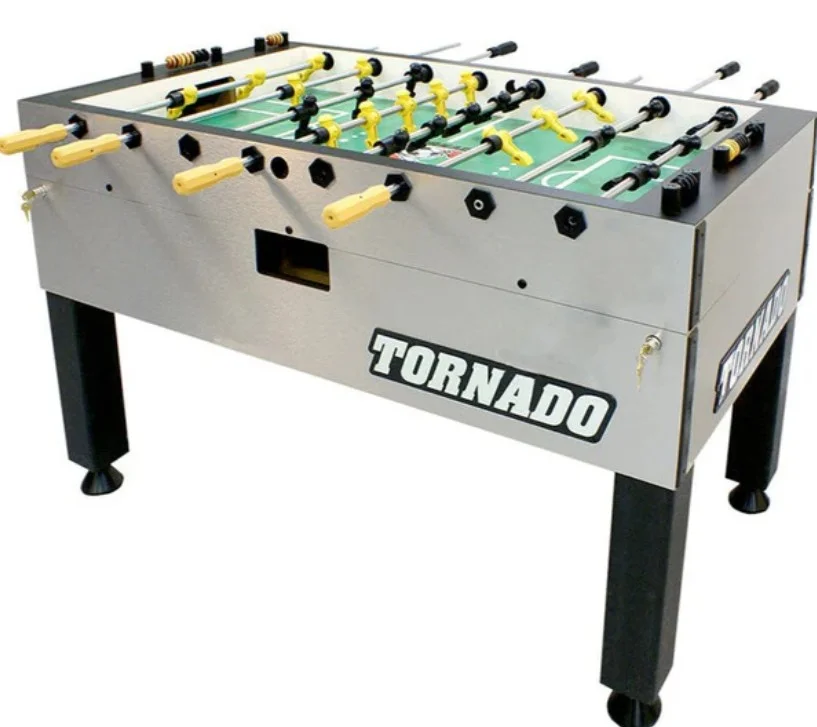
The Tornado Tournament 3000 is the benchmark for serious foosball. It is not just a great table. It is the official table of the Tornado National Tour, the National Foosball League, and ITSF-sanctioned events. When a table becomes the gold standard for competition play at that level, it earns a different category of trust.
The rod configuration on the Tournament 3000 features chrome-plated, heat-treated hollow steel rods that are noticeably different from anything in the mid-range. They are lighter without being fragile, which directly translates to better reaction time and shot accuracy. The patented counterbalanced men add to that precision. Nothing drags, nothing wobbles.
This table ships with a 3-goalie setup as standard, which is the tournament standard configuration used in professional foosball. At this level, that is not a limitation. The 3-man setup here is tight and disciplined because the entire table is built to support precision control and advanced play. The table stability and 355 lb weight mean zero flex during aggressive play.
The split cabinet design with full-access top is a practical touch for serious use. Leg levelers handle uneven floors. Abacus scoring keeps things traditional.
Build: Commercial-grade split cabinet, alloy steel frame, 3/4″ playfield, 8-sided non-slip handles. Comes with 3 high-visibility balls, silicone, bearing wrench, pin punch, and rulebook. Players report excellent rod durability and well-balanced rods even after heavy use.
Best for: Serious players, tournament-style home setups, and anyone who wants actual pro player quality at home. This is not a casual purchase, and it is not trying to be.
2. Tornado Sport II Foosball Table
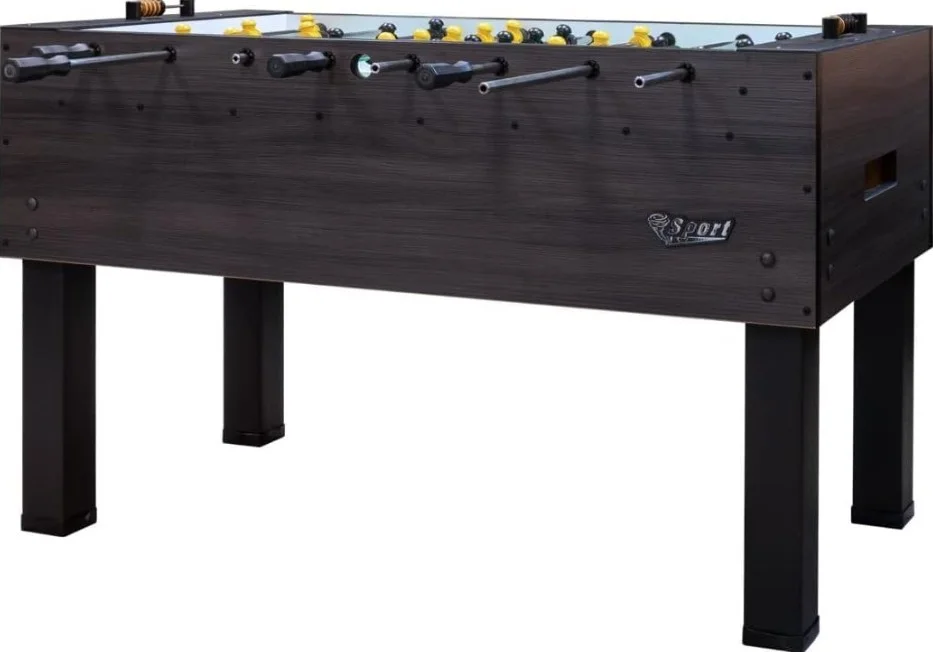
The Tornado Sport II carries the same DNA as its flagship sibling at a more accessible entry point. This is the table for someone who wants genuine Tornado build quality and skill-oriented gameplay without the full investment of the Tournament 3000.
The rod layout mirrors the Tornado philosophy: counterbalanced players, SureGrip rubberized handles, and an emphasis on manual control over passive coverage. At 205 lbs, it has real weight distribution that keeps it planted during fast exchanges.
The 1″ thick cabinet with weathered walnut laminate gives it a premium look in any game room. The 3/4″ melamine playfield provides consistent ball movement across the surface. Height-adjustable legs with boot levelers are a thoughtful addition for mixed-height players.
Assembly is required, and some buyers find the instructions less clear than they would like. But once it is together, players consistently report that it plays above its price tier.
Best for: Home players who want a step up from entry-level tables, families that take foosball seriously, and rec center setups where durability and real gameplay experience both matter. This is also a strong option for players transitioning from casual to more competitive play.
3. KICK Titan 55″ Foosball Table
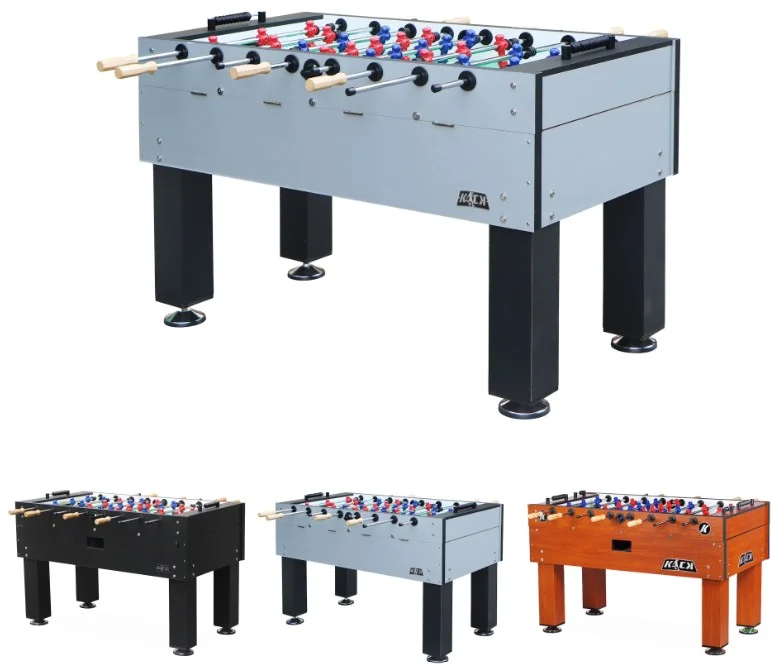
The KICK Titan earns its place on this list for a specific reason: it is one of the few tables with a built-in conversion setup that genuinely supports switching between a 1-man goalie setup and a 3-man goalie setup via an included ramp kit. That is not a marketing claim. Players who use it report that the conversion works as intended.
For buyers who want the flexibility to experience foosball 1 goalie or 3 on the same table without compromising either configuration, the Titan is the most practical option available. The rod distribution and playfield spacing were engineered to accommodate both setups.
The build is serious: solid stainless steel chrome-plated rods, premium bearings for smooth rod action, 5″ leg levelers with rubber bottoms, and side ball returns. At roughly 148 to 286 lbs (specs vary slightly), it has enough heft for stable competitive play without becoming unmovable.
The unlimited lifetime warranty is an honest statement of confidence in the cabinet’s strength and rod durability. Not many manufacturers offer that. Customers describe it as professional-grade, easy to assemble, and genuinely fun.
Best for: Buyers who want near-professional performance, genuine flexibility between goalie configurations, and a strong warranty backing the investment. Also a smart pick for players exploring the best foosball tables under $500 range, where performance matters most.
4. Garlando G-500 Foosball Table
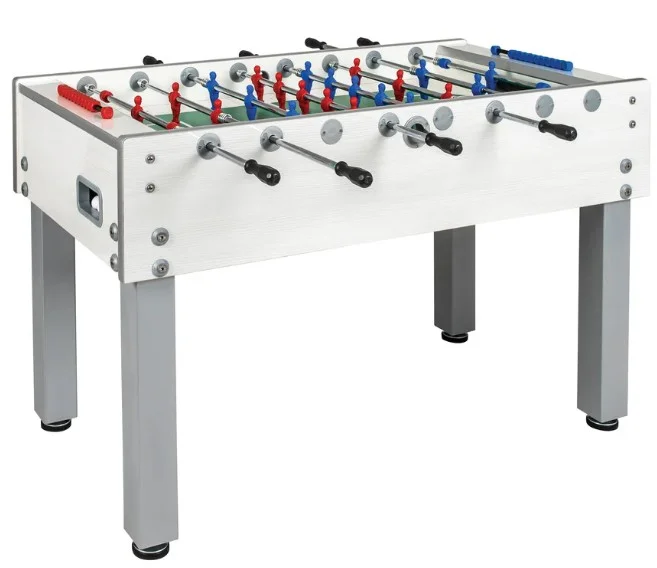
The Garlando G-500 represents something genuinely different on this list. It is the outdoor foosball table option for players who want to keep their competitive play or training practice on the patio, not just indoors.
Garlando is an Italian brand with deep roots in European professional foosball. The European playstyle it reflects involves a slightly different ball movement dynamic and passing feel compared to American-style tables. The playfield surface and player angles produce a distinctive game that experienced players actually appreciate for expanding their skill set.
The construction is built specifically for weather exposure: marine multi-layer plywood with plastic laminate, anti-rust hardware, waterproof surfaces, and fade-resistant silkscreen field lines. The vinyl cover that comes included adds another layer of protection. Anti-scratch varnished steel legs complete the outdoor-ready build.
At 172 lbs, it has respectable table stability for outdoor surfaces. Leg levelers handle patio irregularities.
Assembly is required, and some buyers note the value proposition feels premium relative to strictly indoor alternatives. But for actual performance outdoors with a design that holds up to real-world conditions, this is the standout option. Anyone looking for serious outdoor football table options will also find useful context in our outdoor foosball tables guide.
Best for: Outdoor enthusiasts, players who want a European-style gameplay experience, families with patio space, and anyone who wants a weather-resistant football table that does not sacrifice build quality.
5. KICK Legend 55″ Foosball Table
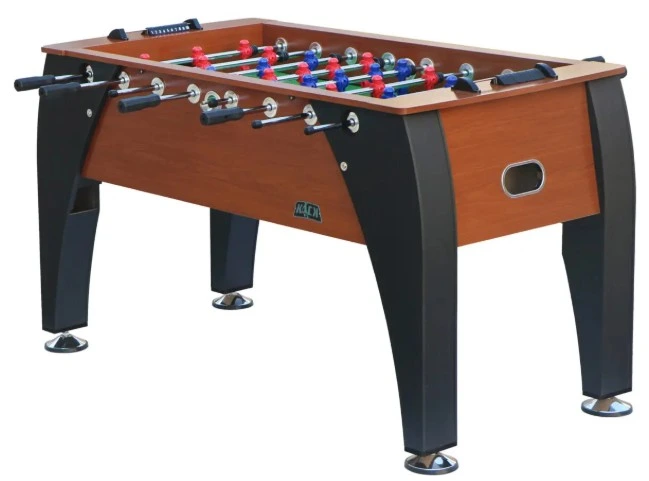
The KICK Legend 55″ is the table that bridges the gap between casual and competitive better than most options in its tier. It is not trying to be tournament-grade, and it is honest about that. But it plays above its weight class in a way that surprises most buyers.
The standout feature for this guide specifically is the switchable 1-man or 3-man goalie setup built right into the table. No conversion kit needed. The table configuration supports both setups at the design level, meaning the rod layout and playfield spacing were considered for both from the start.
Chrome rods, counterbalanced and uniformed players, no-slip wooden handles, and an official-size field make this feel genuinely close to bar-quality foosball. The scratch-resistant surface holds up well under regular use. Plastic manual scoring is functional if basic.
Assembly instructions receive mixed feedback, but the finished product earns strong marks from buyers across age groups and skill levels. Players describe near-bar quality, solid build quality, and gameplay that suits both casual gameplay and more serious skill-based gameplay, depending on the goalie configuration chosen.
Best for: Families, office game rooms, home players who want the option to explore one goalie foosball without committing entirely, and anyone looking for a balanced football table at a sensible price point.
How Table Quality Affects One-Goalie Gameplay
This section is worth reading before you finalize any decision, because it explains why two tables with technically similar specs can feel completely different in one-goalie configurations.
Rod durability is the first factor. On a single goalie foosball table, your goalie rod carries the full defensive burden. A rod that flexes, wobbles, or loses smooth action under pressure will directly undermine your precision control. High-quality rods, particularly chrome-plated hollow steel, maintain a consistent feel across thousands of shots.
The playfield surface affects how the ball travels to and from the goal. A high-quality playfield surface produces predictable ball movement, which matters enormously when you are defending alone. A rough or inconsistent surface makes it genuinely harder to read the ball’s path in time to react.
Table stability is often overlooked until you are playing. During fast, aggressive exchanges, a light or poorly built table will shift, bounce, or vibrate in ways that disrupt your shot. Weight distribution and cabinet construction determine how much of that instability filters into your hands and rods.
Grip control on the handles affects your ability to execute precise movements quickly. 8-sided or rubberized non-slip handles make a real difference during extended sessions.
When you pay for quality on a football table, you are not just paying for aesthetics. You are paying for the mechanical consistency that makes one-goalie gameplay actually rewarding instead of frustrating.
Final Verdict: Should You Choose One Goalie or Three?
The honest answer is that this decision belongs entirely to you, not to a buying guide.
Choose a one-goalie foosball table if:
- You want skill-based gameplay that grows with you
- You care about precision control and shot accuracy
- You are interested in competitive play, even casually at home
- You want to develop real technique and raise your skill ceiling
- You enjoy a faster, more demanding game with genuine advanced play potential
Choose a three-goalie setup if:
- Your priority is casual gameplay and group fun
- You play with kids, beginners, or mixed-skill groups regularly
- You want a beginner-friendly experience that everyone can enjoy immediately
- Family foosball nights are more about laughing than competing
There is no wrong answer here. The best football table is the one that actually gets used, and gets used happily. If you are unsure which direction fits your household, think about the actual people who will play most often. Their experience matters more than any configuration debate.
What is clear, though, is that one-goalie foosball deserves far more attention than it typically gets from mainstream buyers. Once you feel the difference that a single-goalie foosball table makes in terms of control, flow, and genuine skill development, it is hard to go back to three-goalie chaos and call it the better game.
Start with the right table. The gameplay will take care of itself.