06 Standout Picks: Categorized by Strength
KICK Legend 55″ Table
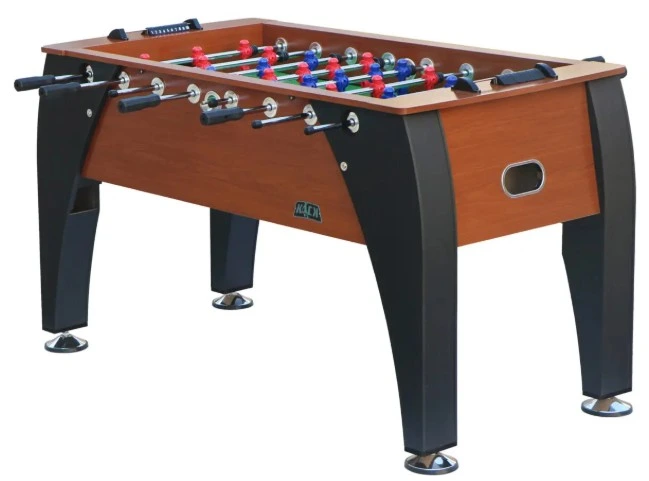
KICK’s Legend model weighs 143 pounds. That’s not marketing fluff. It’s functional mass that prevents the table from shifting during aggressive rod work.
The cabinet uses 0.75-inch engineered wood throughout. Competitors at this price often use 0.5-inch MDF on sidewalls to cut costs. That half-inch difference determines whether the table develops flex after six months of regular use.
Steel rods run through sealed bearings, not plastic bushings. During extended play sessions, plastic bushings heat up and create friction. Sealed bearings maintain smooth rotation regardless of how long you play. Users report the rods still spin freely after two years of heavy use.
The counterbalanced men matter more than most buyers realize. Standard figures swing freely, making controlled passing difficult. Counterbalanced players stay horizontal when released, enabling precise ball placement. This feature appears on tournament tables costing three times more.
KICK includes both black ABS handles and wooden grip options. Wood absorbs hand moisture better during competitive matches. ABS works fine for casual play. Having both lets you experiment.
The adjustable leg levelers extend up to 2 inches. Basement floors rarely achieve a perfect level. Most cheap tables include levelers that adjust maybe half an inch, leaving permanent tilts. KICK’s range handles severe floor irregularities.
Limitations to consider:
The table ships in multiple boxes totaling over 150 pounds. Plan for two people during assembly. Some buyers report that the assembly instructions lack clarity around the goal box installation. Budget 90 minutes for setup.
Cabinet edges use exposed screws rather than dowel joints. Not a structural issue, but visible hardware looks less refined than premium tables.
Real-world feedback:
After testing multiple foosball tables in this category, the Legend handles speed shots without the characteristic hollow thunk of cheaper models. The ball rebounds predictably off the sidewalls. Rod deflection under pressure stays minimal.
KICK Triumph 55″ Table
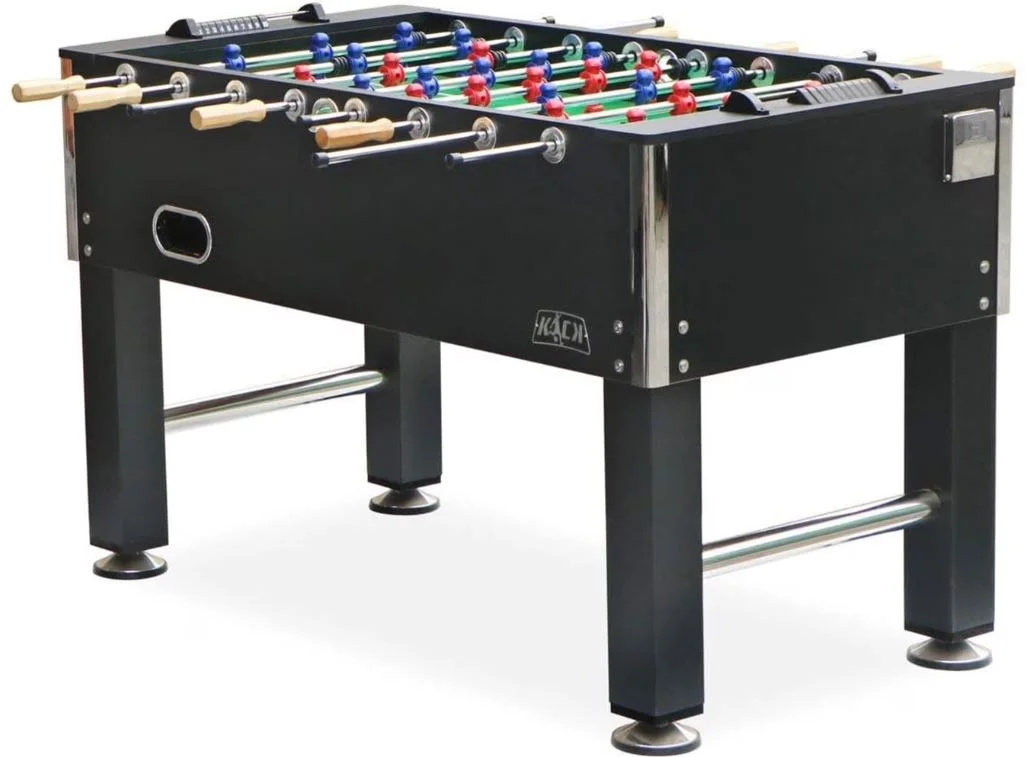
The Triumph costs the same as the Legend but weighs 24 pounds less at 119 pounds. That weight difference comes from slightly thinner cabinet walls, not inferior materials.
What makes the Triumph unique:
KICK includes two complete player sets. One set features counterbalanced men for controlled play. The second set uses traditional uniform figures preferred by players transitioning from commercial tables.
Swapping player sets takes about 20 minutes. Counterbalanced players suit strategic gameplay. Traditional figures work better for fast-paced, arcade-style matches. Having both eliminates the need to commit to one playing style permanently.
The black finish resists showing fingerprints and scuff marks better than natural wood veneers. Families with young children report that this advantage matters after months of use.
Construction quality matches the Legend in areas that affect gameplay. Same steel rod diameter. Identical bearing system. Equivalent leg leveler range. The visual design stays simpler, which explains the identical price point despite lighter weight.
Trade-offs:
The lighter cabinet requires more frequent releveling on uneven floors. The reduced mass means aggressive gameplay can shift the table slightly. Placing rubber pads under the legs solves this issue for most users.
Cabinet walls measure 0.625 inches versus the Legend’s 0.75 inches. Not a durability concern for residential use, but commercial environments might accelerate wear.
User experience notes:
Common issues include minor assembly challenges similar to the Legend. Pre-drilling holes for goal boxes improves installation. The playing surface arrives pre-laminated and doesn’t require additional treatment.
Atomic Pro Force 56″ Foosball Table
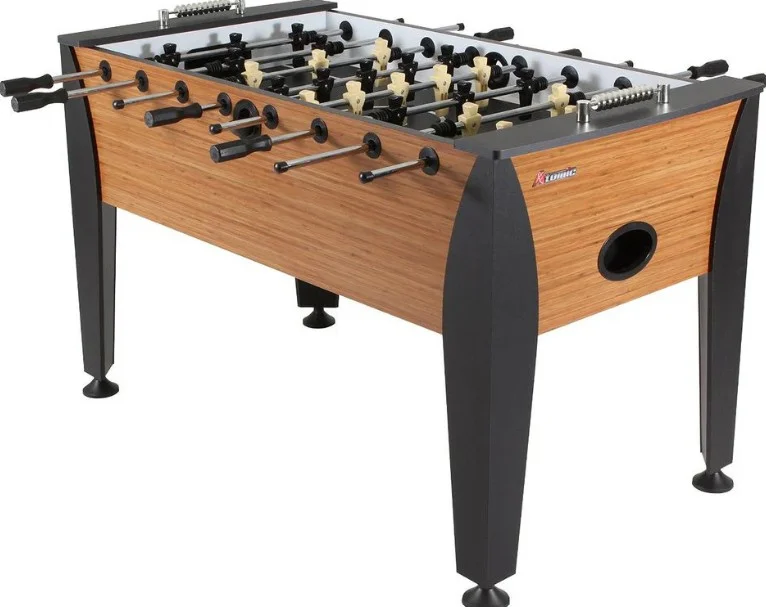
Atomic targets buyers who prioritize aesthetics without sacrificing functionality. The bamboo laminate finish looks distinct from standard black or wood grain options flooding this category.
At 60 pounds, this rates as the lightest table reviewed. Atomic achieved this through hollow steel rods and an engineered wood frame that distributes stress efficiently. Light doesn’t automatically mean flimsy, but expectations should adjust accordingly.
The 3.5-inch leg levelers exceed the industry standard for this price range. Most competitors max out around 2 inches. Those extra 1.5 inches matter for severely uneven garage or basement floors.
The internal ball return system works smoothly based on user feedback. Balls exit through side channels rather than requiring manual retrieval. This speeds up gameplay during competitive matches.
The 56-inch length provides a slightly larger playing surface than standard 54-inch models. That extra two inches increases player spacing marginally, creating room for more deliberate shot placement.
Design considerations:
The hollow rods save weight but transmit more vibration during aggressive play. Solid steel dampens that feedback. Neither approach is objectively better, but the difference is noticeable during back-to-back comparisons.
Sixty-pound tables move more easily, which helps repositioning but hurts stability during intense matches. Placing the table against a wall partially mitigates this issue.
Durability concerns from long-term owners:
Some buyers report rod bearings developing play (looseness) after 12-18 months of heavy use. Not universal, but worth monitoring. Replacement bearings cost under $20 and take 30 minutes to install.
The bamboo finish shows scuffs more readily than darker laminates. Aesthetic preference varies, but maintenance requirements increase slightly.
EastPoint Sports Deluxe Foosball Table
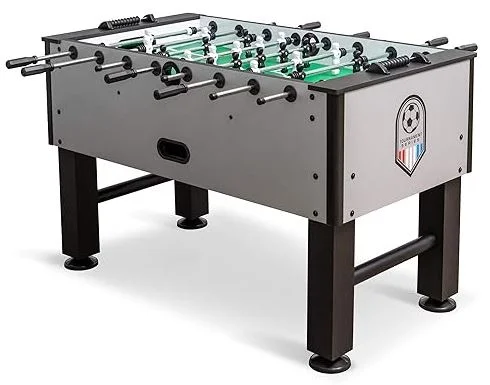
EastPoint builds this table for volume play, not precision technique. The 54.75-inch competition-size playing field accommodates four players comfortably, which matters for families or party environments.
The weighted robot-style players help beginners control the ball without requiring perfect technique. Lightweight figures demand more skill to prevent wild spins. Heavier figures forgive sloppy rod work somewhat.
Bead-style scoring tracks points manually along steel rods mounted on each end. Digital scoreboards fail. Batteries die. Beads work indefinitely. Old-school approach that actually increases reliability.
The 5/8-inch hollow steel rods run through plastic bearings, not sealed ball bearings. This represents the primary cost-cutting measure. Plastic bearings function adequately for casual play but don’t match the smoothness of metal alternatives.
Sideline ramps angle balls back into play after banking off walls. Keeps gameplay moving without constant ball retrieval. Minor feature that improves the experience noticeably during longer sessions.
Assembly challenges:
Multiple users report pre-drilled holes misaligning during assembly. Have a power drill ready to create new pilot holes if needed. This isn’t acceptable quality control, but it’s fixable without specialized tools.
The MDF cabinet arrives pre-finished with wood-grain PVC laminate. Looks decent from a distance. Close inspection reveals the printed texture. Fine for basement game rooms, but it doesn’t blend with high-end furniture.
Who this suits:
Large households where multiple children want to play. Youth groups. Casual environments where gameplay quality matters less than accessibility and group participation.
Who should skip it:
Players who’ve developed proper foosball skills notice the difference between plastic and ball-bearing systems. Anyone wanting a table that ages into intermediate skill levels.
Barrington Foosball Tables
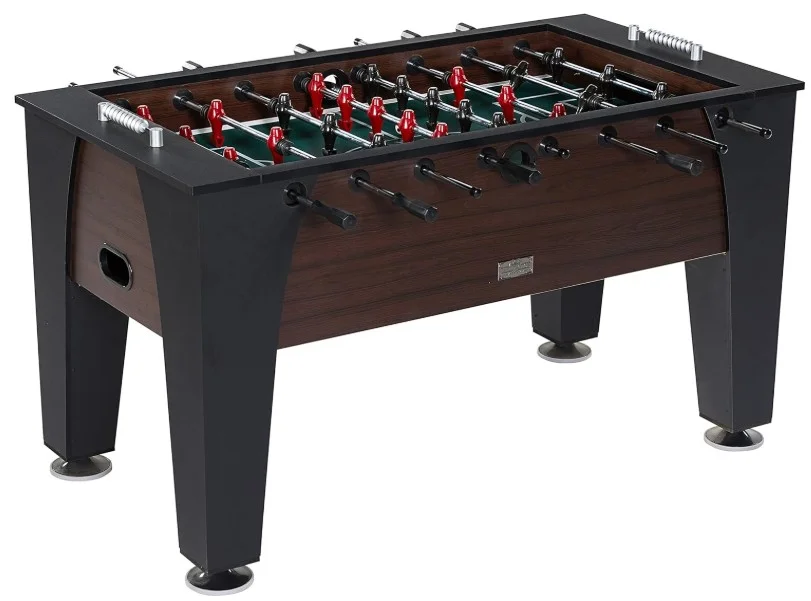
Barrington sells multiple models under one product listing, ranging from $280 to $678. This analysis focuses on the Richmond model at $400.
The variable pricing reflects finish options and minor structural differences. All versions use similar core construction: MDF cabinet with PVC laminate, hollow steel rods, plastic bearings, and adjustable leg levelers.
What justifies choosing Barrington:
Finish variety. The Richmond, Allendale, Coventry, and other models offer different wood tones and design aesthetics. Buyers matching existing game room decor find value here.
The 58-inch length provides more playing surface than standard 55-inch tables. Player spacing increases slightly. Shot angles change marginally. Experienced players notice this difference.
Goal boxes return balls automatically after scoring. The boxes mount internally and don’t protrude from cabinet sides. Cleaner look than external return systems.
Performance limitations:
At 100 pounds, the Richmond falls into the mid-weight category. Heavier than budget tables, lighter than premium options. Stability improves with weight, so expect some table movement during aggressive play.
Durability reports vary significantly. Some buyers report solid performance after 18 months. Others mention cracked bases or scratched surfaces within six months. Quality control appears inconsistent across production runs.
Assembly complexity increases with the 58-inch size. The longer cabinet requires more careful alignment during leg installation. Several users report needing to shim legs after assembly because levelers couldn’t compensate for frame warping.
Best use case:
Buyers who value aesthetics and have moderate gameplay expectations. The Richmond won’t satisfy competitive players, but it works fine for casual home use where appearance matters.
Fat Cat Rebel 4.5′ Tables
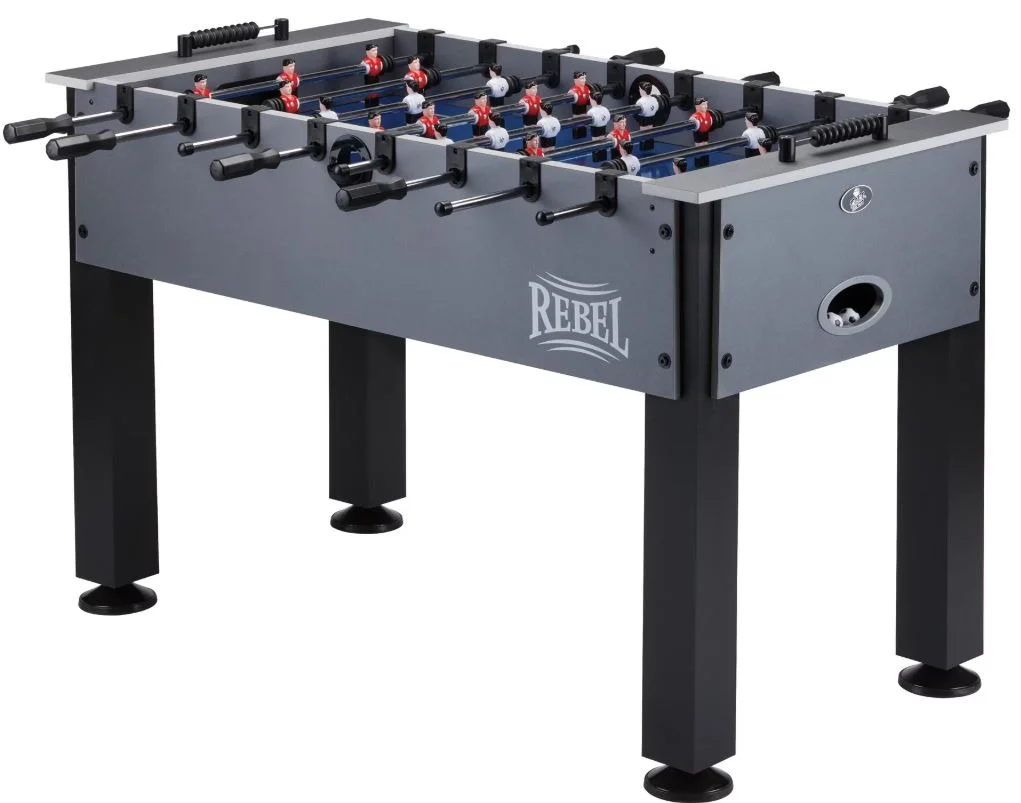
The Rebel measures 54 inches, making it full-size by dimension but lighter by construction at 86 pounds. Fat Cat positions this as their premium offering, though it lands at the budget end of the under-$1,000 category.
Snap-rod assembly represents the main innovation. Rods snap into place without requiring threading, washers, or precise alignment. Assembly time drops to roughly 45 minutes versus 90+ for traditional designs.
The trade-off: snap connections develop play faster than threaded rod systems. After sustained use, rods start wiggling laterally. Not immediately, but the durability curve skews shorter than tables using conventional rod mounting.
High-definition playfield graphics add visual interest. The blue playing surface with white field markings mimics soccer pitch aesthetics. Preference varies, but the design stands out against standard green or wood-tone surfaces.
Four 5-inch leg levelers match premium tables in adjustment range. Considering the Rebel’s budget positioning, this represents above-average attention to setup flexibility.
Build quality concerns:
Multiple buyers report receiving units with cosmetic damage or broken components. Customer service response varies. The table ships in single-box packaging, unlike competitors using multiple boxes with internal supports. This packaging approach likely contributes to transit damage.
The cabinet uses wood composite rather than engineered wood or MDF. Composite holds screws less securely over time. Rod mounting points can develop looseness, requiring periodic tightening.
Who this fits:
Buyers with limited floor space who want full-size gameplay in the lightest practical package. Families where children will use the table primarily. Casual players are not concerned about long-term durability.
Better alternatives exist if:
You have floor space for a heavier table. The added mass improves stability significantly. You plan serious gameplay progression. Snap rods won’t hold up to developing skills that demand equipment precision.
Who Actually Needs to Spend Close to $1,000?
Not everyone should. That’s the truth budget articles won’t admit.
This price range makes sense for:
Families upgrading from tables that cracked, warped, or stopped leveling properly. If your current table developed a permanent tilt or the rods now bind during play, stepping up to this category solves those problems permanently.
Game room builders who want furniture-grade aesthetics alongside performance. Tables in this range feature real wood veneers, integrated cup holders, and finishes that complement existing furniture instead of clashing with it.
Competitive friend groups are tired of arguing whether the table affected the outcome. When rods flex and surfaces warp, every close game sparks debates. Quality tables eliminate that variable.
Airbnb owners or rental property managers who need tables that survive abuse from strangers. Cheaper tables don’t last through rotation after rotation of unfamiliar users.
Skip this category if:
You play casually twice per year during the holidays. A $300 table handles that usage pattern fine.
You want tournament certification for league play. That requires spending over $1,200 for ITSF-approved models.
Your budget genuinely tops out around $500. Better to buy the best $500 table than the worst $1,000 option.
What Changes Between $500 and $1,000?
Testing tables across price tiers reveals specific upgrade patterns. These aren’t marketing claims. They’re measurable differences affecting gameplay.
Cabinet Thickness & Weight
Tables under $500 typically use 0.5-inch MDF sidewalls. Approaching $1,000, that increases to 0.625 or 0.75 inches of engineered wood.
That quarter-inch doesn’t sound significant. During play, it determines whether the cabinet flexes when players apply pressure to rods. Flex creates an inconsistent ball response off the sidewalls.
Weight correlates directly with stability. A 60-pound table requires anchoring or frequent repositioning. A 140-pound table stays planted during aggressive play. Neither approach is wrong, but the experience differs substantially.
Rod Quality & Bearing Systems
Budget tables use hollow chrome-plated rods running through plastic bushings. The chrome coating wears at contact points, creating rough spots that catch during spins.
Near $1,000, manufacturers switch to solid steel rods with sealed ball bearings. Steel doesn’t wear noticeably over residential lifespans. Sealed bearings eliminate friction from dirt or moisture intrusion.
Counterbalanced players appear consistently in this price range. Standard players hang vertically, making controlled passes nearly impossible. Counterbalanced figures stay horizontal, enabling precise ball placement. This single feature separates recreational from strategic gameplay.
Playing Surface Quality
Cheap tables, laminate thin vinyl directly onto MDF. The vinyl bubbles or peels at the edges within months.
Quality tables use thicker PVC laminate bonded under pressure. The surface remains flat indefinitely under normal use. Ball speed and rebound consistency improve measurably.
Some models in this range feature competition-grade surfaces meeting thickness specifications used in tournament tables. The ball doesn’t dead-stop against sidewalls or skip unpredictably.
Stability Features
Leg levelers on budget tables adjust maybe 0.5 to 1 inch. Floors often vary more than that across a table’s footprint.
Tables approaching $1,000 include levelers extending 2 to 3.5 inches. This range handles severely uneven basement or garage floors without permanent tilt.
Crossbars connecting legs appear more frequently in this category. They prevent leg splaying under lateral pressure, maintaining cabinet squareness over the years.
What You Still Don’t Get Under $1,000
Understanding limitations matters as much as recognizing improvements. Tables just above $1,000 deliver features this category can’t match.
Split cabinet construction allows disassembly for moving. Tables under $1,000 typically build the cabinet as a single unit. Moving requires navigating the entire assembled table through doorways and stairwells. Split designs separate at the midpoint, cutting dimensions in half.
Tournament certifications from ITSF (International Table Soccer Federation) require meeting exact specifications for rod height, player spacing, and surface materials. Foosball tables over $1000 often carry these certifications. Under-$1,000 models don’t meet standardized requirements, even when they perform well.
Professional bearing systems use precision-machined components with tolerances measured in thousandths of an inch. Tables in this review use quality bearings, but not precision-grade hardware. The difference affects smoothness during rapid direction changes.
Telescoping rods that don’t protrude from cabinet sides appear exclusively above $1,200. They prevent players from hitting rods on backswing and eliminate the safety concern of exposed rod ends at adult torso height.
Commercial-grade finishes resist cigarette burns, spilled alcohol, and impact damage. Residential tables use furniture-grade finishes adequate for home use but not designed for bar or restaurant environments.
Best Table by Scenario
Matching tables to specific use cases yields better outcomes than ranking by arbitrary criteria.
- Best for Competitive Home Play: KICK Legend 55″: Counterbalanced men and sealed bearings create a predictable ball response. The extra cabinet mass prevents the table shift during aggressive rod work. Players developing advanced techniques won’t outgrow this table’s capabilities.
- Best Modern Game Room Look: Atomic Pro Force 56″: The bamboo finish differentiates this from standard black or wood grain options. Lighter weight simplifies repositioning during room rearrangement. Works best against walls for added stability.
- Best Value Under $700: Barrington Richmond: At $400, this delivers 58 inches of playing surface with automatic ball return. Not the most durable option long-term, but the price-to-size ratio favors buyers prioritizing dimensions over longevity.
- Best Family Setup: EastPoint Sports Deluxe: Weighted players help beginners control the ball. The bead scoring system never fails. Large playing surface accommodates four players without crowding. Ideal for households where multiple children want simultaneous access.
- Best for Smaller Spaces: Fat Cat Rebel: Weighs 86 pounds, making solo repositioning feasible. Snap-rod assembly reduces setup complexity. Full-size dimensions despite lighter construction. Suitable for rooms where moving the table periodically is necessary.
Buyer Decision Framework
Stop researching and start deciding by filtering through these five considerations:
1. Measure Your Room
Tables occupy 55-58 inches lengthwise. Add 3 feet on each end for rod clearance. That’s roughly 12-13 feet total. Width requires 30 inches plus 2 feet per side for player stance. Total: 6.5-7 feet. Confirm your space accommodates these dimensions before proceeding.
2. Decide Casual vs. Competitive
Casual play tolerates plastic bearings and lighter cabinets. Competitive gameplay demands steel bearings, counterbalanced men, and heavier construction. Be honest about usage patterns. Aspirational purchase decisions lead to regret.
3. Choose Rod Type
Solid steel with counterbalanced men’s skill development. Hollow steel with standard players works fine for recreational use. Snap-rod systems favor convenience over durability. Pick based on skill trajectory, not current ability.
4. Pick Cabinet Weight Range
60-pound tables move easily but shift during play. 100-pound models balance portability with stability. 140+ pound construction eliminates movement concerns entirely. Heavier always improves gameplay but complicates relocation.
5. Consider Long-Term Durability
Will children outgrow this table’s quality in two years? Will skill development expose construction limitations? Tables approaching $1,000 should last 5-10 years minimum. If you’re unsure about commitment level, consider tables under $500 as stepping stones.
Frequently Asked Questions
What is the best foosball table under $1000?
The KICK Legend 55″ delivers the most complete package at $650. Counterbalanced men, sealed bearings, 0.75-inch cabinet walls, and 143-pound mass create performance that exceeds its price point. Not perfect, but the best combination of build quality and playability in this category.
Is it worth spending $1000 on a foosball table?
Yes, if you’ve already worn out cheaper tables or progressed beyond beginner skill levels. No, if you play a few times yearly. The value threshold depends entirely on usage frequency and skill development trajectory. For serious home use, the durability and performance gains justify the cost. For occasional entertainment, $200 tables suffice.
Are foosball tables over $1000 much better?
Measurably, yes. They deliver split cabinets, tournament certifications, precision bearings, and commercial-grade finishes. Subjectively, the improvement matters most to competitive players or commercial buyers. Residential users playing for enjoyment notice diminishing returns above $1,000. The jump from $500 to $1,000 affects gameplay more than the jump from $1,000 to $2,000.
What’s the difference between tables under $1000 and over $1000?
Construction tolerances tighten significantly. Over $1,000 brings precision-machined components, standardized dimensions meeting ITSF specs, and materials designed for commercial abuse. Under $1,000 uses quality residential-grade components adequate for home use but lacking tournament approval. Telescoping rods, split cabinets, and premium bearing systems appear exclusively above this threshold.
Which brand makes the best foosball under 1000?
KICK dominates this category with the Legend and Triumph models. Both deliver solid steel construction, counterbalanced options, and sealed bearings at $650. Barrington offers more aesthetic variety but less consistent quality control. Atomic favors design over maximum durability. Fat Cat prioritizes easy assembly. KICK balances performance with reliability most effectively.
The Smart Ceiling Strategy
Most buyers shopping in this category already understand what foosball is and how gameplay works. The question isn’t whether to buy a table. It’s how much to spend.
$1,000 represents the intelligent ceiling for residential buyers. Beyond this point, improvements target commercial durability or tournament compliance, not enjoyment.
Tables approaching this limit deliver cabinet construction that won’t warp. Rod systems that maintain smoothness through years of use. Playing surfaces that respond predictably. Stability systems that compensate for imperfect floors.
These aren’t luxury features. They’re practical requirements that cheaper tables promise but fail to deliver after six months.
If you’re serious about gameplay but not pursuing tournament competition, this category eliminates the upgrade cycle. Buy once. Play indefinitely.
The difference between adequate and excellent often costs less than $300. That investment buys years of consistent performance versus replacing failed tables repeatedly.
For additional guidance on selecting the right table, visit our comprehensive foosball table reviews. Or if you have questions about specific models or setup challenges? Contact us directly.
Choose based on intended use, not aspirational hopes. The best table is the one you’ll actually use for years, not the one gathering dust because you overspent.