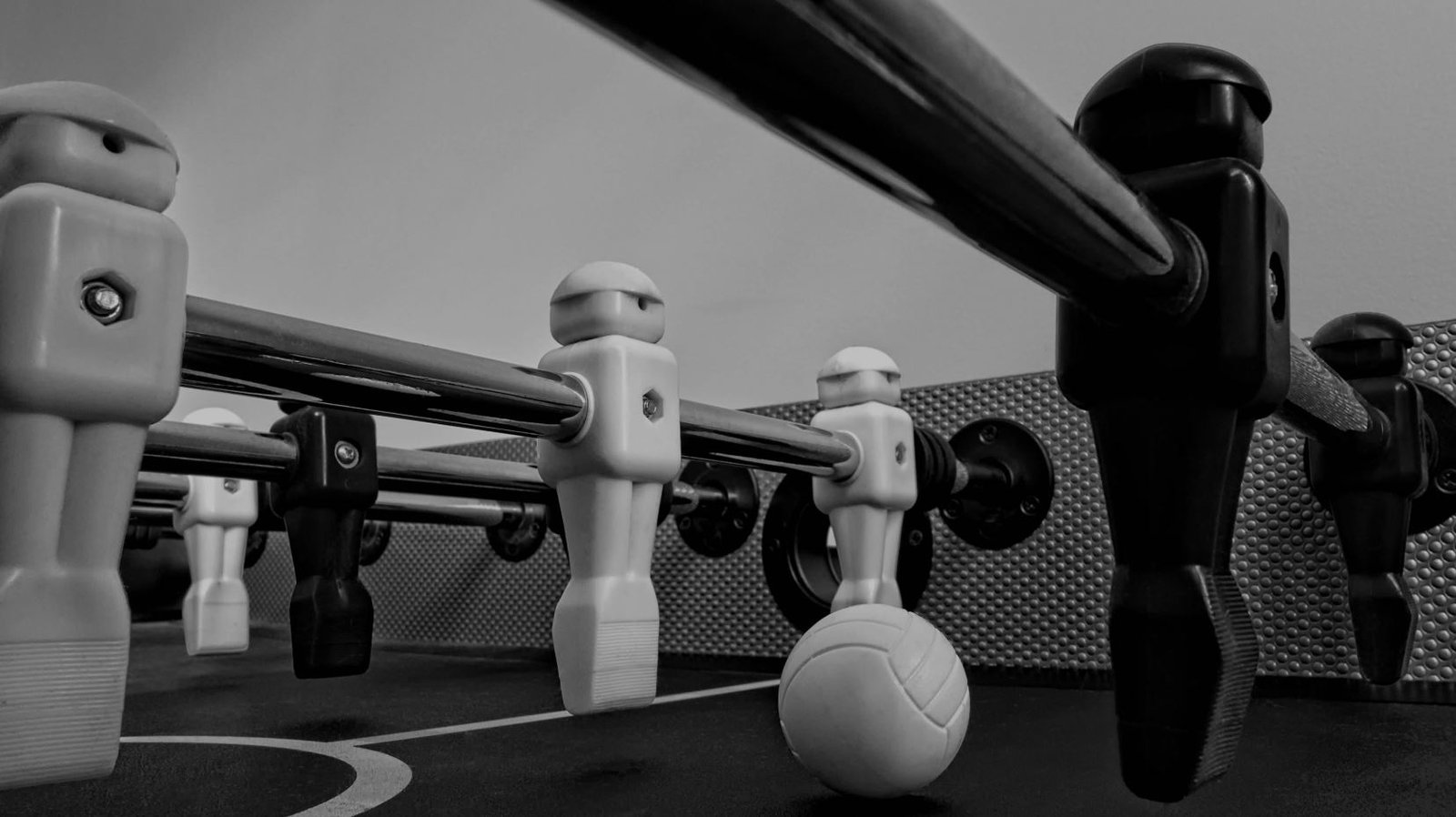
Some foosball tables are chaos in disguise. One team has three goalies, the other barely has defenders. Balls ricochet like they have a mind of their own, and you’re left wondering, how many players are actually supposed to be here?
Here’s the deal: a standard foosball table features 26 players total, 13 per team, spread across 8 rods. But don’t let numbers fool you. Depending on the table style, the game you’re playing, or even where you are in the world, setups can look very different.
In this guide, we’ll decode the perfect player lineup, rod positions, and orientations so every pass, strike, and save feels intentional, and maybe even legendary.
The Standard Foosball Table Setup
Most football tables you’ll encounter have a specific player arrangement. Each team controls 13 men distributed across four different rod types.
The typical layout includes:
- 1-bar (Goalie): 1 or 3 players, depending on table style
- 2-bar (Defense): 2 players for blocking shots
- 5-bar (Midfield): 5 players for passing and ball control
- 3-bar (Attack): 3 players for scoring goals
American-style tables commonly use three goalies while European tables typically feature a single goalie. Both configurations are legitimate for play. The International Table Soccer Federation (ITSF) recognizes multiple table types for official tournaments.
Users report that three-goalie tables are more forgiving for beginners. That extra defensive coverage helps block shots when you’re still learning rod control. Single-goalie tables demand precision but develop sharper skills over time.
The men themselves face your opponent’s goal. They’re mounted at specific angles on the rods to optimize ball contact. Each figure stands perpendicular to the playing surface when at rest.
Table dimensions matter here. Standard adult tables measure about 56 inches long and 30 inches wide. The rod spacing stays consistent across most regulation tables, which keeps gameplay fair and predictable.
Player Positions and Orientation
Understanding which way foosball players face eliminates most setup confusion. Every player on your side faces toward your opponent’s goal. Simple as that.
But there’s nuance to positioning that separates casual players from competitive ones. Experienced players angle their defensive men slightly backward at 30 to 45 degrees. This catches incoming shots instead of deflecting them back to opponents.
Your goalie positioning is critical. The man closest to the opponent’s attacking rod should tilt back like a “back toe” stance. This prevents the ball from bouncing off and creating another scoring chance for your opponent.
The 5-bar midfielders handle most passing work. Players position these figures to catch balls cleanly from the goalie or 2-bar. Poor positioning here means dropped passes and lost possessions.
Your 3-bar strikers face straight ahead for shooting. Rotating them up to 90 degrees (feet toward the ceiling) is legal for powerful strikes. Anything beyond that violates the no-spinning rule in competitive play.
Offensive roles focus on ball control and shot accuracy. Defensive positions prioritize blocking angles and catching deflections. Each rod serves a distinct tactical purpose that changes with game flow.
Strategy tip from Foosball Junkie: Don’t leave your men straight down when defending. Angled figures catch and control the ball. Vertical figures just bounce it back to your opponent.
Team Formats: 2-Player vs 4-Player Games
Singles matches pit one person against another. You control all four rods on your side. This format demands quick hand transitions and full table awareness.
Most recreational players prefer singles for learning. You develop a feel for every position without coordinating with a partner. The downside? It’s physically demanding to cover the entire table solo.
Doubles foosball splits the rod control between teammates. One player typically handles the goalie and 2-bar (defense). The other manages the 5-bar and 3-bar (offense).
This team setup appears in most tournaments. Communication becomes crucial. Your partner needs to anticipate passes and coordinate defensive positioning without verbal cues during fast play.
Some bars feature 6-player or even 8-player tables. These configurations work for large groups but slow down gameplay. Each person controls fewer rods, which limits individual impact on the match.
Four-player games create the best balance for parties. Everyone stays engaged without overwhelming the table. Two teams of two maintain a good pace while allowing social interaction.
Player count affects strategy significantly. Singles players can execute complex setups between their own rods. Double teams must trust partners to be in position for passes and rebounds.
Family foosball games often ignore strict formations. Kids playing casually might all cluster on one side or take turns. That’s fine for fun, but competitive setups demand proper rod distribution.
Foosball Rods and Table Layout Explained
Eight rods span the width of standard tables. Four belong to each team, arranged in a specific defensive-to-offensive sequence.
The metal rods themselves come in two types. Solid rods carry more weight and slow the game pace. This emphasizes skill over speed. Hollow rods spin faster and allow quick reactions.
Check which type your table has before playing. Solid rods require smoother, more deliberate movements. Hollow rods respond to lighter touches and faster wrist snaps.
Rod spacing between positions isn’t random. Tables maintain specific distances that create passing lanes and shooting angles. This spacing matches real soccer field proportions in miniature.
Handles attach to rod ends for player grip. Some use plastic, others feature rubber for better control. Competitive players often have handle preferences based on their shot techniques.
Bumpers sit between the table wall and the rod ends. These rubber cushions prevent damage from aggressive play. They also stop rods from sliding completely through during intense matches.
The playing surface itself measures approximately 40 inches by 23 inches on regulation tables. Smaller tables exist for kids, but they don’t prepare you well for standard competition dimensions.
Rod bearings determine how smoothly figures spin. Ball bearings offer the best performance with minimal friction. Budget tables often use plastic bushings that wear down faster.
Variations and Common Questions
How many men on a foosball table?
26 total figures split evenly between teams. That’s 13 players per side arranged across four rods.
How many foosball rods?
Eight rods in standard configuration. Each team controls four rods for different tactical positions.
Do all tables have the same setup?
No. European tables typically feature one goalie while American tables use three. Both are valid for official play.
The goalie debate confuses new players the most. Three-goalie tables (American style) provide more defensive coverage. One-goalie tables (European style) demand better positioning skills.
Tournament players adapt to both styles. The ITSF sanctions competitions on multiple table brands, including Tornado, Bonzini, Garlando, Roberto Sport, and Leonhart. Each has slight differences in rod spacing and player design.
Beginners benefit from three-goalie tables initially. That extra defensive help builds confidence while you learn basic rod control. Transitioning to one-goalie tables later sharpens precision.
Foosball rules for beginners focus on three core concepts: no spinning (360-degree rotations), no jarring (shaking the table), and time limits for possession (10 seconds on the 5-bar, 15 seconds elsewhere).
Player positions remain consistent regardless of table brand. Your 5-bar always handles midfield passing. Your 3-bar always takes shots. The number of goalies is the main variable.
Some novelty tables break all conventions. Artist Maurizio Cattelan created a 7-meter table requiring 11 players per side. That’s more art installation than functional game equipment.
A competitive foosball setup requires proper player orientation, a level playing surface, and correctly inflated balls. Tournament directors inspect tables before matches to ensure fair play conditions.
Quick Reference: Foosball Player Chart
| Rod Position | Number of Players | Primary Function |
| Goalie (1-bar) | 1 or 3 | Goal protection |
| Defense (2-bar) | 2 | Shot blocking |
| Midfield (5-bar) | 5 | Ball control & passing |
| Attack (3-bar) | 3 | Scoring shots |
| Total per team | 13 | Full field coverage |
American tables: 3 goalies, 2 defenders, 5 midfielders, 3 strikers. European tables: 1 goalie, 2 defenders, 5 midfielders, 3 strikers
Both configurations total 13 players per team and 26 figures on the table. The goalie count represents the only standard difference.
2-player games assign all four rods to each person. 4-player games split rods between partners, typically with one controlling defense (goalie + 2-bar) and one handling offense (5-bar + 3-bar).
Final Thoughts
Standard foosball tables accommodate 26 players across eight rods. Each team controls 13 figures divided into goalkeeper, defensive, midfield, and striker positions.
The setup matters more than most players realize. Proper player orientation catches balls instead of deflecting them. Correct rod spacing maintains fair gameplay between opponents.
Table style affects your experience significantly. Three-goalie configurations suit beginners and fast-paced casual play. Single-goalie tables develop precision for competitive advancement.
Whether you’re setting up for family game night or serious competition, understanding player count eliminates confusion. Now you know exactly what belongs on your table and why each position exists.
Questions about gameplay basics? Visit our comprehensive foosball FAQ or learn how to play foosball with detailed technique breakdowns.