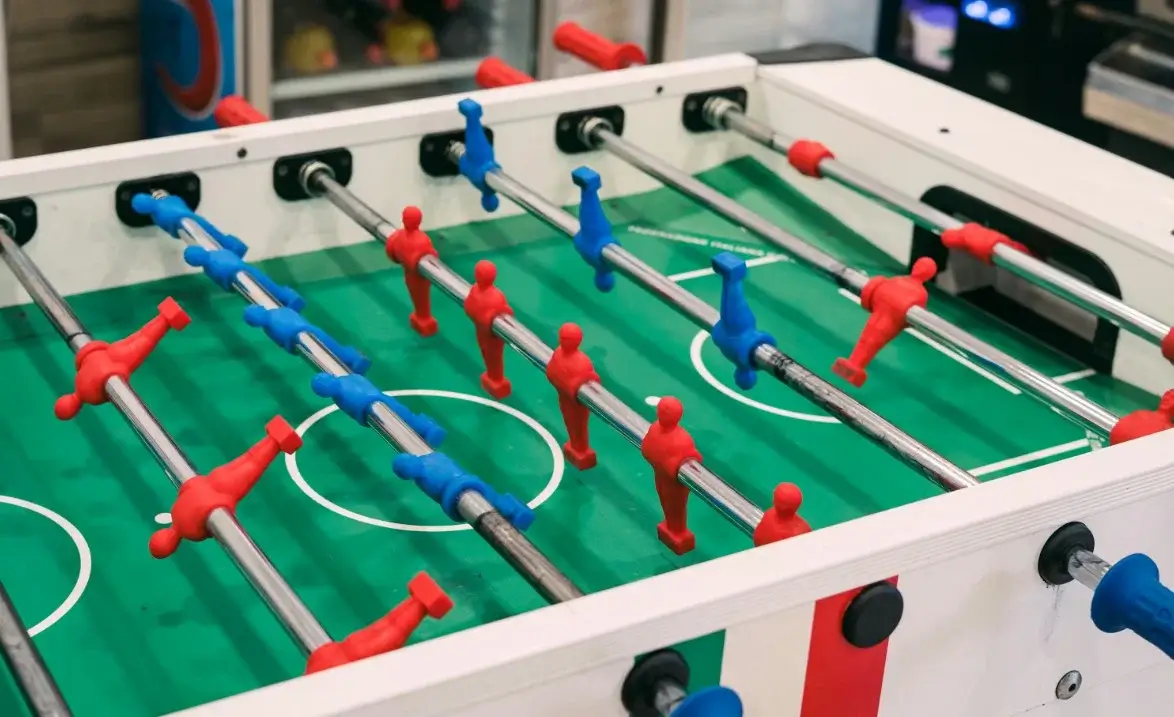
Most people discover the spinning rule the hard way. You’re deep into a casual match, winding up a full-rod twirl for a power shot, and your opponent slams the table and says, “That’s illegal.” Is it? Depends on where you’re playing, and more importantly, how seriously you’re playing.
At Foosball Junkie, we get this question a lot. So here’s the definitive breakdown of foosball spinning rules, from casual house games to ITSF tournament play.
What Is Spinning in Foosball?
Spinning sounds simple, but players actually argue about this more than you’d expect. The official definition makes it clear.
Spinning is any rod rotation that exceeds 360 degrees before or after the player’s figure makes contact with the ball. It does not matter if the shot went in. It does not matter if it was accidental. If the rod completed a full rotation, it’s a spin violation.
A few variations you’ll see on a football table:
- Full rod spin: Using your palm to swing the handle all the way around, letting the rod whip freely
- Spin serve: Launching the ball into play with a spinning motion for an unpredictable trajectory
- Spin shot: A rapid twirl intended to generate a fast, hard strike
There’s also a lesser-known exception worth knowing. If an ungrasped rod spins because a ball hits a player figure on that rod, the spin is considered legitimate. That’s not a penalty. The violation happens when you intentionally release the handle and let the rod spin freely.
Is Spinning Allowed in Foosball?
Short answer: no, not in official play. But the real answer is a bit more layered.
In tournament and competitive foosball, spinning is prohibited without exception. The ITSF (International Table Soccer Federation) governs competitive play worldwide, and its rulebook bans it outright. The rod cannot rotate in excess of 360 degrees before or after the player figure advances the ball upon impact, and players must maintain clear control of the handle at all times.
In casual or home play, it’s a different story entirely. Many garage games and bar tables run on house rules where spinning is a fair game. No one’s calling a referee. If both players agree to allow it before the game starts, technically, no rule is being broken in that context.
The problem is that most players skip that conversation. One person assumes spinning is fine. The other assumes it isn’t. That’s where the arguments start.
If you’re looking to understand the full set of foosball rules and regulations beyond just spinning, it’s worth reading through the complete breakdown.
Why Spinning Is Considered Illegal?
There are two real reasons spinning got banned, and neither one is arbitrary.
Fair play first. Spinning removes the skill element from the game. A controlled wrist flick requires timing, precision, and technique. A full rod spin is just raw torque. It generates unpredictable, fast shots that even a skilled defender can’t read. Spinning is defined as a 360-degree turn of a rod. While you can spin rods backward and forward, you cannot spin them all the way around. The rule exists specifically to keep technique relevant.
Equipment damage second. This one doesn’t get talked about enough. Repeated rod spinning puts serious rotational stress on the bearings, rods, and bumper walls. Handle wear accelerates. The bar itself can warp over time, especially on mid-range tables. If you’ve ever played on a beat-up bar table with sticky or wobbly rods, there’s a good chance chronic spinning played a role.
Since the establishment of the ITSF, the rules have become standardized in most international competitions. Before that standardization, spinning was actually legal in parts of Europe. Some early 1970s and 80s tournaments in certain countries ran with it. That inconsistency is exactly why ITSF stepped in to formalize things.
Common Penalties for Spinning
Penalties depend on the setting, but they follow a consistent logic.
In official tournament play:
The penalty for spinning is a kick-off for your opponent. It’s a spin if the bar rotates more than 360 degrees before or after striking the ball. In ITSF-sanctioned events, the ball is awarded to the opponent’s 5-man rod. Repeated violations can result in a warning, and persistent fouling can lead to a point deduction or match forfeiture under the referee’s discretion.
In casual play:
The most common consequences are:
- Ball possession transferred to the opponent
- A re-serve, with the offending player losing their turn
- In heated games, a full redo of the point
The penalty for letting your hands go and spinning the rod is a loss of ball possession. Your opponent gets to re-serve the ball on their 5-man rod.
The lesson here is practical: even in informal games, getting caught spinning usually costs you the ball. It’s rarely worth the risk of a bad shot and a possession penalty at the same time.
Spin Techniques People Actually Use
Not every “spin” is illegal. This is where a lot of players get confused.
Legal spin techniques involve limited rotation with controlled wrist movement. These are not violations:
- Topspin: Angling the player figure forward before contact to impart forward rotation on the ball. Used by advanced players to control where the ball goes after contact.
- Side spin: A quick lateral flick that changes the ball’s horizontal trajectory. Requires timing and a short rotation, well within the 360-degree limit.
- Controlled snap shot: A sharp, fast wrist snap that makes contact quickly. The rod barely rotates before and after. Clean, fast, and completely legal.
Illegal spin techniques are usually easy to spot:
- Releasing the handle and letting the rod spin freely
- Rapid palm-over twirls are intended to generate power
- Spinning the rod before the ball arrives to build momentum going into contact
The line between legal and illegal isn’t about speed. It’s about whether the rod completes a full rotation. You can shoot fast without spinning. In fact, skilled players do it constantly.
As Bilal Subhani notes from extensive competitive observation, the players who rely on spinning most are typically mid-level players who haven’t yet developed proper wrist technique. Once you learn the snap shot and the pull shot, you stop needing the spin entirely.
How Spinning Affects Gameplay?
If spinning were harmless, it wouldn’t be banned. Here’s what actually happens when someone spins on a football table.
- Accuracy drops: A spinning rod makes controlled ball placement nearly impossible. The player figure contacts the ball at a random point in the rotation. Where the ball goes is largely luck. This is frustrating for both players.
- Ball unpredictability increases: Spin shots bounce unpredictably off walls and players. Defending them becomes guesswork rather than skill. Over time, this degrades the quality of the game for everyone at the table.
- Momentum and miscontrol: When a rod spins without contact, it often overshoots and smacks the cabinet wall. That repeated impact causes the jarring issues mentioned earlier, which is a separate foul under official rules.
- Handle wear and rod damage: Chronic spinning is genuinely hard on equipment. If you care about keeping your table in good shape, this matters. Bearings wear faster. Rods develop wobble. It’s a real cost, especially on quality tables where repairs are not cheap.
Choosing a well-built table reduces this risk. If you’re shopping or upgrading, the guide on the best foosball tables breaks down durable options worth considering.
FAQs: Spinning in Foosball
Can you spin in foosball?
In casual home games with agreed house rules, yes. In official or competitive play, no. You can turn your rod up to 90 degrees so that the feet face the sky. This is as far as you should need to go for shooting. Once you do a complete flip, you’ve violated the spinning rule.
Is spinning cheating?
In official play, yes, it’s a violation. In casual play, it depends on what was agreed before the game. The reason it feels like cheating to many players is that it bypasses skill with brute rotation.
Can you spin the handle, rod, or players?
These all refer to the same action: rotating the rod past 360 degrees. Whether you call it the handle, rod, or player figure, the rule is the same.
Why do some casual games allow it?
Mostly because people learn foosball by watching others play, not by reading the rulebook. Spinning looks effective and feels satisfying. Without someone to enforce the rule, it just becomes part of the local game.
Can you spin the ball in foosball?
You can impart spin on the ball through legal wrist technique, like topspin or side spin, as long as your rod rotation stays within legal limits.
Legal Alternatives to Spinning
If you’ve been relying on spins to generate power, the good news is that proper technique actually produces faster, more accurate shots.
The snapshot is the most common replacement. You pull the rod back slightly and snap your wrist forward on contact. The rod rotates far less than 90 degrees total. The shot is fast, clean, and perfectly legal.
The pull shot and push shot involve moving the ball laterally along the rod before striking. They’re more advanced but highly effective. Timing and grip matter more than rotation.
Controlled topspin is useful for passing. A slight forward angle on your player figure at contact gives the ball a forward roll, making it easier to receive at the next rod.
A few practical tips for building legal technique:
- Loosen your grip slightly. A tighter grip actually reduces wrist speed.
- Focus on the moment of contact, not the follow-through.
- Practice ball control on the 5-man rod before worrying about shot power.
- Precision beats power in most situations.
These techniques take real practice. But players who develop them stop losing points to spin penalties entirely, which is a competitive edge in itself.
You can learn foosball shots in detail to avoid spinning here: https://foosballjunkie.com/foosball-shooting-techniques/
Conclusion
Spinning in foosball is one of those rules that divides casual players and serious ones almost immediately. In a tournament setting, it’s a clear violation with defined penalties. In a garage game, it might be fine if everyone agrees upfront.
What Foosball Junkie recommends: play the right way, even casually. Not for rule-following’s sake, but because legal technique is genuinely more effective. A clean snapshot beats a lucky spin every time. And your table will thank you.
If you want to get serious, learn the snapshot, develop your passing game, and leave the spinning behind. The skill ceiling in this game is high enough that you won’t miss it.