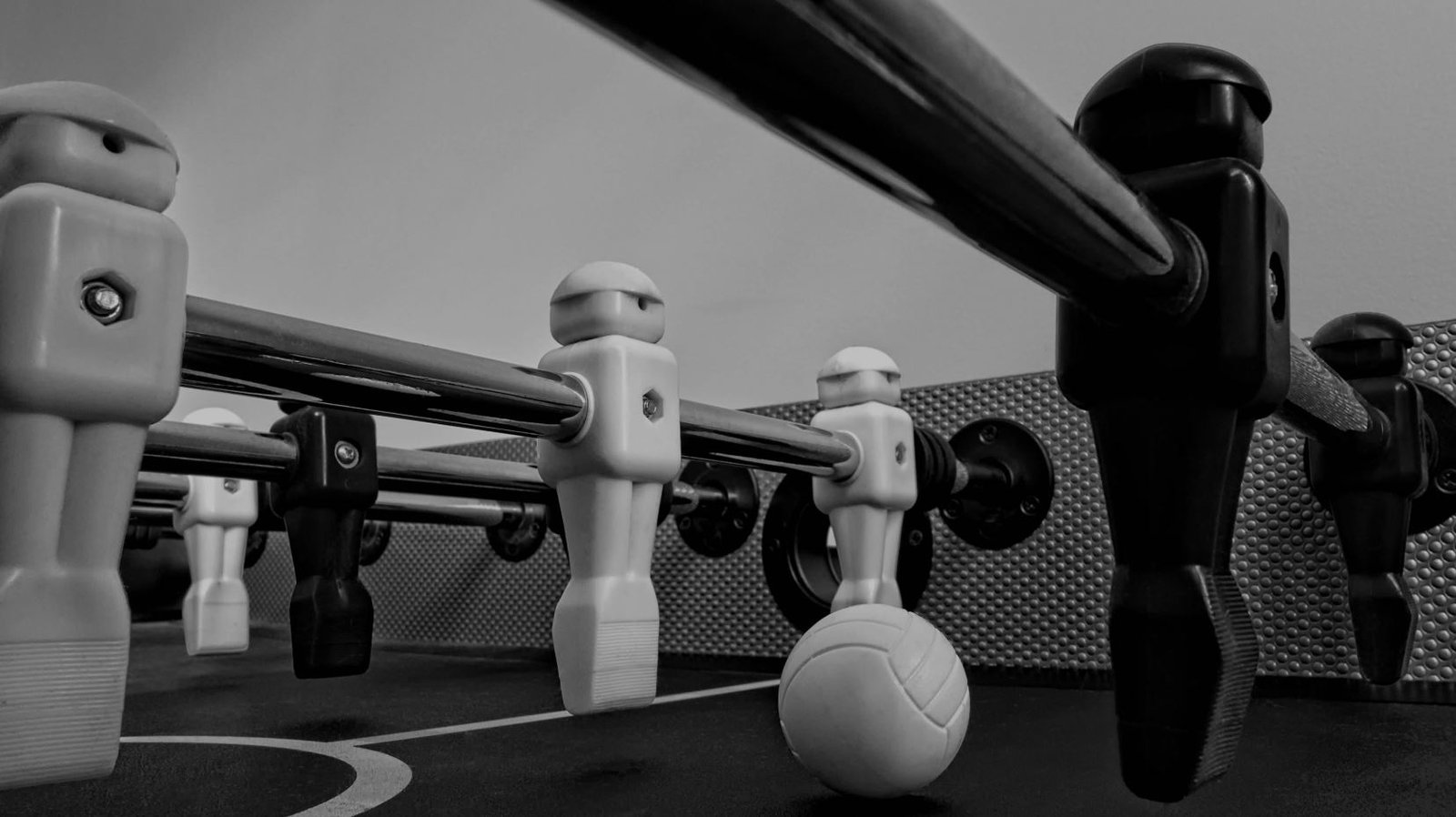
You’ve practiced your shot a hundred times. The ball sits perfectly on your 3-bar. You pull back and fire with everything you’ve got.
The goalie doesn’t move an inch. Your “power shot” rolls straight into their waiting rod.
Most players think they need to hit harder. They’re wrong.
Watch any tournament match, and you’ll notice something strange. The winning shots don’t always look powerful. They look precise. They arrive at angles the defense can’t cover, released at moments the goalie can’t predict.
This guide breaks down every foosball shooting technique that actually wins games. You’ll learn the mechanics behind pull shots, snake shots, and competitive moves that create real scoring opportunities. More importantly, you’ll discover which techniques match your skill level and which ones waste your practice time.
The difference between scoring twice per game and twice per possession starts here.
Let’s start with what actually constitutes a “shot” in foosball.
What Is Foosball Shooting?
A foosball shot is any controlled strike that attempts to score. That’s the simple version.
The deeper reality separates offensive shooting from defensive clearing. Offensive shots come from your 3-bar (three-man rod) or occasionally your 5-bar midfield. Defensive shots involve launching the ball from your 2-bar or goalie rod, though these rarely score against skilled opponents.
Your shooting technique determines three critical outcomes. First, it controls ball speed and trajectory. Second, it dictates whether the defense can predict your move. Third, it decides if your shot stays legal under tournament rules.
Players who master shooting win roughly 60-70% more games than those who rely on lucky bounces, according to competitive foosball communities. The skill gap isn’t about strength. It’s about repeatable mechanics that create scoring opportunities.
Most recreational players never progress past random slapping. They generate noise and movement but create zero real scoring threats. Learning proper techniques changes that completely.
Fundamentals of Foosball Shooting Technique
Proper Foosball Grip
Your grip controls everything that happens next.
Wrap your hand around the handle with your palm flat against the grip. Your fingers should curl naturally without squeezing too hard. Think “firm handshake” rather than “death grip.”
The wrist stays slightly cocked upward in a neutral position. This alignment lets you snap the rod without straining. Players who grip too low lose control. Players who grip too high sacrifice power.
Your thumb placement matters more than most guides mention. Position it opposite your fingers to create a stable fulcrum point. This setup allows quick wrist rotation while maintaining rod control.
Common mistake: gripping too tightly causes fatigue within minutes. Your forearm burns out before you’ve played three games. A relaxed grip with periodic adjustments prevents this entirely.
Shooting Form & Stance
Stand with your feet shoulder-width apart, weight slightly forward. Your dominant side should angle toward the goal you’re attacking.
Keep your shooting arm relaxed with a slight bend at the elbow. Locked elbows kill your ability to adjust mid-shot. Your non-shooting hand controls defensive positioning or sets up passes.
Your shoulders stay square to the table. Twisting your torso introduces inconsistency. The best players look almost motionless except for their shooting arm.
Body positioning affects reaction time dramatically. Players who stand too far back add 200-300 milliseconds to their shot setup. That delay gives defenders time to close holes.
Face the football table at a 45-degree angle if you’re learning. Adjust to what feels natural as your mechanics improve.
Wrist Snap & Rod Control Techniques
The wrist snap generates 80% of your shooting power.
Start with your wrist cocked back slightly. As you strike the ball, snap your wrist forward while pulling or pushing the rod. The motion resembles flipping a light switch quickly.
Your rod should rotate no more than 360 degrees total. Anything beyond that qualifies as illegal spinning under ITSF tournament rules. Referees watch for this constantly in competitive play.
The snap timing matters enormously. Early snaps miss the ball entirely. Late snaps produce weak, predictable shots. Practice until the wrist motion and ball contact happen simultaneously.
Rod control means knowing exactly where your men are without looking. Develop muscle memory by practicing blind shots. Set up the ball, close your eyes, and shoot. This drill builds the spatial awareness that competitive players rely on.
Timing and Shot Setup
Knowing when to shoot beats knowing how to shoot.
Wait until the defender commits to one side or reaches for a ball fake. Shooting into a perfectly positioned defense wastes possession. Patient players create two or three times more scoring chances.
Ball setup involves positioning your man directly behind or beside the ball. The ball should contact the foot’s sweet spot, usually the center or slightly forward. Poor setup angles cause the ball to skip, spin, or miss the goal entirely.
Offensive rod control starts with small adjustments. Slide the ball laterally across your 3-bar to find open lanes. Defenders track movement, so quick repositioning beats them more often than raw power.
Most beginners shoot within one second of gaining possession. Tournament players often wait three to five seconds, studying defensive patterns before striking.
How to Hit Foosball With Power?
Power without control just makes noise.
Generating legitimate shot speed requires proper torque application. Pull or push the rod laterally while simultaneously snapping your wrist forward. These two motions combine to accelerate the ball significantly.
Rod acceleration happens in the final six inches before striking. Players who try generating power too early lose both speed and accuracy. The motion should feel like a whip crack, not a slow pull.
Controlled power means hitting hard enough to beat the goalie but soft enough to aim precisely. Wild hits that rattle the table usually miss the goal entirely. Calibrate your power level during practice so you can reproduce it under pressure.
Why spinning is illegal: Rotating the rod more than 360 degrees before striking gives unfair speed advantages. It also damages tables and creates unpredictable ball movement. Legal power generation relies on wrist snap and lateral rod movement instead.
Tournament players regularly achieve 35+ mph shot speeds using only legal techniques. You don’t need to spin to generate serious power.
Here’s what actually creates velocity: the combination of lateral rod speed and precise ball contact. Hit the ball at the exact moment your wrist reaches maximum snap velocity. That timing multiplies force dramatically.
Common issues players report include wrist soreness after attempting power shots. This signals you’re using arm strength instead of wrist mechanics. Fix your technique before you develop tendonitis.
How to Score in Foosball?
Scoring requires identifying and exploiting defensive gaps.
Every goalie leaves holes, usually near the corners or during transitions. Watch where your opponent’s goalie naturally rests. Most players unconsciously favor one side, creating a permanent opening on the opposite side.
Shooting lanes are the paths between your striker and the goal. The defense blocks most lanes, but movement creates temporary openings. Shoot when a lane appears, not when you feel like shooting.
Reading the defense means tracking their man positioning and reaction patterns. Defenders who react instantly to lateral movement struggle against quick shots. Defenders who commit early are vulnerable to fakes.
High-percentage shots target the corners at angles the goalie struggles to cover. Straight shots down the middle work only if the goalie moves first. Side-angle shots from the outer men beat center-focused defenses.
Bilal Subhani from Foosball Junkie notes that beginners focus entirely on their own shots while ignoring defensive positioning. That approach succeeds maybe 20% of the time. Strategic shooters who read defenders succeed closer to 60-70%.
Exploiting goalie gaps requires patience. Fake a shot to one side and watch where the goalie moves. The opposite side just became vulnerable. Strike immediately before they recover.
Best Foosball Shots & Tutorials
Each shot type creates different defensive problems.
Pull Shot
The pull shot involves sliding the ball laterally across the rod, then striking it toward the goal while it’s moving. This technique ranks among the most popular in competitive play.
Step-by-step mechanics:
- Position your middle man behind the ball
- Pull the rod toward you (laterally across the table)
- As the ball reaches your desired position, snap your wrist forward
- Strike the ball square with your man’s foot
The motion should feel smooth and continuous. Jerky movements telegraph your timing to defenders.
Pull shot tips:
Start slow to build muscle memory. Speed comes naturally after 50-100 practice reps. Focus on striking the ball at the same lateral position every time. Consistency beats power when you’re learning.
Most players struggle with timing the wrist snap correctly. The ball should still be moving laterally when you strike. Waiting too long stalls the ball and ruins the shot.
Watch: Pull Shot Tutorial
Push Shot
The push shot mirrors the pull shot but moves the rod away from your body instead.
Proper setup requires positioning the ball on the opposite side of your rod from the pull shot starting position. Everything else follows identical mechanics, just reversed.
Push shot combos:
Alternate between pull and push shots to keep defenders guessing. Players who only shoot in one direction become predictable within three possessions. Mixing both techniques doubles your effective scoring threat.
The push motion feels less natural for most players initially. Your wrist mechanics don’t change, but the lateral movement direction does. Practice this separately until it feels automatic.
Push shots excel against defenders who overcommit to blocking pull shots. When you notice defensive bias, exploit it immediately.
Watch: Push Shot Breakdown
Snake Shot (Rollover Shot)
The snake shot dominates tournament play for good reason.
This technique involves pinning the ball against the playing surface, then rolling your wrist to generate spin before striking. The ball launches with topspin, making it harder to block.
Step-by-step snake shot tutorial:
- Trap the ball between your man’s foot and the table surface
- Roll your wrist backward to cock the shot
- Snap your wrist forward while sliding the rod laterally
- The man’s foot rolls over the ball, striking it forward with spin
The motion resembles opening a doorknob quickly. Your wrist controls everything.
Why it’s effective: The ball stays in contact with your man longer than other shots. This extended contact creates unpredictable release timing that defenders struggle to read. The topspin also adds speed and makes the ball hop slightly on contact.
Snake shot slow motion tips:
Watch professional videos at quarter speed. Notice how their wrist stays relaxed until the final moment. Tension kills snake shot velocity and accuracy.
Common mistakes include rolling too early or applying insufficient downward pressure. The ball should feel pinned before you begin the wrist roll. Loose control creates weak, easily blocked shots.
Watch: Snake Shot Tutorial
Watch: Snake Shot Slow Motion
Foosball Pin Shot
Pinning the ball gives you maximum control before shooting.
Place your man directly on top of the ball, pressing down firmly. The ball stops moving completely. From this position, you can shoot in any direction by adjusting your man’s angle before striking.
How it improves accuracy: Shooting from a dead stop eliminates variables. The ball isn’t rolling, spinning, or bouncing. You control exactly when and where it launches. This reliability makes pin shots ideal for beginners.
Advanced players use pin shots to set up pull or push shot variations. Pin the ball, slide it laterally while maintaining pressure, then release at the optimal moment. This combines pin shot control with pull shot speed.
The main limitation involves timing. Pinning the ball telegraphs your intention to shoot. Smart defenders position themselves while you’re setting up. Quick execution becomes essential.
Watch: Pin Shot Tutorial
Spray Shot
Spray shots angle the ball diagonally toward either goal corner.
Position your man at roughly 45 degrees to the ball’s starting position. Strike through the ball while aiming toward the far post. The angled contact creates a diagonal trajectory.
When to use spray vs direct: Spray shots work best against goalies who stay centered. The angle makes it harder for them to react in time. Direct shots work better when the goalie commits to one side early.
The spray technique requires precise man positioning. Too much angle sends the ball wide. Too little angle creates a weak shot straight into the goalie.
Practice spray shots from each position on your 3-bar. The outer men create sharper angles than the center man. Understanding these differences improves shot selection dramatically.
Watch: Spray Shot Angles
Aerial Shot
Aerial shots lift the ball off the playing surface.
Scoop under the ball with your man’s foot angled upward. The ball pops into the air, potentially sailing over the goalie’s reach. These shots look impressive but work inconsistently.
How to lift and score: Position your man behind and slightly under the ball. Snap your wrist upward while making contact. The ball should lift 2-3 inches maximum. Higher lifts usually sail over the goal entirely.
Defensive aerial opportunities: Occasionally, the ball bounces high near your defensive rods. A well-timed aerial clear can launch it into the opponent’s goal. These situations are rare but game-changing when they occur.
Most competitive players avoid aerials except in desperation. The technique lacks reliability compared to surface shots. Use it when conventional shots aren’t working.
Watch: Aerial Shot Setup
Bank Shot
Bank shots use the table walls to create unexpected angles.
Aim your shot at the sidewall at roughly 30-45 degrees. The ball rebounds off the wall and redirects toward the goal. Defenders tracking your man position struggle to predict the actual trajectory.
Angles to hit: Shallow angles (15-20 degrees) create long rebounds that often miss. Steeper angles (60+ degrees) bounce back toward midfield. The 30-45 degree sweet spot produces goal-directed rebounds consistently.
Bank shots work particularly well from the outer men on your 3-bar. The wall proximity makes angle calculation easier. Center man bank shots require more precision.
Practice reveals which angles work on your specific table. Different table brands have slightly different wall materials and bounce characteristics.
Watch: Bank Shot Techniques
Goalie Shot
Shooting directly from defense occasionally catches opponents sleeping.
Clear the ball from your defensive zone with enough force to reach the opponent’s goal. This works maybe 5% of the time, usually when the opposing goalie is distracted or poorly positioned.
Rare but effective moves: After blocking an opponent’s shot, immediately launch a goalie clear while they’re recovering. The element of surprise compensates for the low accuracy.
Most goalie shots miss or get blocked easily. Use them sparingly, primarily as psychological pressure. Opponents who fear goalie shots position their defense more conservatively, creating midfield opportunities.
Bilal Subhani from Foosball Junkie recommends practicing goalie shots only after mastering standard offensive techniques. They’re entertaining but rarely decide competitive matches.
Watch: Goalie Shot Opportunities
Advanced & Competitive Shots
Tournament Foosball Shots
Competitive players rely on three core techniques: pull shots, push shots, and snake shots.
Everything else represents variations or situational moves. Tournament players spend 80% of their practice time perfecting these three because they create the highest-percentage scoring opportunities.
ITSF legal shots overview:
The International Table Soccer Federation maintains strict rules about what constitutes a legal shot. No spinning beyond 360 degrees. No jarring or lifting the table. No touching the ball with anything except the foos figures.
These rules exist to maintain competitive fairness and equipment longevity. Players who develop legal techniques don’t need to adjust their game when entering tournaments.
Pull and snake shots dominate professional matches because they combine power, accuracy, and defensive unpredictability. Push shots appear slightly less often but remain essential for keeping opponents honest.
Quick Release & Brush Pass
Quick-release techniques minimize the time between ball contact and shot execution.
Touch the ball and shoot within 200 milliseconds. Defenders lack time to react. This approach sacrifices some accuracy for pure speed advantage.
Moves that disguise intent:
Brush passes involve barely touching the ball to your adjacent man. The motion looks like shot preparation, but actually repositions the ball. Defenders who react to the fake leave openings for the actual shot.
Competitive players chain together 2-3 brush passes before shooting. Each fake movement forces defensive adjustments. By the third movement, gaps appear that weren’t available initially.
Timing off the fake:
Wait until you see defensive movement before committing to the real shot. Faking without reading defensive response wastes the technique’s advantage.
3-Bar Offensive Strategies
Coordinated offense involves multiple men on your 3-bar working together.
Move the ball between your three men to find open shooting lanes. Defenders must track multiple threats simultaneously. This creates confusion and temporary defensive holes.
Setting up combo shots:
Pass from your outer man to the center man, then immediately shoot. The pass draws the goalie toward the ball’s path. Your shot targets the opening they just created.
Chain passes require precise ball control. Sloppy passes gift possession to your opponent. Practice passing accuracy before attempting it during competitive play.
Three-bar strategies work best against single-goalie setups. Two-goalie defenses cover more ground and limit the effectiveness of lateral passing.
Accuracy & Control Techniques
Power means nothing if the ball misses.
Improving shot accuracy starts with eliminating variables. Shoot from the same position repeatedly until you can score blindfolded. Consistency builds when you remove decision-making from the equation.
Ball trapping and positioning:
Control the ball completely before shooting. Trap it against the table surface or pin it with your man’s foot. Moving balls introduce trajectory errors that even professionals struggle to compensate for.
The best players in the world hit 70-80% accuracy on standard shots during practice. Match pressure reduces this to 50-60%. Building your practice accuracy higher creates a cushion for stress-induced performance drops.
Dead-ball control involves stopping the ball’s movement completely before shooting. This technique sacrifices the speed advantage of moving shots but dramatically improves aim.
Set the ball, adjust your man’s angle, verify your target, then strike. The sequential process feels slow initially, but produces significantly higher scoring percentages.
Passing before shooting creates better angles than forcing shots from poor positions. Pass to your center man if your outer man faces a bad angle. The two-second delay beats rushing a low-percentage attempt.
Players who prioritize accuracy over speed during their first 100 hours of practice develop fundamentally better techniques. Shortcuts teach bad habits that require months to unlearn.
Strategy for Winning at Foosball
Offense without strategy is just random shooting.
Offensive strategy fundamentals:
Control possession first. You can’t score without the ball. Maintain pressure by keeping the ball in your offensive zone. Force your opponent to defend continuously until they make a mistake.
Possession-focused play wins roughly 65% more games than shot-focused play, according to tournament statistics. Beginners shoot too quickly and lose possession unnecessarily.
Shot selection strategy requires understanding percentage plays. Corner shots from your outer men succeed more often than center shots against skilled goalies. Adjust your approach based on what’s working.
Track which shots score against specific opponents. Some defenders struggle with pull shots. Others can’t handle snake shots. Exploit their weakness repeatedly until they adjust.
Finishing under pressure:
Championship points create mental pressure that degrades performance. Combat this by focusing exclusively on mechanics, not outcomes. Trust your practiced technique rather than forcing unusual shots.
Players who maintain their standard shooting routine under pressure win finals 70% more often than players who panic and switch techniques.
Competitive foosball tactics include psychological elements. Varying your shot timing makes you harder to read. Mixing speeds and angles forces defenders to guess rather than react.
Never fall into predictable patterns. Shoot pull-push-pull-snake-push instead of pull-pull-pull-pull. Unpredictability multiplies your effective threat level.
Common Mistakes & How to Fix Them
Power Without Control
You’re hitting the ball hard but scoring nothing.
This indicates you’re using arm strength instead of wrist mechanics. Dial back your power by 30% and focus on accurate placement. Speed returns naturally once you’ve grooved proper technique.
Players who chase power first develop tension-based shooting styles. These feel forceful but lack precision. Relaxed, controlled shooting produces both power and accuracy.
Bad Grip Habits
Your hand cramps within minutes, or your shots feel inconsistent.
Check your grip pressure. Most players squeeze 3-4 times harder than necessary. Lighten your grip until the rod nearly slips, then add just enough pressure to maintain control.
Rotate your wrists periodically between shots. Locked positions cause fatigue rapidly. Small adjustments keep blood flowing and prevent cramping.
Predictable Timing
Opponents block everything you shoot.
You’re shooting too quickly after gaining possession. Add 2-3 seconds of ball movement before striking. Defenders tracking your timing can’t react if you vary the delay.
Mix immediate shots with delayed shots randomly. Unpredictability is a weapon most players ignore completely.
Wrist Soreness & Injury Prevention
Your wrist hurts after playing.
This signals you’re using incorrect mechanics or playing too long without breaks. Proper wrist snap technique should create zero soreness even after 30+ minutes of continuous shooting.
Take 10-minute breaks every 30 minutes during practice. Stretch your wrists between games. Pain indicates technique problems that will cause injury if left unaddressed.
Consider wrist braces if pain persists despite technique correction. Some players have underlying wrist weakness that benefits from external support.
Rules & Legality in Foosball Shooting
Legal Shot Definitions
A legal shot involves striking the ball with a foosball figure while the rod rotates less than 360 degrees before or after contact.
The ball must be struck deliberately, not accidentally contacted during defensive positioning. Intent matters in competitive rulings.
You cannot jar the table, lift the rods off their bearings, or interfere with your opponent’s rods during shot execution. These actions result in loss of possession or point penalties.
Shooting Rules (No Excessive Spinning)
Spinning the rods is the most common illegal move in recreational play.
Rotating beyond 360 degrees before striking generates unfair velocity and damages table mechanisms. Referees in tournaments watch for this constantly and penalize offenders immediately.
The rule exists because spinning creates shot speeds that are impossible to defend against legally. It undermines competitive balance and reduces foosball to whoever spins fastest.
Rod Rotation Limits
Before striking the ball, your rod can rotate 360 degrees maximum. After striking, the follow-through can also rotate 360 degrees maximum.
These limits mean you can complete roughly one full revolution total during shot execution. Anything beyond that qualifies as spinning.
Some players argue they’re not spinning because the rotation feels controlled. The rules don’t care about feelings. They care about rotation degrees.
Illegal Foosball Shots Examples
- Spinning the rod multiple rotations before striking
- Jarring the table to move the ball
- Shooting immediately after a timeout without referee approval
- Touching the ball with your hand during live play
- Shooting while your opponent’s rod is out of position due to mechanical failure
Tournament directors have discretion to call additional violations. When in doubt, ask before attempting unusual shots.
Frequently Asked Questions
What is the easiest shot to learn?
The pull shot teaches fundamental mechanics without complex wrist movements. Most beginners can execute recognizable pull shots within 15-20 minutes of focused practice. Snake shots require 10-15 hours before they become reliable.
Can you shoot from anywhere?
Technically, yes, but practically only shots from your 3-bar score consistently. Midfield shots succeed maybe 10% of the time. Defensive shots score under 5%. Focus 90% of your practice on 3-bar techniques.
Is the snake shot legal in tournaments?
Absolutely. The snake shot is one of the most common techniques in professional play. As long as your rod doesn’t spin beyond 360 degrees, it’s perfectly legal under ITSF rules. Many tournament champions rely primarily on snake shot variations.
How do I hit harder without losing control?
Increase your wrist snap speed while maintaining the same lateral rod movement. The wrist generates power. The rod movement maintains control. Never sacrifice rod control to gain power. Better technique beats harder hitting every time.
What’s the difference between a pull shot and a push shot?
Pull shots move the rod toward your body before striking. Push shots move it away. The mechanics are otherwise identical. Good players master both to keep defenders guessing.
How long does it take to master foosball shooting?
Basic competency takes 20-30 hours of focused practice. Tournament-level mastery requires 200-500 hours, depending on athletic background. Players with racquet sport experience learn faster due to similar wrist mechanics.
Should I practice on a tournament-style table?
Yes, if possible. Recreational tables have different ball physics and rod spacing. Skills developed on tournament tables transfer everywhere. Skills developed on recreational tables often don’t translate to competition.
Conclusion
Foosball shooting separates casual players from competitors.
You’ve learned the fundamental techniques behind pull shots, push shots, snake shots, and every major scoring move. More importantly, you understand that power without accuracy means nothing.
Start with pull shots until they feel automatic. Add push shots to keep defenders honest. Progress to snake shots once your wrist mechanics feel solid. Everything else builds from these three foundations.
Practice deliberately for 20-30 minutes daily rather than playing casually for hours. Focused training builds skills. Casual playing just reinforces your current habits, good or bad.
The players who dominate didn’t get there through natural talent. They mastered mechanics through repetition, then added strategy and shot selection on top of solid fundamentals.
Your next game starts with better technique. Every shot you take should feel more controlled than the last. That’s how improvement happens. That’s a goodbye from Foosball Junkie!