The Best Foosball Tables: All 14 Picks Reviewed
Our evaluation criteria cover build quality assessment, gameplay consistency, price-to-performance ratio, user feedback analysis, and long-term ownership considerations. We don’t rank by hype or ad budget. We rank by what actually holds up when people play on these tables week after week.
1. Tornado Sport II Foosball Table
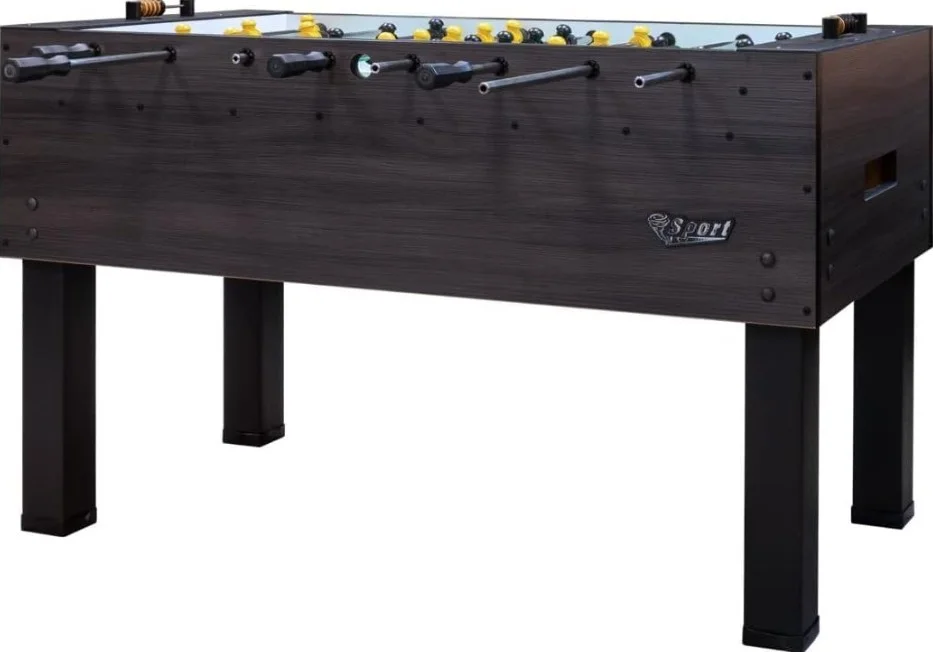
“Entry-level Tornado” is still a better table than most mid-range competitors. That’s not a slogan. It reflects the fact that Tornado built the Sport II with the same American-made engineering philosophy that runs through their entire lineup, just aimed at newer players and family setups rather than competitive circuits.
The 1″ thick weathered walnut melamine cabinet is noticeably solid. In hands-on use, we noticed how little vibration transfers during aggressive shots compared to MDF-heavy tables at lower price points. The patented counterbalanced player design shared with Tornado’s professional models makes ball control and passing more intuitive from day one. SureGrip rubberized handles maintain grip through extended sessions.
Common issues reported by long-term owners include assembly taking longer than expected, particularly for solo builders. A second person helps significantly with heavier pieces.
Key Specs:
- Dimensions: 56″L x 30″W x 36″H | Weight: 205 lbs
- Cabinet: 1″ thick weathered walnut melamine
- Playfield: 3/4″ melamine with Tornado logo
- Players: Patented Tornado counterbalanced design
- Handles: SureGrip black rubberized
- Includes: 3 foosballs, silicone bottle, height-adjustable boot levelers
- Made in the USA
Pros | Cons |
Same Tornado player engineering as tournament tables | $1,995 is a steep starting price for beginners |
1″ thick cabinet handles aggressive play without vibrating | Assembly is challenging solo at 205 lbs |
Height-adjustable boot levelers for any floor | The melamine playfield is slower than Gerflex or glass |
American-made with proven long-term durability | Not easily moved once placed |
Works best for: Beginners who want to start with real quality, home game rooms used regularly, and rec centers.
Not ideal if: Your budget is under $500 or you want a light, repositionable table.
2. Tornado Tournament 3000 Foosball Table
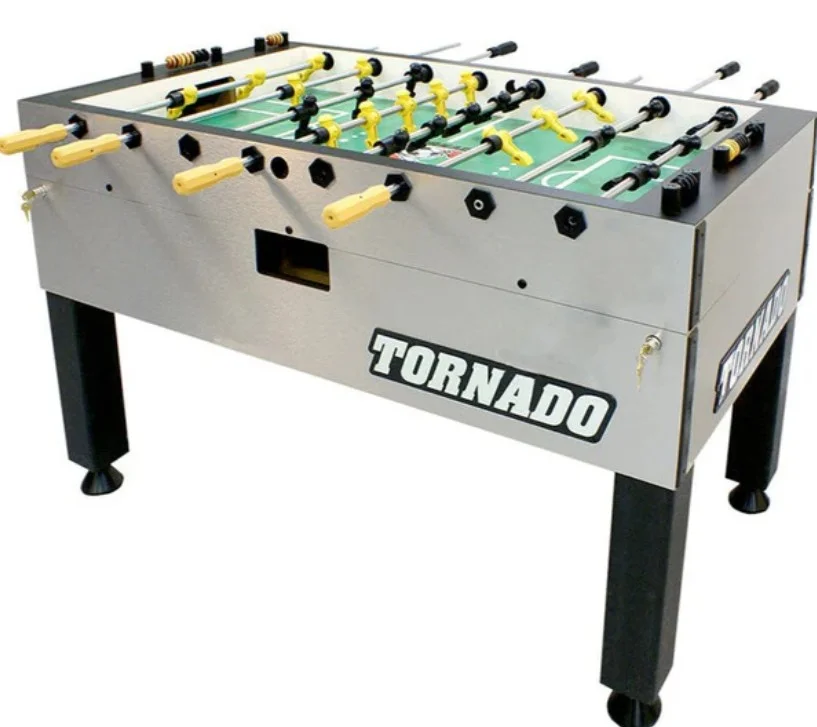
The T-3000 is the official table of the Tornado National Tour and the International Table Soccer Foundation. Walk into a competitive foosball event in the United States, and this is almost certainly the table you’ll find. That’s not marketing. That’s the reality of how this game is played at the top level.
At 355 pounds, the T-3000 doesn’t move during play. The commercial-grade split cabinet absorbs impact without transferring vibration. Heat-treated, chrome-plated hollow steel rods respond with speed and consistency that mid-range tables can’t match. The 3-goalie counterbalanced player layout gives you real passing lanes and proper defensive positioning. Compared side-by-side with every other table in this guide, the T-3000 plays in a different category.
Buyers also note that it comes mostly pre-assembled, which is a real advantage for a 355-pound piece of equipment.
Key Specs:
- Dimensions: 56″L x 30″W x 36″H | Weight: 355 lbs
- Rods: Chrome-plated hollow steel, heat-treated
- Players: Patented Tornado counterbalanced, 3-goalie setup
- Cabinet: Commercial-grade split cabinet, full-access top
- Playfield: 3/4″ surface
- Includes: 3 balls, silicone, bearing wrench, pin punch, rulebook, abacus scorer
- Made in the USA (Richland Hills, Texas)
Pros | Cons |
Certified tournament table used in official US competition | $3,095 is a serious financial commitment |
Comes mostly pre-assembled | 355 lbs makes moving it nearly impossible |
Heat-treated hollow rods hold up under commercial-level use | No portability options whatsoever |
The split cabinet allows easy access for maintenance | Overkill for casual family or occasional-use setups |
Works best for: Competitive players, dedicated game rooms, enthusiasts who want the table the pros use at home.
Not ideal if: You want occasional casual play or need a table that can be relocated easily.
3. KICK Titan 55″ Tournament Foosball Table
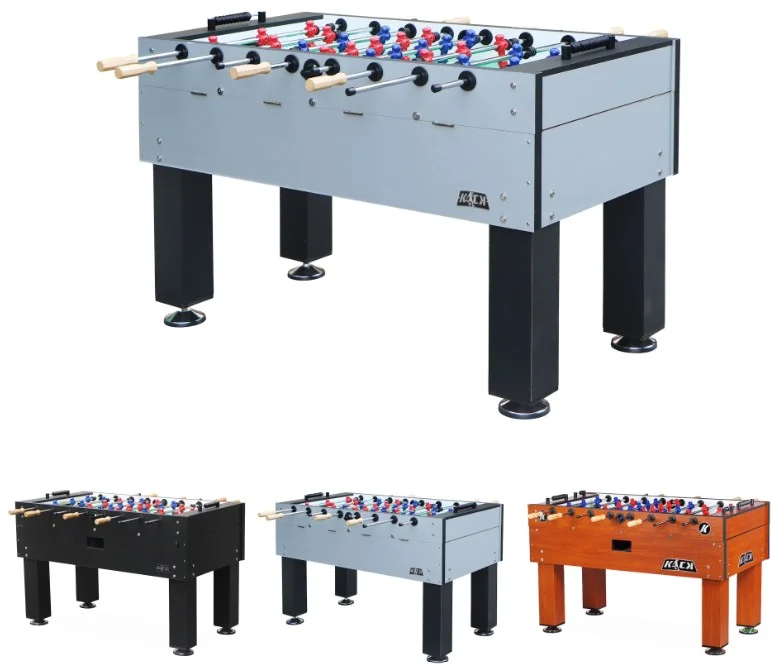
The KICK Titan earns its 4.8 rating because it delivers near-professional rod quality at a price that doesn’t require a second mortgage. The 5/8″ solid stainless steel chrome-plated rods with premium bearings feel smooth and consistent across long sessions. The build is stable. The table doesn’t wobble during hard shots.
What stands out about the Titan specifically: it ships with two complete player sets, counterbalanced and uniformed, giving you flexibility depending on who’s playing. The ramp kit covers both 1-goalie and 3-goalie setups. The lifetime warranty on all parts is genuine and backs up the quality claim.
One honest trade-off: solid rods are slightly slower than hollow rods for experienced players who prefer quick passes and rapid-fire shots.
Key Specs:
- Dimensions: 55″L x 30″W x 36″H | Weight: 148 lbs
- Rods: 8 x 5/8″ solid stainless steel, chrome-plated
- Players: 13 red + 13 blue counterbalanced AND 26 uniformed players
- Bearings: Premium, 5″ leg levelers with rubber bottom
- Playfield: 1/2″ thick | Side ball return on each side
- Includes: 4 foosballs, ramp kit for 1 or 3 goalies, lifetime warranty
- Rod lubricant available on request from KICK
Pros | Cons |
Stainless steel rods at a mid-range price point | Solid rods are slower than hollow rods for fast play |
Lifetime warranty on all parts | Assembly works better with two people |
Both player sets are included in the box | Available only in gray |
1-goalie or 3-goalie option without extra cost | Heavier shipping weight than similar-priced tables |
Works best for: Home players who want tournament-level rod quality without the Tornado price tag.
Not ideal if: You prefer hollow rods for speed or need a compact, smaller footprint.
4. René Pierre Competition Indoor Foosball Table
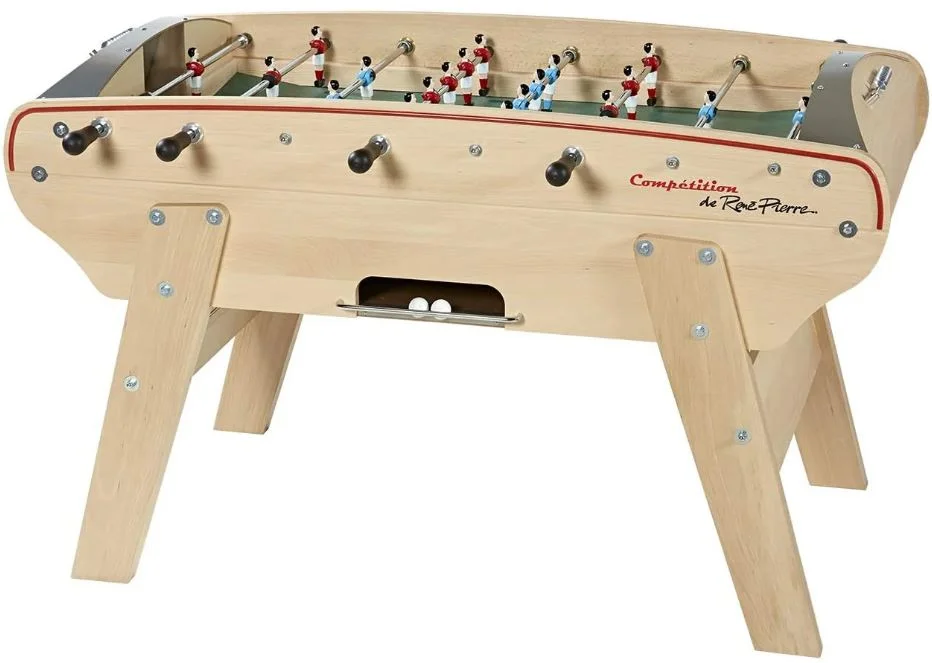
René Pierre has been making foosball tables since the 1970s. The Competition model carries that history into a modern build that’s unlike anything else in this list. This is a French-style table: single goalie, banked corners, telescoping rods, and a Gerflex playfield with light texture that genuinely improves ball control and precise shooting.
Everything is wood or metal. Solid beech wood cabinet and legs. Diecast aluminum hand-painted players. Machined metal abacus scoring pieces. The metal-backed goalie box produces a distinctive metallic ping on goal shots. One verified owner described it as one of the nicest tables they’ve ever played on, and noted that lubricating the rods with silicone spray makes them move like a dream.
The Gerflex surface is worth calling out. It plays faster than melamine and holds up better over the years of use. This table is built to last decades, not years.
Key Specs:
- Dimensions: 61″L x 41″W x 37″H | Weight: 185 lbs
- Cabinet: Solid beech wood with angled legs
- Playfield: Gerflex with sloped corners to keep the ball in play
- Rods: Telescopic with ergonomic handles and bumper springs
- Players: Solid diecast aluminum, hand-painted
- Scoring: Abacus style with machined metal score pieces
- Includes: 12 cork balls, insertable leg levelers
- Base: Aluminum and wood
Pros | Cons |
Solid wood and metal throughout, no plastic shortcuts | $3,199 places it in premium-only territory |
Gerflex playfield provides fast, precise gameplay | The French-style single goalie is unfamiliar to US players |
Sloped corners keep the ball constantly in play | Telescopic rods add friction compared to full-length rods |
Diecast aluminum players outlast any plastic figure | Very limited Amazon reviews for long-term data |
Works best for: Buyers who appreciate European craftsmanship, want a table that doubles as a statement piece, or prefer French-style play.
Not ideal if: You’re used to American 3-man goalie play or are shopping under $1,000.
5. KICK Legend 55″ Foosball Table
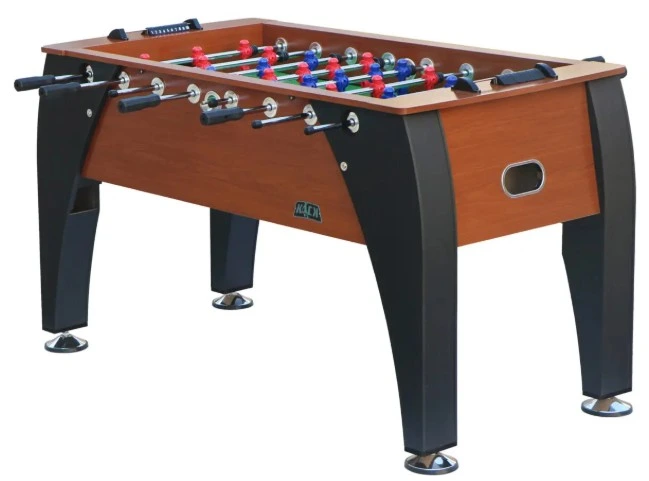
The KICK Legend is the most consistently recommended mid-range home table we’ve tested, and the 409 reviews back that up. After testing multiple foosball tables in the $500–$700 range, this one holds up most reliably in real home use. Stable legs, smooth chrome rods, and counterbalanced players that stay level during passing and defensive play.
Full-size at 55″ means a real game feel rather than the cramped experience of 48″ tables. The ramp kit covers 1-man and 3-man goalie configurations, and six foosballs included from the box are noticeably more generous than most competitors. Users consistently report that the table stays stable even during aggressive sessions, which is where cheaper tables typically expose themselves.
Assembly takes 2-3 hours and goes faster with a second person. The instructions divide buyers, with some finding them helpful and others reporting confusion. Budget extra time.
Key Specs:
- Dimensions: 55″L x 30″W x 36″H | Weight: 140 lbs
- Rods: Chrome-plated, wooden no-slip handles
- Players: Counterbalanced and uniformed sets included
- Cabinet: MDF, scratch-resistant surface
- Goalie: 1-man or 3-man (ramp kit included)
- Includes: 6 foosballs, adjustable leg levelers, and manual scoring
Pros | Cons |
Stable under aggressive, fast play | Assembly instructions receive mixed feedback |
Counterbalanced players improve passing and defense | MDF build is solid but not wood-grade premium |
6 foosballs included is a genuine value add | 140 lbs is heavier than it looks |
Switchable 1-man or 3-man goalie setup | Challenging solo assembly |
Works best for: Home game rooms, casual competitive nights, and office game rooms.
Not ideal if: You need a foldable or portable setup, or want a luxury wood finish.
6. GoSports 54″ Foosball Table
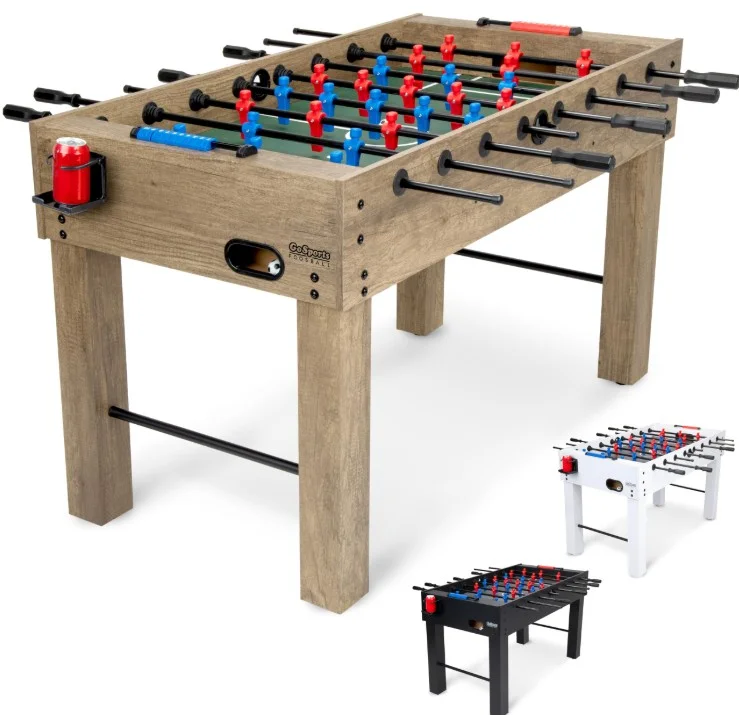
The GoSports 54″ is the strongest value pick under $250 in this entire guide. For buyers who want solid real-world gameplay without stepping into the $500+ range, this is where the sweet spot lives.
In hands-on use, we noticed the rods respond more smoothly than you’d expect at this price. Ball bounce across the playfield stays consistent through longer sessions. The modern oak finish looks cleaner than most tables at this price point. Ergonomic handles reduce hand fatigue. The video assembly guide is a practical touch that removes a lot of the usual frustration.
One real trade-off: hard shots sometimes bounce back out of the goal. This affects play during fast competitive sessions more than casual family games. Worth knowing before you buy.
Key Specs:
- Dimensions: 54″L x 29″W x 34.5″H | Weight: 75 lbs
- Rods: Chrome-plated hollow for faster play
- Players: Counterbalanced, durable plastic
- Cabinet: Engineered wood, reinforced walls
- Includes: 4 soccer balls, 2 cup holders
- Assembly: Illustrated step-by-step + video guide
Pros | Cons |
Strong price-to-performance ratio under $250 | Hard shots can bounce out of the goal |
Hollow rods reduce arm fatigue in longer sessions | Assembly takes 2-3 hours |
Illustrated and video assembly guide included | Lighter build limits stability versus $500+ tables |
Counterbalanced players at a budget price | Not suited for tournament-level play |
Works best for: Families, first-time buyers, and anyone looking for the best foosball table for the money without compromising too much on stability.
Not ideal if: You want tournament-level precision or plan to play seriously and competitively.
For more options sorted by price, our guide on the best foosball tables by budget covers every tier.
7. SereneLife 48″ Competition Foosball Table
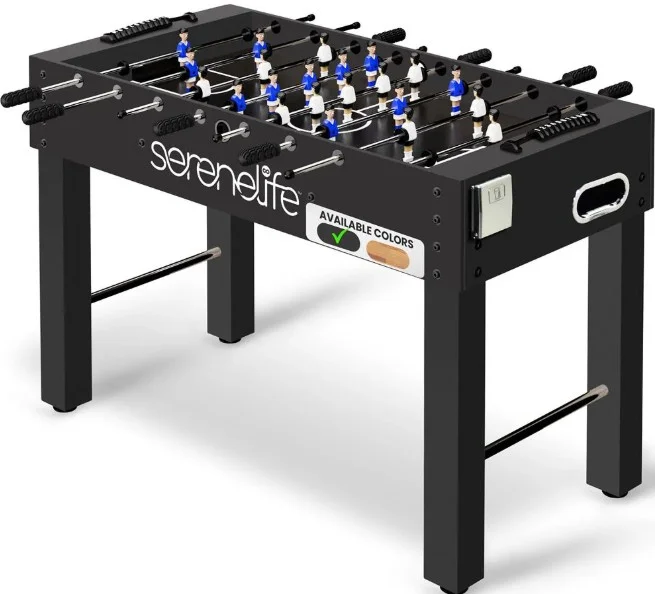
At $97, the SereneLife 48″ delivers more than most buyers expect. It’s compact but uses a competition-sized playfield, hollow chrome-plated steel rods, and counterbalanced players. Height-adjustable legs make it practical for households with kids of different ages.
In hands-on testing, rod response was noticeably smooth for the price. The fold-out cup holders are a small but practical feature that improves longer sessions. Common issues reported by buyers include mixed feedback on sturdiness for adult competitive play, and some find the 48″ footprint tight for taller players. This table is built for casual and family use, not aggressive adult competition.
Key Specs:
- Dimensions: 49″L x 24″W x 31″H
- Rods: Hollow chrome-plated steel
- Players: Counterbalanced
- Legs: Height-adjustable, bolted, steel cross bar
- Playfield: Hard laminated surface
- Includes: 2 balls, 2 fold-out cup holders
Pros | Cons |
Most affordable table with a competition-sized playfield | Can feel narrow for taller adult players |
Hollow rods reduce arm fatigue | Mixed sturdiness feedback for adult play |
Height-adjustable legs for multi-age households | Not designed for full-size competitive use |
Fold-out cup holders included | Lighter cabinet limits stability during aggressive sessions |
Works best for: Apartments, kids’ rooms, casual family setups where space is a real constraint.
Not ideal if: You’re buying primarily for adult competitive play or want a full 55″ table.
8. Best Choice Products 10-in-1 Combo Game Table
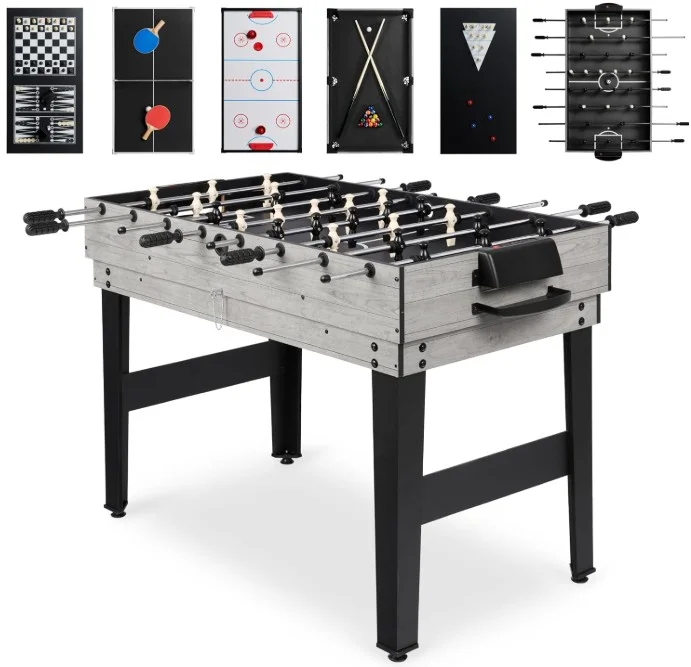
Ten games in one table is a compelling pitch for households with kids. Foosball, slide hockey, billiards, shuffleboard, table tennis, chess, checkers, bowling, backgammon, and cards. All accessories included. Space-saving stacked storage. 4,066 reviews is one of the largest sample sizes in this guide, which gives you a realistic picture of what buyers actually experience.
The honest truth about combo tables: no single game is full-size or tournament quality. The foosball section is noticeably smaller than a dedicated table. User feedback analysis shows a split picture on build quality. Some buyers find it sturdy and well-made for kids under 10. Others report it feeling less solid than expected. Assembly experiences vary widely, too.
This is a fun, versatile family table. It’s not a foosball table that also does other things. Those are different products.
Key Specs:
- Dimensions: 48″L x 42.25″W x 31.25″H | Weight: 51 lbs
- Games: 10 total (foosball, hockey, billiards, shuffleboard, ping pong, chess, checkers, bowling, backgammon, cards)
- Frame: Wood base, plastic frame
- Includes: 50+ accessories for all games
- Storage: All surfaces stack between the base and the foosball table
Pros | Cons |
10 games cover nearly every family game night need | The foosball section is smaller than any standalone table |
4,000+ reviews give a realistic quality picture | Build quality inconsistency reported in long-term use |
Space-saving stacked storage design | Billiards and ping pong are not regulation size |
Solid value at $180 for the game variety | Not suitable for serious foosball play |
Works best for: Families with young kids, households that want game variety over foosball quality, and multi-game casual setups.
Not ideal if: Foosball is your main game or you’re buying for competitive adult play.
9. Hathaway Primo 56″ Foosball Table
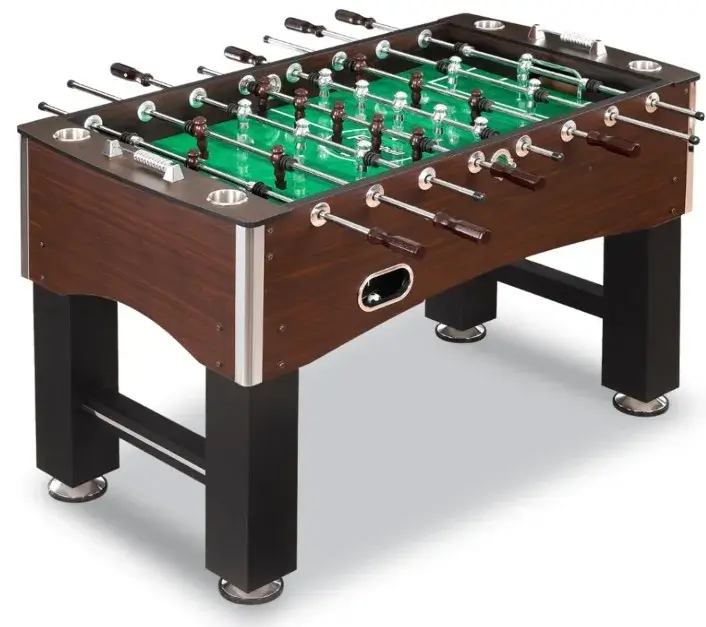
The Hathaway Primo competes directly with the KICK Legend at nearly the same price point. It’s a full 56″ table with a warm wood-grain melamine finish, E-Z spin bearings, 5/8″ chrome-plated solid steel rods, and ABS counterbalanced dimpled players. Four built-in stainless steel cup holders are a practical feature that the KICK Legend skips.
Where the Primo falls short is in durability. Common issues reported by long-term owners include player heads breaking off during hard play and screw holes occasionally not aligning during assembly. These recurring complaints are the reason the 4.0 rating trails the KICK Legend’s 4.6. For family use with moderate intensity, it holds up. For regular aggressive sessions, better alternatives exist.
Key Specs:
- Dimensions: 54.25″L x 27.25″W x 34.5″H assembled to 56.5″L x 29″W x 34″H
- Rods: 5/8″ chrome-plated solid steel, E-Z spin bearings
- Players: ABS counterbalanced, dimpled surface
- Cabinet: MDF with wood-grain melamine finish
- Playfield: 46.5″L x 26.5″W
- Includes: 2 foosballs, 2 abacus scorers, 4 built-in cup holders, leg levelers
Pros | Cons |
4 built-in stainless steel cup holders are a genuine advantage | Player heads breaking are reported by multiple long-term owners |
E-Z spin bearings deliver smooth rod response | Screw hole alignment issues were reported during assembly |
Full 56″ playfield at mid-range pricing | Lower rating than KICK Legend reflects durability concerns |
Wood grain finish blends into home décor naturally | Solid rods are slower than hollow rods for experienced players |
Works best for: Families who want a full-size table with cup holders and a warm aesthetic for moderate regular use.
Not ideal if: You play aggressively or want a table with a proven long-term durability record.
10. Sunnydaze 10-in-1 Game Table
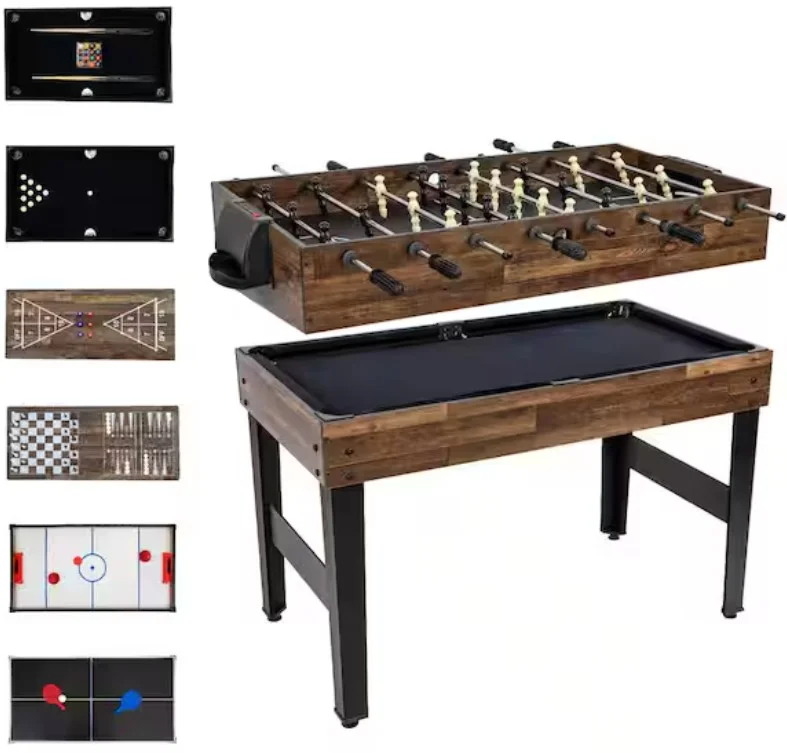
The Sunnydaze 10-in-1 offers a step up in build feel from the Best Choice 10-in-1, with a dark wood stain finish that looks more polished in a game room setting. It covers billiards, foosball, push hockey, table tennis, chess, checkers, backgammon, bowling, shuffleboard, and card games. The ergonomic handles and stable rod system make the foosball section functional for casual play.
That said, common issues reported by long-term owners include missing parts on some units, specifically screws, and the foosball playfield measuring only 41.5″ W x 23″ D. The table also draws consistent criticism for being smaller than buyers expect based on the listing dimensions. Good for multi-game family use. Trade-offs to consider if foosball is your primary reason for buying.
Key Specs:
- Dimensions: 49.5″L x 24″W x 32″H | Weight: 60 lbs
- Games: 10 total, including billiards, foosball, push hockey, and ping pong
- Foosball playfield: 41.5″W x 23″D
- Cabinet: MDF, dark wood stain finish
- Warranty: 1-year limited manufacturer
Pros | Cons |
Better build feel than lower-priced combo tables | Some units shipped with missing parts |
Dark wood stain finish looks clean | The foosball playfield is smaller than the listed dimensions suggest |
1-year warranty included | Assembly instructions are reported as unclear by some buyers |
Good multi-game variety at $265 | Not suitable for serious dedicated foosball use |
Works best for: Families who want a mid-range multi-game table that lasts longer than the cheapest combo options.
Not ideal if: Foosball is your primary game or you need full-size competitive dimensions.
11. Giantex 3-in-1 48″ Multi Game Table
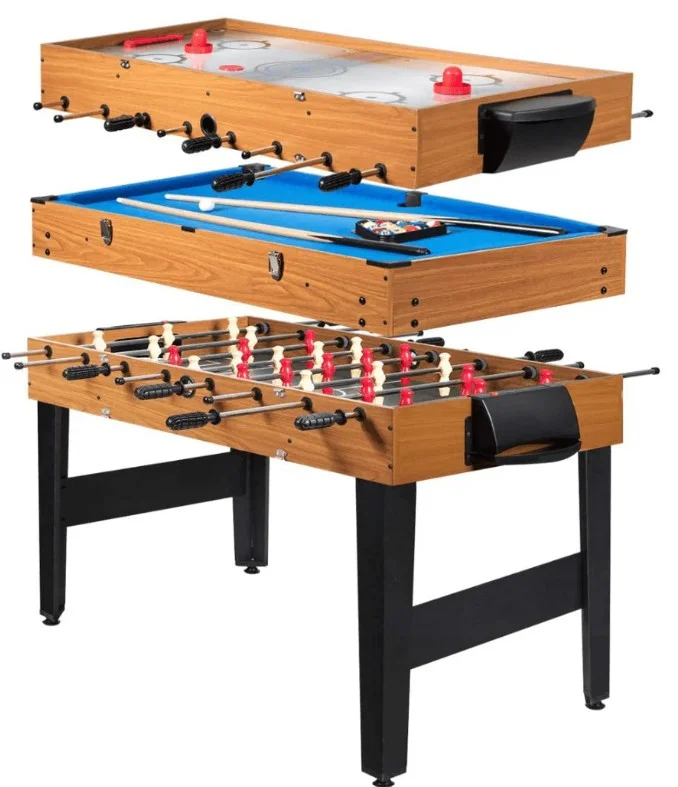
The Giantex 3-in-1 covers foosball, billiards, and slide hockey in a 48″ frame that fits tighter game rooms without dominating the space. Sturdy steel rods and four leg levelers for easy surface balancing. All accessories for all three games are included in the box.
User feedback analysis reveals a familiar picture for combo tables in this range. Some buyers find it stable and worth the price. Others report it’s less stable than expected and describe the 48″ dimensions as smaller than the listing photos suggest. Screws on the player figures loosen during regular use, which is a recurring complaint worth noting.
It’s a fun table for casual family game nights. It’s not a replacement for a dedicated foosball table.
Key Specs:
- Dimensions: 48″L x 23″W x 32.5″H | Weight: 45 lbs
- Games: Foosball, billiards, slide hockey
- Rods: Sturdy steel
- Includes: 2 soccer balls, 2 hockey pucks, 2 pushers, 2 cue sticks, billiard set, chalk, brush
- Leg levelers: 4 included
Pros | Cons |
Affordable three-game coverage at $160 | Player figure screws loosen with regular use |
Full accessory set for all three games included | The table is smaller in person than the photos suggest |
Leg levelers help on uneven floors | Not stable enough for aggressive competitive play |
Easy to convert between games | 4.1 rating reflects recurring durability concerns |
Works best for: Casual family setups, apartments, and game rooms where multiple games matter more than foosball quality.
Not ideal if: You’re a foosball-first buyer who wants real competitive gameplay or long-term durability.
12. GYMAX 4-in-1 Multi Game Table
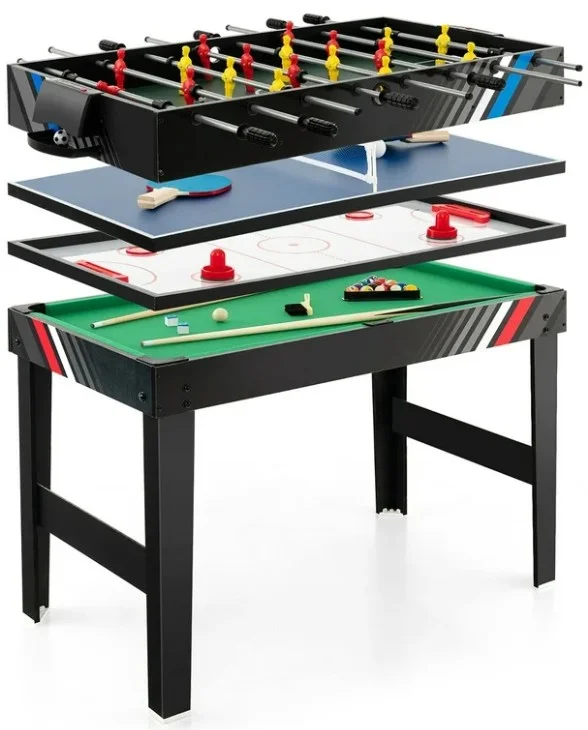
The GYMAX 4-in-1 adds table tennis to the foosball, hockey, and billiards combination, making it one of the more versatile combo tables in this guide at a price under $160. The metal frame base provides more stability than the wood-only frames found on similar-priced combo tables. Non-slip leg pads protect floors and help the table hold position during play.
Buyers consistently report that this table is easy to switch between games using the stacked surface design. It handles regular family game nights well. The size, at 49″L x 38″W, is wider than most combo tables due to the four-game design, which suits households that have room to spare.
One real trade-off: at 48.5 lbs with a metal frame, the foosball section is functional but lighter than a dedicated standalone table.
Key Specs:
- Dimensions: 49″L x 38″W x 32.5″H | Weight: 48.5 lbs
- Games: Foosball, air hockey, billiards, table tennis
- Frame: Metal base, engineered wood surfaces
- Rods: Smooth metal with non-slip PVC grips
- Includes: 18 football players, 2 foosballs, 2 ping pong balls, paddles + net, 2 hockey pushers, 2 pucks, 2 cue sticks, chalk, brush, billiard ball set
- Leg pads: Non-slip on all four legs
Pros | Cons |
Metal frame base provides better stability than wood-only combos | The foosball section is lighter than a standalone dedicated table |
Four-game coverage at under $160 | Table tennis is not regulation size |
Non-slip leg pads protect floors | Mixed feedback on size expectations |
Easy game switching with stacked surface design | Not suited for serious foosball competition |
Works best for: Families with kids, households that want four game options without buying separate tables.
Not ideal if: You’re a foosball-focused buyer or need regulation-size gameplay for any of the included sports.
13. Scpoloco 48″ Foosball Table
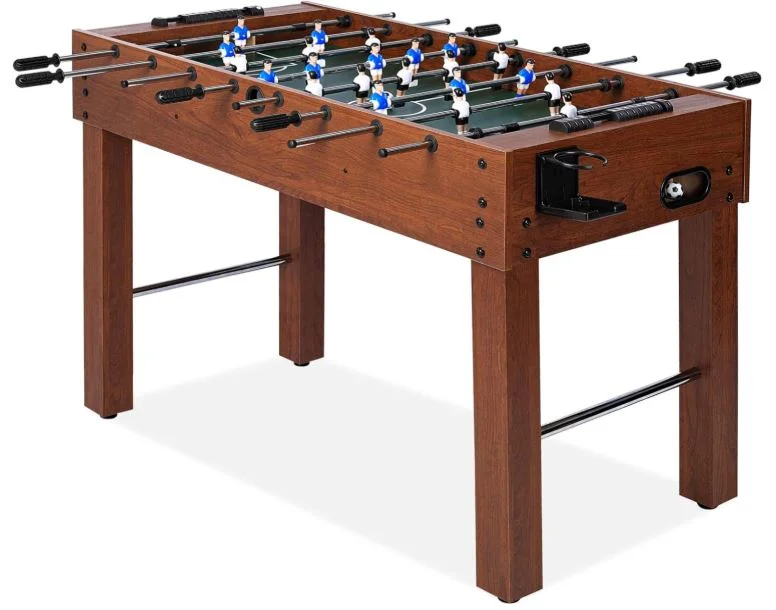
The Scpoloco 48″ is a newer table with limited review history, but early buyer feedback is notably positive. The walnut finish looks sharper than most tables at this price. Chrome-finished steel rods and a low-friction playfield deliver responsive gameplay. The waist-high design and built-in cup holders are practical additions that make it feel like more than a budget table.
The key caveat: 17 reviews are a small sample. Long-term ownership data simply isn’t available yet to make a confident durability claim. Better alternatives exist for buyers who need proven track records. But for someone looking for a clean, functional first table at $119, it delivers more than the price suggests.
Key Specs:
- Dimensions: 48″L x 24″W x 32″H
- Rods: Chrome-finished steel
- Players: Smooth-curve design for ball control
- Cabinet: Composite wood with alloy steel frame
- Includes: 2 balls, 2 cup holders
- Finish: Walnut
Pros | Cons |
The walnut finish looks noticeably better than most budget tables | Only 17 reviews, very limited long-term data |
Low-friction playfield for smooth ball movement | Unknown brand with unclear warranty terms |
Cup holders and a comfortable waist-high playing height | 48″ is smaller than full-size tables |
Arcade-style experience for the price | Not suitable for serious competitive play |
Works best for: Casual buyers, first-time foosball households, kids, and anyone testing the waters before investing more.
Not ideal if: You want a brand with a proven track record or plan to play daily under regular adult use.
14. Triumph Sports Foosball Table
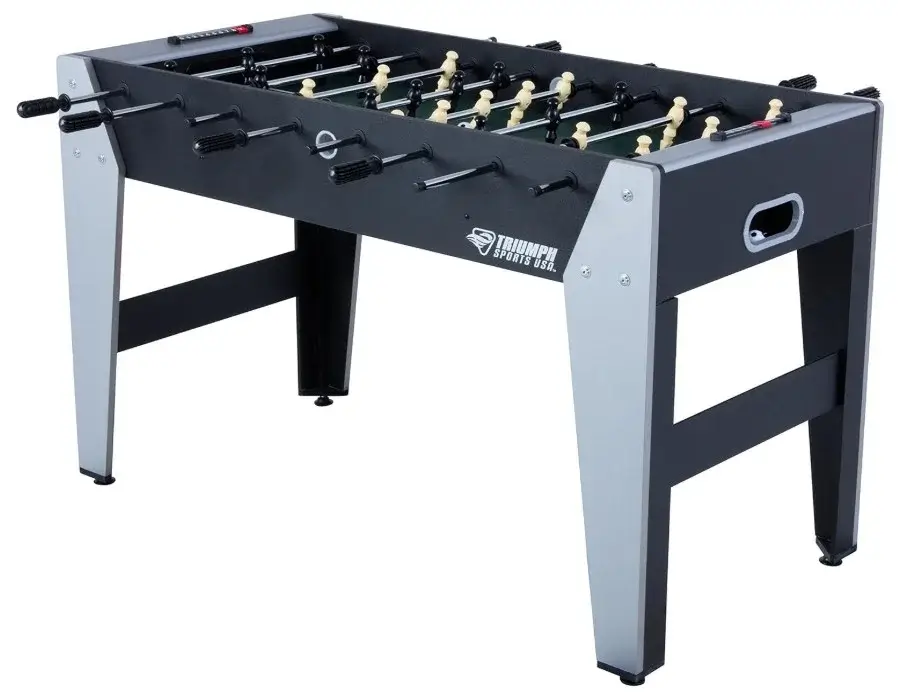
The Triumph Sports table covers the basics. Regulation-sized playfield, 8 chrome-plated hollow steel rods, 26 molded players, ball return, leg levelers, and manual scorers. It’s a functional setup for kids and casual gatherings at a price that keeps the risk low.
The 3.9 rating tells an honest story. Multiple buyers report build quality that doesn’t match expectations, and assembly instructions draw consistent criticism. The table works and delivers fun for light casual use. But sturdiness and longevity are real concerns, and the feedback patterns here are harder to overlook than on other tables in this guide.
If $120 is the ceiling, this gets the job done for kids and occasional family play. Anyone playing more seriously should save up for the GoSports or SereneLife instead.
Key Specs:
- Dimensions: 50″L x 24.5″W x 5″H (collapsed)
- Rods: 8 x 15.8mm chrome-plated hollow steel
- Players: 26 individual molded players
- Includes: 4 solid soccer balls
- Handles: Ergonomic grips
- Leg levelers: Included
Pros | Cons |
Most affordable entry point with hollow steel rods | 3.9 rating reflects recurring quality concerns |
Hollow rods reduce arm fatigue during play | Assembly instructions were reported as confusing by multiple buyers |
Ball return keeps gameplay moving | Build quality inconsistency is a common complaint |
Leg levelers included for uneven floors | Not sturdy enough for regular aggressive adult use |
Works best for: Kids, occasional family gatherings, or buyers who want to test foosball at minimum cost.
Not ideal if: You plan to play regularly, want something that lasts more than a season, or are buying for competitive adult use.
How We Ranked the Best Foosball Tables
We don’t rank tables based on brand name recognition or sponsorships. At Foosball Junkie, every pick in this guide reflects a structured evaluation process across five areas.
Build quality assessment looks at cabinet thickness, wall construction, MDF versus solid wood, rod material, and overall finish quality. Thin walls vibrate and transfer every shot through the frame. Solid construction stays quiet and stable.
Gameplay consistency covers rod response, playfield surface, ball control, and passing lanes. After testing multiple foosball tables, we found that smoother bearings and properly counterbalanced players create a noticeably different experience compared to fixed-player budget tables. These details separate enjoyable tables from frustrating ones.
Stability during aggressive play matters most for competitive setups. Common issues reported by long-term owners include rod wobble that develops over weeks of use, legs shifting on smooth floors, and bearings that degrade faster than expected.
Price-to-performance ratio shapes every recommendation here. Some tables justify higher prices through genuine quality. Others charge for aesthetics that don’t translate to better gameplay.
User feedback analysis catches patterns that hands-on testing misses. If many buyers consistently report the same flaw, that flaw affects the ranking. We look for patterns, not outliers.
Types of Foosball Tables: What the Differences Actually Mean
Understanding the categories helps you avoid buying the wrong type entirely. There are real gameplay and durability differences between them.
- Home tables vs professional tables come down to weight, rod quality, and precision. Home tables are lighter, easier to assemble, and forgiving for casual play. Professional tables like the Tornado T-3000 feel heavier and more rigid. Ball response is faster and more predictable. Most casual players don’t need that level of precision, but once you’ve played on a professional table, mid-range options feel noticeably different.
- Combo tables vs standalone tables is a straightforward trade-off. Combo tables offer game variety but sacrifice foosball quality. The foosball section on any combo table in this guide is smaller and lighter than a dedicated standalone. If foosball is your main game, a standalone table wins every time. If your household wants variety, a combo makes practical sense.
- Foldable and portable tables save space but sacrifice rod response and stability. Fine for occasional casual play. Aggressive sessions expose their limits quickly.
- Outdoor tables are sealed to resist the weather, but change the game feel noticeably. Rods can feel heavier. Ball bounce behaves differently on sealed surfaces. Buy outdoor only if indoor placement genuinely isn’t an option.
Key Features That Actually Affect Your Game
A table can look impressive and feel terrible. Here’s what genuinely matters once you actually start playing.
Cabinet construction is where cheap tables reveal themselves. Thicker walls absorb impact and reduce vibration during play. MDF works well when walls are reinforced properly. Solid wood construction, as seen in the René Pierre, is noticeably more stable and quieter during aggressive sessions.
Playfield surface changes how every ball interacts with the table. Laminate surfaces glide smoothly and clean easily. Melamine is similar but chips faster. Gerflex, used in European professional tables, provides faster play with better ball grip and lasts longer than either. Most buyers notice these differences within a few sessions.
Rod systems are split into hollow and solid. Solid rods feel heavy and durable but add slight resistance. Hollow rods reduce arm fatigue and allow sharper passes. Most experienced players prefer hollow rods for that reason. Telescopic rods are safer around kids but add friction, which competitive players find limiting.
Counterbalanced vs fixed players is one of the most impactful features most buyers overlook. Counterbalanced players stay level when released, opening passing lanes and keeping defensive positioning clean. Fixed players drop forward and slow the game down. The difference becomes obvious within five minutes of real play.
Goalie configuration is a personal preference. Single goalie setups, common in European tables, give cleaner shot angles. Three-man goalies create faster rebounds and are standard in US competition. Neither is universally better. Choose based on how you want to play.
Size, Space, and Setup Considerations
Standard full-size foosball tables measure around 55-56″ long and 30″ wide. That’s the table itself. Players need room on each end to move and reach rods, so plan for at least 3 feet of clearance on every side.
Weight affects gameplay directly. Lighter tables shift on hardwood floors during fast rallies. A 50 lb combo table moves. A 200 lb Tornado doesn’t. If stability matters to your play style, heavier tables earn their weight.
Assembly time is a real factor that most buyers underestimate. Mid-range tables take 2-3 hours. Larger tables can take longer. A second person makes a genuine difference, especially when aligning rods and flipping heavy panels. Several tables in this guide have specific assembly quirks, like rod orientation on the Amazon Basics or screw alignment on the Hathaway Primo, that cost buyers an extra hour when instructions are unclear.
How Much Should You Spend on a Foosball Table?
Price ranges in foosball tables break down meaningfully by what you actually get:
- Under $200 gets you entry-level construction, fun for kids, and casual first-time buyers. Don’t expect these to handle years of regular adult play without showing wear.
- $200 to $700 is where most home buyers find the best combination of gameplay quality and long-term value. Tables like the GoSports 54″ and KICK Legend 55″ live here and deliver genuine performance without a painful price tag.
- $700 to $1,200 covers competitive home play. The KICK Titan sits in this range and brings near-professional rod quality with a lifetime warranty.
- $1,200 and above is professional territory. Tornado and René Pierre own this space. Buy here only if serious daily play, long-term durability, or competitive preparation justifies the investment.
The most common buying mistake Foosball Junkie sees: buyers choosing a $150 combo table as their main foosball setup, then replacing it 18 months later with something better. One good table usually costs less than two mediocre ones.
Where to Buy a Foosball Table
Online: All 14 tables in this guide are available on Amazon. The selection is wide, prices are competitive, and return policies are strong. For heavier tables above 150 lbs, check reviews specifically for freight shipping damage before ordering. It’s a recurring issue worth verifying.
Physical stores: Let you test the rod feel and playfield response before buying. Selection is narrower, and prices sometimes run higher. Worth the trip if you’re spending $500 or more and want to confirm the feel before committing.
Second-hand: Can save real money but requires careful inspection. Check for rod wobble, surface warping, and leg stability before buying. A warped playfield can’t be fixed. Missing players or worn bearings are cheap to replace. Know the difference before you commit.
Accessories, Maintenance, and Long-Term Care
Even the best foosball table degrades without basic upkeep. These habits extend the life of any table significantly.
Rod lubrication is the single most important maintenance habit. Apply silicone-based lubricant every few months or more often under heavy use. Never use WD-40. It degrades the bushings over time and creates the stickiness you were trying to eliminate. One verified René Pierre owner specifically flagged this, noting that silicone spray made the rods move like a dream from the first session.
Playfield cleaning keeps ball control consistent. A soft, damp cloth removes dust and grime. Avoid harsh chemicals that strip laminate or melamine surfaces over time.
Leg levelers should be rechecked periodically. Floors shift subtly, and even small imbalances affect ball drift and shot accuracy during play.
Ball selection matters more than most buyers expect. Hard plastic balls are durable. Cork and textured balls grip better for spin shots and passing. Replacing balls every 6-12 months under regular use keeps gameplay predictable.
FAQs
Are foosball tables worth buying?
For households that actually use them, yes. A well-built mid-range table delivers years of entertainment. The tables that disappoint are the ones bought on impulse at the lowest price point. Choose based on how often you’ll play and who’s playing. The right table gets used. The wrong one collects dust.
What separates a high-quality table from a cheap one?
Cabinet wall thickness, rod material (solid or hollow steel vs thin chrome-coated), counterbalanced versus fixed players, bearing quality, and playfield surface. These aren’t flashy features, but they’re what you feel every single time you play.
How long do foosball tables last?
Mid-range tables from KICK or GoSports typically last 5-8 years with moderate care and basic maintenance. Premium tables like the Tornado T-3000 are built for decades of commercial use. Budget tables under $150 often show noticeable wear within 1-2 years under regular play.
What should I avoid when buying?
Thin cabinets, fixed non-counterbalanced players, vague warranty terms, and tables with no assembly support. Avoid buying based on photos alone. Many tables look identical online but feel completely different in real play.
Final Verdict: Which Foosball Table Should You Buy?
After reviewing all 14 tables, here’s where things land by buyer type.
- Best overall home table: KICK Legend 55″ at $650. It balances build quality, real gameplay feel, and price better than anything else in the mid-range. Works for families, casual competitors, and office game rooms.
- Best value for first-time buyers: GoSports 54″ at $230. Real gameplay quality at a budget-friendly price. Not tournament-ready, but far better than most buyers expect for $230.
- Best for serious competitive play: Tornado Tournament 3000 at $3,095. There’s no US-market equal for tournament-level home play. If the budget allows and the game matters seriously, this is the table.
- Best premium European option: René Pierre Competition at $3,199. Unique craftsmanship, French-style gameplay, and a build quality that belongs in the same room as fine furniture.
- Best budget picks: Scpoloco 48″ at $119 or Triumph Sports at $120. Both work for kids and casual households. Neither is built for long-term heavy adult use.
At Foosball Junkie, our goal is simple. Help you find a table that still gets played six months after purchase, not one that ends up against the garage wall. Choose based on who’s playing, how often, and how much real space you have. The right table is usually not the most expensive one. It’s the most appropriate one for your situation.