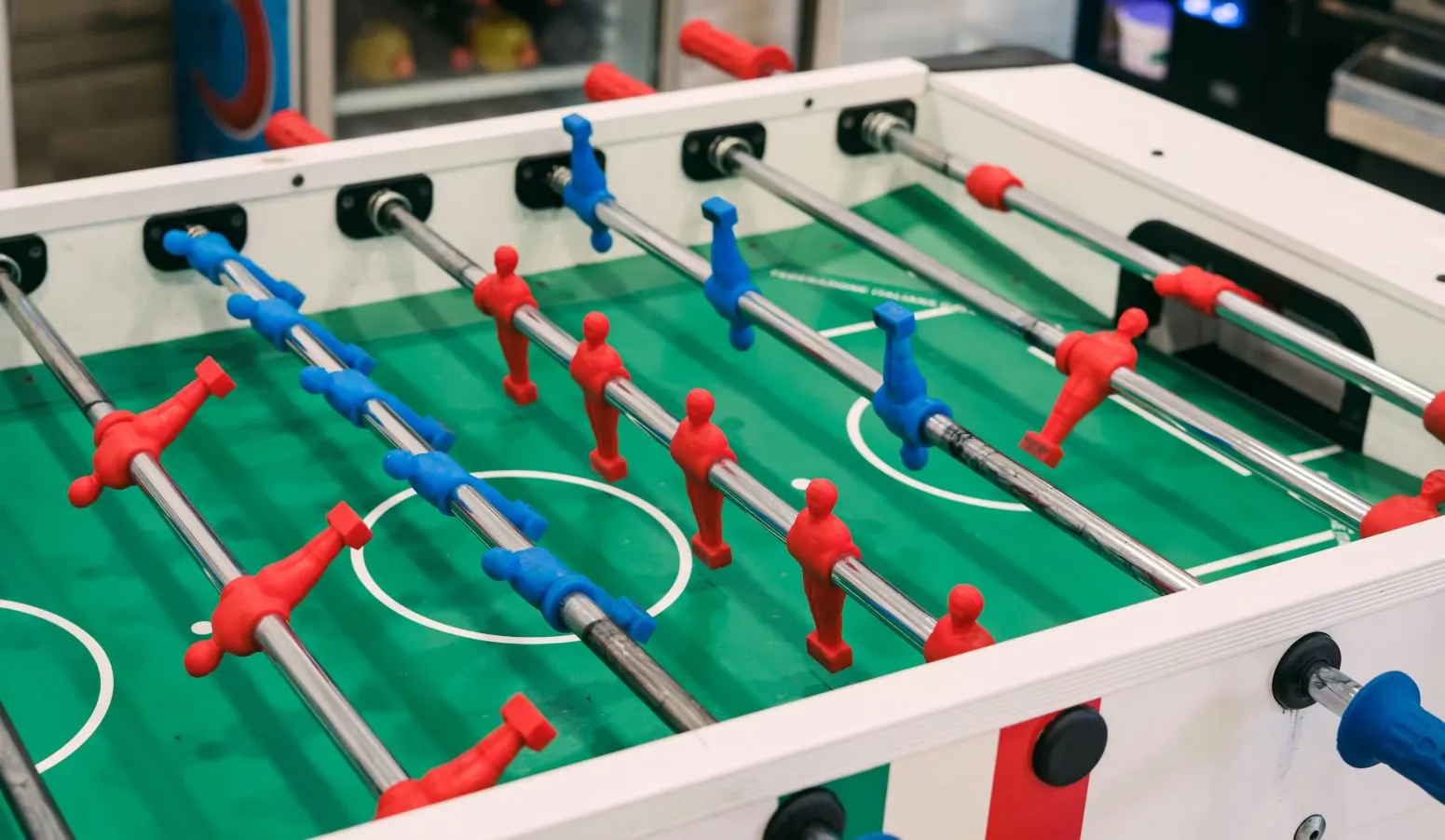
You walk into a game room. Someone spins a rod. The ball flies off the table. Someone yells “Goal!” even though it went nowhere near the net. Five minutes later, you’re arguing about spin rules.
That’s foosball.
At Foosball Junkie, we get this question constantly. New players ask it. Parents buying their first table ask for it. Even people who’ve owned a table for three years still ask it. This guide explains what foosball actually is, how it works, who benefits from playing, and where confusion usually happens.
What Is the Foosball Game?
A foosball game is tabletop soccer controlled by rods instead of feet. You move miniature players mounted on metal bars. The objective is scoring goals while preventing your opponent from doing the same.
Most games involve two or four people. Singles matches pit one person against another. Doubles put two per side, controlling different positions.
The game feels simple at first. You spin the rods and hope the ball goes in. Then timing starts mattering. Control becomes essential. Patience separates wins from losses.
Foosball works well for casual players looking for quick entertainment. It fits offices needing break room activities. Families with mixed skill levels enjoy it because younger kids can compete with adults on semi-equal footing.
It doesn’t work well for people who hate losing or sharing control. Solo players often get frustrated. People expecting football-level physicality leave disappointed.
Common observation from users: The learning curve hits around game five. That’s when random hits stop working, and actual strategy becomes necessary.
Objective of Foosball
The objective is simple. Score more goals than your opponent before time runs out or someone hits the winning number.
No hidden tricks exist here. The complexity comes from how scoring happens, not what scoring means.
Controlled passes beat wild shots. Defense matters more than most beginners expect. Spinning rods usually backfire because you lose ball control.
In competitive settings, players treat this as a serious sport. Professional tournaments follow strict rules about technique and equipment. In homes, it stays a game. Both approaches work fine.
The difference is expectations. Competitive players practice shots for months. Casual players learn enough to have fun. Neither group is wrong.
What Is a Foosball Table?
A foosball table is the playing surface where everything happens. It represents a miniature soccer field, scaled down and enclosed by walls.
Every standard table includes fixed player figures attached to steel rods. The surface can be textured or smooth, depending on quality. Side walls keep the ball contained while affecting how it bounces.
Handles on rod ends let you rotate players for shots and blocks. The ball enters through openings on each side. Goals sit at opposite ends, usually with ball return systems underneath.
At Foosball Junkie, we remind buyers constantly. The table affects gameplay more than skill at beginner levels. A warped surface changes ball behavior. Bent rods ruin timing. Sticky bearings slow reaction speed.
Quality matters even for casual play because bad equipment teaches bad habits.
Foosball Meaning and Definition
Foosball means table football. The word describes both the game itself and the equipment used to play it.
A proper definition would be: “A competitive tabletop game simulating soccer using rods and fixed players controlled by handles.”
People constantly confuse meaning with skill level. Foosball doesn’t mean casual only. The game scales with experience like any sport. Beginners play differently from professionals, but both are playing foosball.
Regional names vary. Europeans often say table football. Some areas use table soccer. All refer to the same game with minor rule variations.
Etymology: Why Is It Called Foosball?
The name comes from German. Fußball means football in German. When the game spread internationally, English speakers adapted the pronunciation.
Fußball became foosball in America. The spelling changed to match how English speakers said the word. No deeper meaning exists beyond translation and adaptation.
Fun detail that annoys some players: Many European competitors dislike the word foosball entirely. They prefer table football and consider foosball too casual or Americanized.
The International Table Soccer Federation uses both terms in official communications. Language travels. Games stay the same regardless of what you call them.
How Do You Spell Foosball?
The correct spelling is foosball. Two o’s, one s, one b.
- Not fooseball
- Not fuseball
- Not foosbol.
- Not fussball (unless you’re writing in German)
Common misspellings happen because the word sounds informal. Search engines autocorrect most variations. Rulebooks and tournament organizers do not.
If you’re buying a table online, spell it correctly. Product listings sometimes use misspellings, but official brands stick to standard spelling.
How Do You Spell Foosball Table?
It’s spelled foosball table. Two words. No hyphen. No capitalization unless starting a sentence.
Some manufacturers write “Foosball Table” in product names using title case. That’s branding, not grammar. In regular writing, lowercase works fine.
How to Pronounce Foosball?
Foosball is pronounced “FOOZ-bawl” in American English. The first syllable rhymes with “choose.” The second sounds like “ball.”
British speakers sometimes say “FOOS-bawl” with a shorter first syllable. Both pronunciations work fine in conversation.
The table pronunciation follows the same pattern. Foosball table sounds like “FOOZ-bawl TAY-bull.”
Audio guides exist on Forvo if you want native speaker examples. Most people pick it up from hearing others say it once or twice.
What Is Foosball Called in Other Languages?
The game is known by different names around the world. While the rules stay largely the same, the local term often reflects the country’s language and football culture.
| Language | What Foosball Is Called | Notes |
|---|---|---|
| Arabic | كرة قدم الطاولة (Kurat Qadam Al-Tawila) | Literally means “table football.” Some Arabic speakers also use the English word “Foosball.” |
| French | Baby-foot | The most common name in France. Although “football de table” exists, baby-foot is used far more often in everyday conversation. |
| Italian | Calcio Balilla or simply Calciobalilla | The standard Italian term for table football, used for both casual and competitive play. |
| Portuguese | Matraquilhos (Portugal) / Pebolim (Brazil) | Portugal and Brazil use different names for the same game. |
| Spanish | Futbolín | The standard term throughout Spain, while some Latin American countries use regional variations. |
Although the names differ, they all describe the same tabletop game known as foosball or table soccer in English.
Is Foosball a Sport?
Foosball becomes a sport when rules are enforced, matches are structured, and skill consistently beats luck.
It remains a game when house rules dominate, spinning is allowed without penalty, and nobody cares about results.
Both versions exist peacefully in different contexts.
Professional players train daily. They practice specific shots hundreds of times. Tournament positions pay money. Governing bodies regulate equipment and technique. That’s sport.
Casual players make up rules as they go. Spinning happens constantly. Games last until someone gets bored. That’s a game.
Foosball is not an Olympic sport. The International Olympic Committee hasn’t recognized table soccer. Professional leagues exist globally, but Olympic inclusion remains unlikely according to ITSF statements.
Neither approach is wrong. The difference is intent, not legitimacy.
Why Is Table Football So Much Fun to Play?
Table football works because it hits three psychological buttons simultaneously. Fast feedback, visible improvement, and social pressure.
Games end quickly. Most matches last five to ten minutes. You see results immediately. That keeps engagement high compared to games requiring hour-long commitments.
Improvement shows up fast. Your first game feels random. Your tenth game shows patterns. By game twenty, you’re making intentional shots. That progression feels satisfying.
Social dynamics add tension. Trash talk stays friendly because everyone’s standing close. Partners coordinate in doubles. Rivalries develop naturally.
The game also avoids a major football problem. You don’t need field space, athletic ability, or good weather. A small room and four people work fine. That accessibility matters more than people admit when choosing entertainment.
Users consistently report higher replay value than video games because physical presence adds stakes that screen-based competition lacks.
Foosball vs Football. What’s the Difference?
| Aspect | Foosball | Football |
|---|---|---|
| Space needed | Small | Large |
| Physical effort | Low | High |
| Skill focus | Control and timing | Speed and endurance |
| Accessibility | High | Limited |
Foosball removes physical barriers that make football exclusive. You don’t need stamina, speed, or athleticism. Ball control happens through mechanics, not footwork.
Football keeps physical dominance as the deciding factor. Faster, stronger players usually win. Strategy matters, but athleticism matters more at amateur levels.
This difference defines who enjoys each activity. People who love physical competition prefer football. People who enjoy tactical challenges without exhaustion prefer foosball.
Neither replaces the other. They serve different purposes despite sharing soccer as inspiration.
FAQs About Foosball
Why is it called foosball?
The word foosball comes from German Fußball, meaning football or soccer. When the tabletop game spread to America, the pronunciation became foosball. The spelling was adapted to match how English speakers said the word naturally.
Why do Americans say foosball?
Americans adopted the German pronunciation when foosball tables arrived in the 1950s. The name stuck through marketing and popular use. Most other countries say table football instead, but both terms refer to the same game.
What is the difference between foosball and football?
Foosball is a tabletop game controlled through rods. Football is field-based and requires running. Foosball focuses on timing and angles. Football emphasizes speed and endurance. Both simulate soccer but require completely different skills.
What do British people call foosball?
Most British players call it table football. The term foosball exists, but sounds American to UK speakers. Both names work fine, though table football is more common in Europe generally.
Is foosball soccer?
Foosball simulates soccer on a tabletop. It uses soccer rules and positioning but replaces running with rod control. Calling it soccer works casually, but table football or foosball is more accurate technically.
Final Thoughts from Foosball Junkie
Foosball works best when expectations match reality. It’s not a toy. It’s not a replacement for field sports. It’s its own thing with unique benefits and limitations.
If you enjoy quick competition, shared spaces, and visible skill growth, foosball fits perfectly. If you expect physical dominance or lengthy matches, it probably won’t satisfy you. That clarity saves money, frustration, and space before buying equipment.
The game scales from a complete beginner to a professional competitor. Your experience depends entirely on how seriously you take it and who you play with. Both casual and competitive approaches work fine.
The table matters more than most people realize. A quality table makes learning easier. A cheap table teaches bad habits that stick around. Invest appropriately for your skill level and frequency of play.
Start with clear rules. Decide if spinning is allowed. Agree on scoring systems before the first serve. House rules work fine as long as everyone knows them upfront.
Most importantly, foosball is supposed to be fun. Don’t overthink it at first. Play some games. Learn what you enjoy. Adjust from there.