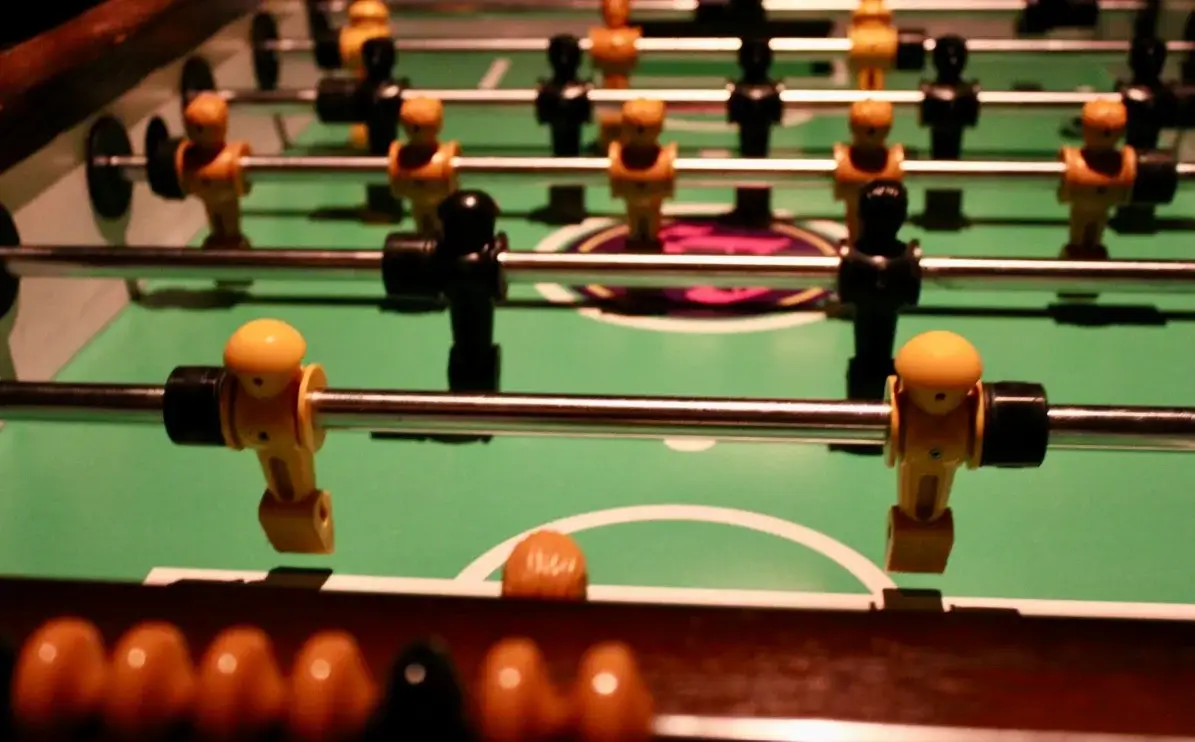
Most arguments at a foosball table start the same way. Someone scores a wild goalie shot and claims two points. Someone else spins freely and calls it a fair game. Nobody actually agreed on the rules before the ball dropped.
That is where things go sideways fast.
At Foosball Junkie, we have seen casual games turn into full debates and competitive matches get disrupted because players did not share the same rulebook. Whether you are new to the game or preparing for a tournament, knowing the actual foosball rules and regulations is what separates a real match from a backyard argument.
This guide covers everything. Official regulations, serving rules, scoring breakdowns, passing limits, tournament formats, regional differences, and fun variations. By the end, you will know exactly how the game is supposed to be played.
Core Rules That Define Foosball
Foosball looks simple until you sit down to actually explain it. The basic premise is clear enough: two sides, one ball, score more goals than your opponent. But the rules of the foosball game go deeper than that, and those details matter.
Before jumping into specifics, it helps to understand the structure of a standard match.
Most official games are played to 5 goals per game, with matches running best of 3 or best of 5 games. In tournaments, a 5-game set is common at higher levels. The team that loses a game serves next. Sides switch after each game to keep things fair.
The foosball table has five rods per side:
| Rod | Figures | Primary Role |
| 1-bar | 1 | Goalie / last defense |
| 2-bar | 2 | Defenders |
| 5-bar | 5 | Midfield passing |
| 3-bar | 3 | Attacking / shooting |
| (Goalkeeper rod varies by table brand) | ||
Understanding which rod does what is part of the foosball fundamentals: basic rules explained for beginners. The 5-bar is for passing, not direct scoring. The 3-bar is your primary attack zone. New players often ignore these distinctions entirely, and it shows.
If you are just getting started, this full overview of how to play foosball walks through the game from the beginning.
Basic fair play rules that apply in almost every version of the game:
- No spinning rods. A rod that completes a full 360-degree rotation before or after contact is a violation.
- No jarring the table. Hitting the sides, lifting the table, or shaking it is a foul.
- No reaching into the playing field while the ball is live.
- Players must call “ready?” before serving, and both sides must acknowledge.
These are not suggestions in official play. Even in casual settings, violating them consistently means you are not really playing by the foosball rules and regulations. You are playing something else.
Understanding Official Foosball Rules
Here is something most recreational players do not realize. The game they are playing probably does not match the official foosball rules at all. And that is fine for casual play, but the gap is significant.
ITSF (International Table Soccer Federation) governs international competition and works with major table brands including Garlando, Bonzini, Roberto Sport, and Tornado. Their ruleset, the ITSF foosball rules, is recognized across 40+ member nations and used at events like the Foosball World Championship.
Key differences between official and house rules:
| Area | House Rules (Typical) | Official Rules |
| Spinning | Often allowed | Strictly illegal |
| Time limits on possession | Rarely enforced | 15 sec on 5-bar, 10 sec on others |
| Dead ball | Varies | Re-serve by the team that scored |
| Goalie shot value | Usually 1 point | 1 point (2-point variations are informal) |
| Jarring | Often ignored | Foul, loss of possession |
Pro foosball out-of-bound rules state that if the ball leaves the playing surface entirely, play stops and the ball is re-served. Who re-serves depends on which rod last touched the ball. Suppose it was last touched by a defensive rod, the defense re-serve. Offensive touch means the offensive team loses possession.
You can find the full foosball rule book directly on the ITSF official website. The latest official foosball rules from ITSF were revised in 2022, tightening several areas around time violations, dead-ball scenarios, and serving procedures.
Foosball Serving Rules:
Serving is one of the most rule-heavy parts of foosball. And it is also where the most casual violations happen.
The foosball serve rules exist for one reason: to give both players a fair start. The serving team does not get an automatic advantage just because they have possession. The procedure matters.
Standard serving procedure under ITSF rules:
- The ball is placed through the serving hole on the side of the table.
- The serving player must ask “Ready?” and wait for acknowledgment from the opponent.
- The ball must touch at least two players before it can be shot on goal.
- The serve must be completed within 10 seconds of the acknowledgment.
That last rule is often skipped in casual play. But in sanctioned events, failing to serve within the time window after “ready” is acknowledged can result in loss of possession.
The foosball faceoff rules apply in some older formats and certain regional leagues where both teams compete for the ball at the start using the 5-bar. This is less common now under ITSF regulations, which use a standard side-serve instead.
Regarding the new foosball serve rule that came into effect in revised ITSF regulations, the ball must make contact with a 5-bar figure before any offensive shot attempt. Shooting directly off a serve from the 5-bar without a pass is not permitted. This rule separates competitive play from typical house rules, where players fire straight from the serve.
The foosball ready go rules simply refer to the acknowledgment protocol. Both players must confirm readiness. Serving without that acknowledgment is a re-serve violation.
Common serving mistakes that restart the serve:
- The ball did not touch two players before it was controlled
- The serving player shot before acknowledgment was given
- Time limit exceeded after “ready” was confirmed
- The ball never entered the playing field cleanly
Foosball Scoring Rules
Scoring in foosball is not just about putting the ball in the net. Several conditions affect whether a goal counts, who gets the point, and, in some variations, how many points are awarded.
The foosball scoring rules under standard official play are straightforward: any ball that completely crosses the goal line counts as one goal, regardless of which rod scored it.
Goalie Shots and Self-Goals
The foosball goalie scoring rules are one of the most debated topics at any table. Under official rules, a goalie shot is worth exactly one point, the same as any other goal. The old myth that goalie goals count for two points is a house rule variation, not a standard regulation.
The foosball rules goalie shot specifically state: if a player scores from the 1-bar (goalie rod), the goal counts as one point. There is no bonus for difficulty.
What about foosball rules, self-goalie shot, also called “selfing”? If your own goalie accidentally deflects the ball into your own net, that counts as a goal for the opposing team. You do not get any credit, and it absolutely does count. This is one situation where “I didn’t mean it” carries zero weight in the rulebook.
Self-goals from any rod count as valid goals for the opponent. It stings, but the rules of the foosball game are clear on this.
The 5-Man Scoring Rule
The foosball rules 5-man scoring controversy is real. Under strict ITSF foosball rules, a goal scored directly from the 5-bar does NOT count. The 5-bar is a passing rod, not a scoring rod. If the ball goes straight into the goal from a 5-bar figure without touching another player’s rod, the goal is disallowed and the defending team re-serves.
The foosball 5 bar rules around this are more strictly enforced in tournaments than in casual play. If you are training for competition, get out of the habit of shooting from midfield.
The 2-Point Rule
The foosball rules 2 points scenario exists in some informal and house rule variations, typically awarding 2 points for goalie shots or “long shots.” This is not part of the official ITSF ruleset. If you play in a league or tournament context, always confirm which scoring rules are in place beforehand.
What happens when the ball bounces out of the goal?
Under the foosball rules, if the ball enters the goal and then bounces back out, the goal still counts. The moment the ball fully crosses the goal line, the point is awarded. It does not need to stay in the net.
This trips up new players regularly. Once it crosses the line, the score is final.
For players looking to develop clean shooting from the 3-bar rather than relying on lucky deflections, this guide on foosball shooting techniques covers the mechanics in detail.
Rules for Passing and Ball Control
Passing is where competitive foosball really separates itself from casual play. The foosball passing rules are detailed, time-sensitive, and often completely ignored at recreational tables.
Here are the key time limits for passing:
- 5-bar possession: Maximum 15 seconds before you must pass or shoot
- All other rods: Maximum 10 seconds before you must move the ball
- Catching/stopping the ball: You have a limited window to pin the ball before it must be moved
The clock starts the moment the ball is controlled, not when it stops moving. This is a point of confusion even for experienced players.
Legal passes under official rules:
A legal pass from the 5-bar must make contact with at least one figure from another rod before being considered a completed pass into the attack zone. Lane passes (where the ball travels between two 5-bar figures) are permitted, but only within time limits.
The foosball rules of passing also regulate what counts as ball movement. Simply rocking the ball back and forth without transferring it to another rod does not reset the possession clock. Stalling is a violation.
Ball out-of-bounds rules:
If the ball exits the playing field and lands outside the table, the pro foosball out-of-bounds rules state that play stops immediately. The ball is re-served by the team that last did not touch it, or by the team opposite to whoever sent it out, depending on the specific situation.
A ball that hits the top rail and comes back in is still live. A ball that goes over the rail entirely is out of bounds.
Dead ball rules:
A dead ball is called when the ball stops in a zone where no player can reach it. In this case, the ball is re-served by the team that was last scored on, or by the team that did not cause the dead ball, depending on the governing organization’s specific ruling.
For a deeper look at how to use your defensive rods strategically, this guide on how to defend in foosball is worth reading alongside these passing rules.
Competitive Play and Tournament Rules
Tournament foosball operates on a different level than casual matches. The official foosball tournament rules are stricter, faster-paced, and leave far less room for interpretation.
Match Format
In most foosball tournament rules formats, matches are played as best of 5 games. Each game goes to 5 goals. Some championships use best of 7 at the finals stage. Tie-breakers are used when a match is tied at the final game, and the deciding game goes to 5 as well.
The tornado foosball tournament rules specifically apply at events using Tornado tables, which are predominantly used in North American competition. Tornado tables have a faster ball and slightly different rod tension than European tables, which can affect ball movement and passing dynamics.
Modern foosball tournament rules have also incorporated time violation enforcement more strictly. Referees actively watch possession clocks. Players at high-level events get called for stalling regularly. This is one reason why practicing solo and in drills builds better habits than casual open play.
Doubles / Team Rules
In foosball doubles rules, two players share one side of the table. One player typically controls the defensive rods (1-bar and 2-bar) and the other controls the offensive rods (5-bar and 3-bar). Players cannot switch rod assignments mid-game without agreement, and communication rules apply in some governed events.
Foosball doubles adds a coordination layer that singles play does not require. Timing your pass from the 5-bar player to the 3-bar player becomes a team movement, not a solo decision.
You can find more details on player count configurations in this breakdown.
Human Foosball and Life-Size Variations
The human foosball tournament rules follow the same general principles as table foosball but are adapted for a full-sized court with people attached to ropes or bars. Players cannot leave their rod position, and standard out-of-bounds and scoring rules apply. Life-size foosball is popular at corporate events and school competitions.
The foosball world championship rules run entirely under ITSF governance. Events are held annually across multiple categories: singles, doubles, and team. National federations send qualified players, and the governing regulations used are the current published ITSF rulebook.
How Foosball Rules Vary by Region and Table Brand
One of the genuinely confusing things about foosball is that the rules are not fully universal. Regional culture, table brand, and governing body all influence what counts as “the rules” in a given location.
American vs. European Rules
American foosball rules, centered around Tornado tables, tend to emphasize faster play, stricter time limits, and a harder ball. The game is more aggressive in style.
European foosball rules, governed under ITSF and played on tables like Garlando and Roberto Sport, often feature a softer ball, slightly different rod configurations, and some variation in passing lane rules. French foosball rules and Italian foosball rules follow ITSF guidelines but with historical adaptations based on domestic league traditions.
UK foosball rules largely mirror ITSF regulations, as the British Table Football Association is an ITSF member. German foosball (or Tischkicker as it is locally known) also falls under ITSF but has an active domestic circuit with some informal adaptations.
Brand-Specific Rules
Different football table brands have physical differences that create subtle rule variations:
Garlando foosball rules follow ITSF standards. Garlando is an ITSF-approved table and one of the most widely used in European tournaments.
Bonzini foosball rules also operate under ITSF. The Bonzini B-60 is iconic in French foosball culture and has a distinctive cork ball and rod style.
Aussie rules foosball table refers to the Aussie brand table, which is popular in certain regions but does not have a separate governing ruleset. Standard ITSF or house rules apply depending on context.
The IFP foosball rules (International Foosball Players) were a precursor to some ITSF standards and are occasionally referenced in historical tournament discussions, though IFP as an organization is largely inactive today.
If you are shopping for a table and want to train on something competition-ready, this guide on the best foosball tables breaks down top options by brand and use case.
Casual Play and Fun Variations
Not every game needs a rulebook. Foosball is a social sport, and a big part of its appeal is how well it adapts to casual settings. House rules exist for a reason.
Common House Rules
Foosball house rules vary wildly from garage to office to bar. Some common variations include:
- Spinning is allowed: The most common house rule and the most condemned one in competitive circles.
- Goalie wars: Players only control the 1-bar (goalie) and shoot from there. A popular mini-game for two players.
- 2-point goalie shots: Scoring from your own goalie rod counts for two points in this version.
- No 5-bar shots: Some casual groups enforce this even without knowing it is actually the official rule.
The foosball goalie wars rules are simple: both players only use the goalie rod, the goal is widened mentally by removing defensive strategy, and the game becomes a pure shooting contest. It is a great way to practice goalie accuracy.
Slingshot Foosball
Slingshot foosball rules (also called sling foosball) involve pulling the rod back and releasing it quickly to generate power, similar to a slingshot motion. In official play, this counts as a snake shot or wrist flick variant, depending on technique. As a house game variation, slingshot foosball refers to a mode where players specifically compete using only this shot style.
Drinking Game Variations
Foosball drinking game rules are an entire subset on their own. The most common format: every time a goal is scored, the scoring player assigns a drink to the opponent. Some versions require the losing team to drink for each goal in the losing game. These are obviously not sanctioned anywhere, but they are wildly popular in recreational settings.
Foosball disc game rules apply when some tables come with a disc accessory instead of a ball. The movement is slightly different, and the rules typically mirror standard foosball rules, but with adapted possession and dead-ball rulings since a disc behaves differently than a round ball.
Latest Rule Changes and Historical Amendments
Foosball rules have evolved significantly over the past two decades. The shift from informal house rule play to organized international competition drove most of these changes.
The ITSF foosball rules were first published in a standardized format in 2006. Before that, other governing organizations had their own versions that differed in meaningful ways. The push for global events required one unified ruleset.
Key updated foosball rules in recent years:
- 2022 ITSF Revision: Tightened serving procedure, added clearer language on time violations, and updated out-of-bounds definitions. The revised rulebook is the current governing document for all ITSF-sanctioned events.
- Serving rule change: The requirement that the ball must touch two players during the serve was clarified. Earlier versions had inconsistent interpretations across member nations.
- Dead ball re-serve clarification: The 2022 revision made explicit who re-serves depending on which team caused the dead ball, removing ambiguity that created disputes at major events.
- 5-bar scoring: The prohibition on direct 5-bar goals was reaffirmed, and referees were given clearer enforcement guidelines.
The latest official foosball rules are always available directly from the ITSF website. If you are playing in any organized league, always confirm which version of the rules is in effect.
Historical note: Early foosball competitions in Europe during the 1970s and 80s operated under wildly inconsistent rules. Spinning was legal in some countries and illegal in others. Goalie shot values varied. The standardization that ITSF brought was genuinely a major step for the sport’s growth globally.
Common Player Questions
Can the goalie score?
Yes. A goal scored from the 1-bar (goalie rod) counts as one point under official foosball scoring rules. There is no bonus, and the goal is fully valid. The 2-point goalie shot is a house rule, not an official regulation.
What happens if the ball bounces out of the goal?
The goal counts. Once the ball fully crosses the goal line, it is a scored point regardless of whether it bounces back out. The foosball rules: if the ball bounces out of the goal, make this clear: crossing the line is all that matters.
What counts as a legal pass?
A legal pass must move the ball from one rod to another. Under foosball rules, passing, you cannot simply rock the ball in place and call it a pass. On the 5-bar, you have 15 seconds to complete a pass. On all other rods, the possession limit is 10 seconds. Failing to pass within the limit results in loss of possession.
What is an illegal serve, and what happens?
If the serving player shoots before the opponent acknowledges “ready,” or the ball does not contact two figures during the serve, it is an illegal serve. The ball is returned and re-served. Repeated violations can result in the opponent receiving possession.
Does a self-goal count?
Yes. If any rod figure deflects or shoots the ball into your own goal, it counts as a goal for the opposing team. The foosball rules selfing rule is consistent across ITSF and most governing bodies.
Can you reach into the table to stop the ball?
No. Reaching into the playing field while the ball is live is a foul. In official play, it results in a loss of possession. In some cases, repeated violations can result in a warning or point penalty under tournament rules.